































THIS quote from President George Bush captures the essence of his management agenda. Few people realize that in the midst of the war on terrorism, the Bush Administration has been fighting an equally important and pervasive war on public sector inefficiency. On October 30, 2001, less than two months after 9/11, the Director of the Office of Management and Budget (OMB), Mitch Daniels, issued a memorandum to the heads of executive departments and agencies on the implementation of the President’s Management Agenda. Whatever else you may think of his other policies, Bush has to be commended for maintaining focus on essential priorities of good governance and sustaining momentum for making the US government machinery more effective.
The Management Agenda consists of five government-wide and nine agency-specific goals to improve federal management and deliver results that the US President believes matter to the American people. The government-wide initiatives include Strategic Management of Human Capital, Budget and Performance Integration, Competitive Sourcing, Expanded e-government, and Improved Financial Management. The President’s Management Agenda was designed to “address the most apparent deficiencies where the opportunity to improve performance is the greatest”. It focuses on remedies to problems generally agreed to be serious, and commits to implement them fully.
In addition to the five government-wide initiatives, there are nine agency-specific reforms. They include programmes like Better Research and Development Investment Criteria; Elimination of Fraud and Error in Student Aid Programmes and Deficiencies in Financial Management; Reform of Food Aid Programmes, etc. While US government agencies face a long list of critical management and performance problems, these nine reform efforts were chosen to begin the effort based on several criteria such as severity of the problem and the importance of the problem to those served; direct and demonstrable benefit to citizens; opportunity to make a dramatic and Material difference in programme performance; and probability of achieving improvements in the near term.
It can be argued that there is nothing special about a government setting priorities and announcing new management initiatives. Many, if not most, governments do so during their tenure. The Indian government too is famous for announcing major steps for improving functioning of various government departments. However, the US government’s emphasis on the follow-up and implementation of these initiatives sets the American approach apart from the rest.
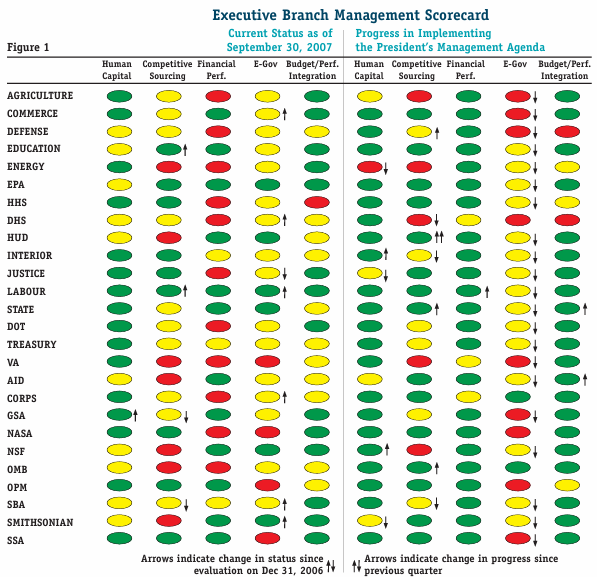
To ensure that the rhetoric is converted into reality, an Executive Branch Management Scorecard is used to show how well a department or an agency is implementing the President’s management initiatives. This scorecard is provided to the department/agency heads and the President on a regular basis. Indeed, it is available on the internet for all Americans (and the world) to see.
Figure 1 gives an example of a recent Management Scorecard. It has two columns: one showing the current status of implementing the five management initiatives against their respective standards of success (left column), and the other representing the progress in implementing the initiatives (right column).
Scores for “status” (left column) are based on the scorecard standards for success. Figure 2 gives an example of these standards for Strategic Management of Human Capital. These standards for success are developed by the President’s Management Council and discussed with experts throughout the US government and academe, including the National Academy of Public Administration. An agency is rated as “Green” or “Yellow” if it meets all of the standards for success listed in the respective columns and “red” if it has any one of a number of serious flaws listed in the “Red” column.
The “progress” made by agencies in filling up the gaps and achieving an acceptable status (right-hand column) is judged against the deliverables and time lines established for the five initiatives that are agreed upon with each agency. The color coding implies the following: Green implies that the implementation is proceeding according to plans agreed upon with the agencies; yellow implies some slippage or other issues requiring adjustment by the agency in order to achieve the initiative objectives on a timely basis; and red indicates that the management initiative is in serious jeopardy and is unlikely to realize objectives without significant management intervention.
Strengths
Whatever the flaws, and there are some significant ones, this policy represents a major improvement over past efforts of President Clinton’s National Performance Review and is an important step in the right direction. This tool (Management Scorecard) also represents a continuity of effort in reforming governments in the US.
It is now widely recognized that the efficiency of government acts as a ceiling on the efficiency of all sectors. The efficiency of The executive branch, in particular, is a key determinant of public sector efficiency and effectiveness. Normally, most governments caught in a vicious cycle of poor governance do not know where it all began. It is like a cancer and once it has spread to other parts of the body, it is too late to perform a localized surgery. In a sense, when this has happened, it is not important how it all began. From a public policy point of view, it is more important to find levers to break this vicious cycle of inefficiency and ineffectiveness in the government departments. In the US context, people elect a President every four years to fix the government and, thus, a President who is engaged in this task deserves our praise.
Second, this management tool corrects a major flaw in the system of Performance Agreements initiated by President Clinton under the aegis of National Performance Review. Introduced under the Government Performance and Results Act of 1993, Performance Agreements (PAs) were a bold attempt to introduce accountability for performance in the Executive arm of the US government and I remain an admirer of that governance innovation. PAs gave a concrete shape to the nebulous concept of accountability for results. PAs were agreements that listed the mission, objectives, and measurable (verifiable) annual targets for each agency. The problem with them was that they had a weak evaluation system. Thus, they remained a good concept in theory without achieving their intended objective. David Osborne, author of Banishing Bureaucracy, believes that the real reason was lack of political courage for making the evaluation results public. For this reason alone, the system of Management Scorecard (MS) represents a bold political move.
Weaknesses
No management system is perfect and MS too has its share of conceptual problems. However, all these problems are small in comparison to the achievements of this system and they are all remediable. In comparision to international best practice, some areas for future improvement stand out. For example, there is an implicit assumption that all elements of the President’s management agenda are equally important. What if the circumstances of an agency require that in the interest of its clients (the new word for citizens) it must focus exclusively on e-government? This may be the right thing to do for this agency at that moment, but the MS system allows no such flexibility. If the top management of this agency really sticks to its guns and does what it believes to be the “right” thing, it may end up getting a quick green in the e-government column, but have a lot of red dots in the other four areas. Thus, the system can fail to send the “correct” signal to the management of the public agency. Not only does it not allow prioritization among the individual elements of the President’s management agenda, it also fails to recognize the need for prioritization among the “standards for success” mentioned in Figure 1.
Lessons for India
There are many good lessons that our government leaders can learn from the way their counterparts deal with management of government performance. First, they must act quickly and not set up seemingly immortal administrative reform commissions and committees that have a unique capacity to outlive the government tenures. Both Presidents Clinton and Bush set their administrative reform agenda as soon as they got into power and implemented most of it at the beginning of their tenures. This is the time when, as Margaret Thatcher observed, you have a lot of political capital to reform the government.
Second, the leader of the government must drive the agenda and not be seen as waiting for ideas from outsiders. They must have some basic passion to improve performance of government and show it by action and not by repeating platitudes.
Finally, unless the performance of government departments is made public (like through the Management Scorecard), it will have no impact on the behaviour of the government mandarins who rule in the name of public service. President Bush has shown that improving government performance is more to do with common sense and political will than with theory and technical skills. Finally, in these days of internet connectivity and globalization of information, most of the tools and technique for improving government performance are in the public domain. Not utilizing this information to serve the poorest and the needy is, frankly, a sign of intellectual corruption