

















Garland a cow,
win an election

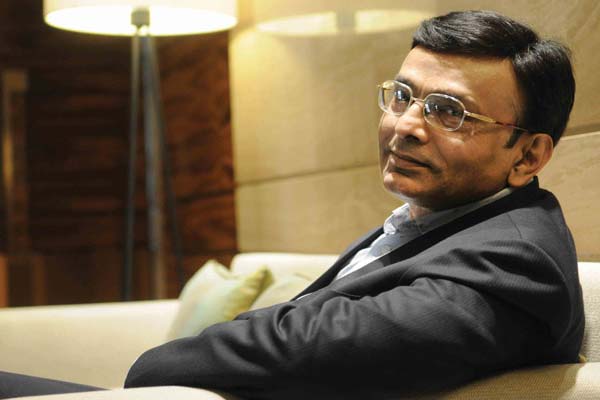
Avinash Mishra , a 1979-batch Indian Forest Service officer of the AGMUT cadre and Resident Commissioner of Delhi’s Arunachal Pradesh Bhawan is known more for his political skills, interest in astrology and for recommending occult practices than for looking after forests. In the last Assembly polls, scores of aspiring MLAs approached him to get astrological help for the elections.
An obscure tribal politician, having secured a ticket, filed his nomination papers and then found, as electioneering gathered momentum, that he was lagging behind his rivals badly. He met Mishra and requested him to invoke divine intervention. Mishra, seated in a meditative posture, pondered for a moment and then told him to garland a cow the next day.
So, the next morning, the candidate went out in search of a cow. He did spot one and stood face to face with her in utmost reverence, garland in hand. But, the next moment, as he garlanded her, the cow lowered her head and caught him in the stomach with her horns. The poor man was catapulted into the air and ended up grievously injured. He spent the remainder of the campaigning period in hospital. The news spread like wild fire among the electorate and crowds thronged the hospital to see him. And, the “sympathy wave” so generated won him the election. He is now utterly beholden to Mishra .
Prostration is the
best policy
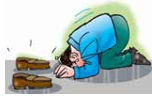
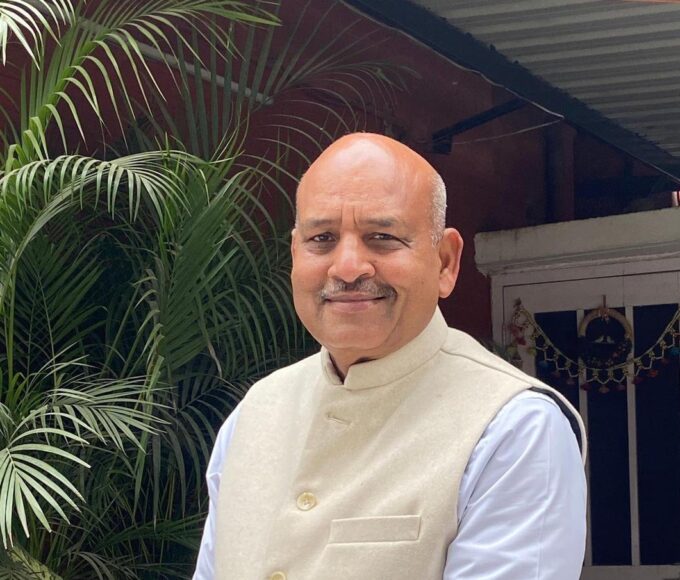
Not to be outdone is another officer with similarly strange ways, this time in the Department of Agriculture and Horticulture, Government of Karnataka. Arkalgud Ramaswamy , a 1974-batch IAS officer and Principal Secretary, is by all accounts a competent and honest officer. Yet, he feels compelled to physically prostrate himself before politicians to curry favour with them. Eyewitnesses have seen him prostrating before a former Prime Minister.
Such prostration (euphemistically referred to as “public relations” by his staff) is apparently part of his daily routine. He comes to office at 12.30 pm and then leaves after barely an hour. He reappears at 3.30 pm and works till 9 pm. The reason for his absence from office is readily revealed by his staff to visitors. “Sir is doing public relations in and around the Assembly,” they say, quite tongue-in-cheek.
Ramaswamy is eyeing the coveted post of Chief Secretary, according to sources. He plans to become Development Commissioner first, as the post is equivalent to Additional Chief Secretary, and then move to the top slot. After President’s Rule was imposed in the state and the Assembly kept under suspended animation in November last year, Ramaswamy was confronted with a problem: how to gain access to the Governor, Rameshwar Thakur, and prostrate before him.
Babu proposes,
sarkar disposes
For far too long, the government was all talk and little action when it came to rain-water harvesting. Lately, though, due to the problem of the receding level of ground water and also its contamination , both the government and non- government sectors have woken up to the need to make optimum use of rain water.

So the Central government decided to despatch a team of Secretaries – one each from four states facing acute shortage of potable water – to the island nation of Maldives to study the rain-water harvesting technology for application back home. The Indian Ocean tsunami of December 2004 played havoc with the ground-water system of the Maldives. But the country faced the challenge by going in for rain-water harvesting in a big way. Rain water is now the sole source of potable water in the islands.
However, the Secretaries were reluctant to go to the Maldives. Instead, they wanted to go to a European country to observe rain-water harvesting there. The government did not budge and ultimately the team reluctantly departed for the Maldives.
There, experts from the local government escorted them to the sites of community and rain-water harvesting, showed the systems consisting of catchment surface , conveyance system and water storage tanks, and explained the functioning of the technology. After one such visit to a site was over, a junior officer among the Maldivians remarked hesitantly, “ Sir , we have been importing the entire technology and systems for rain-water harvesting from India. I am surprised that you have come to study it here.”
The babus were left feeling at once vindicated for their initial refusal to go to the Maldives and wistful at the thought of how much more enriching their trip to a European country would have been, had it materialised.
Bu then, no one listens to a babu anymore.