
















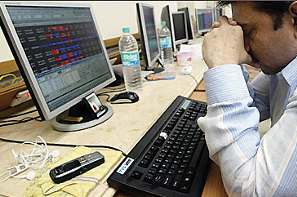
What has happened in the American markets is the biggest financial meltdown on Wall Street since 1929. The proposed bailout of the US financial system entailing $700 billion by the US treasury has to an extent controlled the damage and reinstilled some confidence in the system and the markets. Markets the world over cheered the bailout though mainly due to short covering but could not sustain the gains. Hence, the question foremost in everyone’s mind today is – what will be the impact of crises in the American financial system, considered the main engine that drives the world economy, on the rest of the world including India.
Early symptoms of slow
down are visible. Growth
in direct tax revenue has
started tapering off. Rising
costs have started impact
ing corporate earnings
The myth of decoupling has already been shattered and the fact remains that India is very much linked to the health of the American financial system. The most prominent effect of the impact was visible when capital flows to the Indian stock markets got reversed; earlier the flow was due to the easy liquidity in the American financial system. The stock markets of the US, Europe and Asia, including India, fell correspondingly. Also, America’s growth prospects now pose a big question mark. This may have a severe impact on industries that depend heavily on the US such as services, especially IT and financial services. Even industries having major exports focus, such as textiles, may get further affected due to the slowing demand in US and Europe.
The bailout will expand fiscal deficit in the US. This will result in a sharp rise in the inflation rate and a much lower US exchange rate. The weaker dollar and inflation may cause havoc for countries like India that are net commodity importers. The situation may further aggravate if other countries and the UK also decide to bail out their banks as well. Oil prices, though, have declined to around $100 levels which may be good news for countries like India. But falling share prices have led to a sharp erosion in the value of the Indian rupee which declined to a low of around Rs 46 per US dollar. This may be good news for exporters but is likely to offset substantial gains arising out of falling crude prices.
FIIs have been continuously dumping Indian stocks due to problems faced by them elsewhere in the world. Trading volumes have started drying up and raising new money has become extremely difficult. The US government will soon start the process of writing down the value of troubled assets it has acquired on a market to market basis. So, the coming year may see massive though gradual de-leveraging of balance sheets. Most of these banks are known to have created debt to the extent of 30 to 50 times their equity. For instance, Lehman Brothers leveraged financial assets worth $600 billion on an equity base of $25 billion. The de-leveraging exercise will lead to further drying up of liquidity in the US with possible global impact. Indian companies may therefore find it extremely difficult to access foreign funds. This may eventually make the economic slowdown more severe.
Back home, early symptoms of slowdown are clearly visible. Growth in direct tax revenue has started tapering off. Rising costs have started impacting corporate earnings. The advance tax data for the current quarter too is not very encouraging. Moreover, the earnings are likely to remain under pressure for at least another two quarters. Industrial production, indirect tax collection and service tax collection have all slowed. Losses in the stock market have in general depressed consumer sentiment and that may lead to lower spending in days to come. This may lead to further slowing of sales revenue for the corporate sector. The meltdown in the real estate sector may lead to worsening impact on industries with strong linkages such as steel, cement, electrical, paints and so on. In a nutshell, the days to come are likely to be quite turbulent. Owing to this, I am not recommending a stock and instead am advising investors to stay away from the markets till the dust settles.

The author is retired as Professor from the University of Delhi in 2024. He is an alumnus of IIM Indore and holds a PhD from the Delhi School of Economics. An investor activist and former member of various SEBI committees. He taught Capital Markets and Investment Banking at leading business schools of India.