



























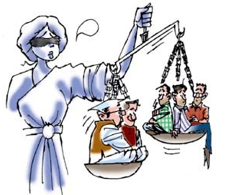
A Transparency International report last year estimated that about Rs 21,000 crore is paid annually in bribes by Indian citizens– with the fields of police, judiciary, education and health swallowing the most bribes. The report has been ig- nored despite the government relying on it to answer a query in Parliament on corruption.
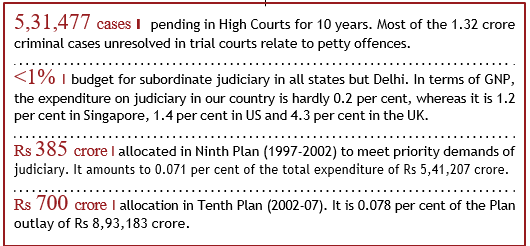
One reason for this malaise is the whopping 3-crore backlog of judi- cial cases. President APJ Abdul Ka- lam has suggested a “court martial” type dispensation to clear it. A former Supreme Court judge has pointed out, “Adjournments should be grant- ed in exceptional circumstances, the process to serve notices on the re- spondents should be streamlined, and the names of unwanted respondents should be deleted.”
Other reformers propose filling vacancies of subordinate judges and magistrates, and increasing the judi- ciary’s numerical strength. The judge- population ratio in India (based on the 1971 census) was 10.5 judges per million persons. The Law Commission says India needs 107 judges per mil- lion persons. To begin with, the judge strength needs to be raised five-fold, i.e. 50 judges per million in five years. Union Law Minister Hans Raj Bhardwaj recently announced an al- location of Rs 1,000 crore for making justice dispensation from the grass-roots level to the apex court “e- friendly”. Even an impoverished liti- gant at the infrastructure-starved taluk level would be able to access basic in- formation about the status of his case without spending on lawyers, police, courts et al.
Chief Minister Narendra Modi says Gujarat would have a “high-tech” justice delivery system on the pattern of Singapore. “E-courts and technol- ogy courts will enable plaintiffs to file lawsuits electronically,” he says. Modi also favours use of digital transcrip- tions of court proceedings.
The Centre has suggested improv- ing the crime investigation system to preclude chances of material witnesses turning hostile. For this, all statements of witnesses would be recorded by magistrates rather than policemen and a witness who retracts would be charged with perjury regardless of the accused’s acquittal.
But senior judicial administra- tors object to this. The government would have to appoint a large number of magistrates at the taluk level who would be required to testify before trial courts that witnesses had made statements to them without fear, in- timidation or favour.
Governmental suggestions for judi- cial reforms are viewed with suspicion by the public as any real improvement would kill the milch cow of corrup- tion. Genuine reforms would be detri- mental to the vested interests of a large chunk of lawmakers who are in the legal net for various offences, many gruesome in nature.
SARITA BHATNACAR (WRITER IS A FREELANCER)
