

















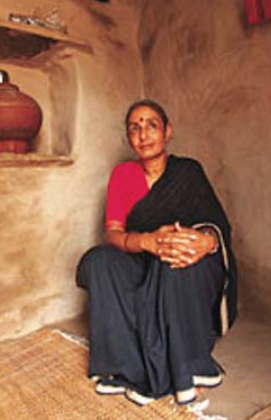
In the last 15 years, I have come to understand that there are many bridges that have to be built. I built my own. The first was a counter-migration bridge over which I crossed from the city of my residence, Delhi, to Rajasthan. I first worked with the SWRC Tilonia, which now calls itself Barefoot College, from 1975 to 1983. I left Tilonia because I wanted to be a sociopolitical non-party activist. Some of my colleagues and I moved farther into the heart of rural Rajasthan and lived in mud huts. We also kept a goat. Our goal was to reach out to our fellow beings who lived there and help them empower themselves through a deeper understanding of democracy as well as grassroots ownership of democratic institutions. In the 1960s and 1970s, there was a movement that propelled college graduates and others into what was called alternative development work. Many of my college-mates, including my husband Sujit Bunker Roy, plunged into this arena.
Bands of young men and women with privileged backgrounds and educational levels that would equip them for jobs in the plum sectors of the economy marched out, like Bunker, into remote, ignored areas. They included Anil Sadgopal, now renowned for his work in education, and Dunu Roy, who moved to remote Shahdol in Madhya Pradesh after jettisoning his successful career with IIT.
What inspired Bunker to forge tools to craft an interaction between specialists and technicians and rural folk? What motivated Dunu to start an apprentice workshop to train the unskilled and the landless? Why did I quit the Indian Administrative Service in 1974,after joining in 1968,to start marching to the beat of my own distant drummer? It is significant that the word “Naxalite” was coined in 1968.The beginning of Naxalism – the birth of extremist responses to socio-economic problems – was a social symptom of the rampaging disease of inequality. Many of us who ventured out to develop alternative solutions were assaulted by guilt. We were from privileged backgrounds but what had we given back to the country that had given us privileges?
The monogram of SWRC shows a farmer and a professional holding hands – one with a sheaf of corn in one hand, the other with a hat. It is a symbol of equality. I left SWRC because I wanted to work in a political framework but not within the ambit of a political party framework. As a woman, I say my life is a revolution. My life is political. I am fighting against inequality, every step, every moment of the day. As a person, if I were born in a Dalit family in rural India, I would be battling inequalities. Any fight against inequality is a political battle. We have narrowed the definition of politics into party politics, into being members of a political party,and we have disowned our role in shaping the country.
It’s not enough to join the IAS and cop out on social responsibility by pleading political bosses do not want you to implement the Constitution!
It is not enough to be a specialist. It is not enough to go to IITs. It is not enough to join
the IAS and then cop out on fundamental social responsibility by pleading the excuse that your political bosses do not want you to implement the articles of the Constitution! A government official’s allegiance is to the Constitution and not to a political master. I often asked myself the meaning of political empowerment. Does it mean that I must leave everything and join a political party and contest elections? Or does it mean I must use democracy better?
I am a fervent believer in Indian democracy. Not only have we had regular elections but we have also had the courage to respect and preserve dissent. No matter who is in power, we have people speaking against them. I believe India is a better democracy than the US. In the US, I recently found people were scared to show a spoof on President George W. Bush publicly. But we have tremendous democratic pluralistic space.
But look at the flip side. If I contest elections in my area, I will lose not because I haven’t done any good work but because I do not belong to the Rawat caste in a Rawat dominated area. If democracy has to be delineated by the parochial definitions of caste and religion, then we have lost out somewhere. But a great plus – apart from the right to dissent – is that the rural poor of India vote in greater numbers than the urban privileged and the middle class. The rural poor understand the power of democracy. They understand that at least once a year someone asks them for their vote, and during this campaign period the voters are VIPs – they are the real sovereigns choosing the people who are supposed to understand their special needs and to
serve them. It is largely the impact of the rural vote that led to progressive legislation such as the Right to Information and Employment Guarantee Acts.
(Exclusively adapted from a closed-door interactive session with PSU employees.)