





















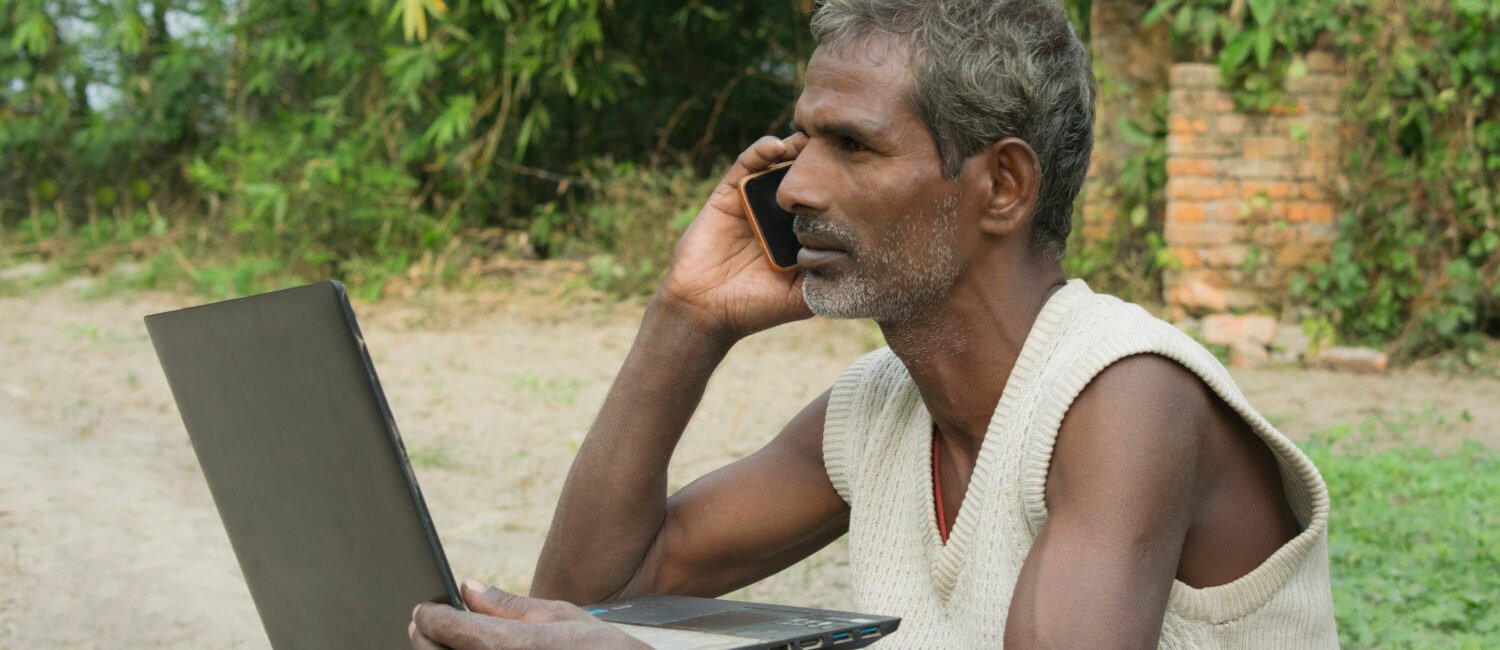
My company has taken a giant stride in attempting to solve what appeared to be an impossible problem by using digital technology to be able to link with the small and marginal farmer and provide him information and knowledge which otherwise would not be available to him. Unfortunately, the traditional government “extension services” have lacked motivation on the part of the service providers. What ITC has done is to package scientific and agricultural knowledge that has been flowing from research in Indian universities and related institutions and channel it into villages.We call this e-Choupal. It is not that complicated.You provide software in the local language and customize the information,keeping in mind the farmer’s requirements.
For every six or seven villages there is one e-Choupal. The purpose is not only to empower the farmer with information and knowledge but also to convert village communities into virtual producer cooperatives. The farmers now receive valuable information as well as farm inputs that previously were unavailable or unreliable–varieties of seeds, germination information and the like. The sanchalak assures availability and helps supervise best farm practices in order to raise farmer confidence levels, as well as negotiates with the suppliers to make available the finest inputs at the lowest cost.
A common question is how we make money. We have circumvented this problem by establishing multiple transactions riding a particular channel. We call this the Choupal-sagar. If a village community does not have the capacity to spend and you still want to connect the village community, you recover the cost by creating a highway – a low-cost, high-quality fulfilment channel that allows access to multiple users. Anybody who wants to reach these village populations with their goods and services has to use ITC’s toll road, so if you want to sell a tractor you are most welcome to do so based on our fulfilment channel, but you will have to pay a toll fee for it.At the moment, about 40 other companies are marketing their goods and services through these channels. After creating 5,300 e-Choupals in different states, we are expanding.
This is, in essence, a clearing house and a resource centre where input requirements like fertilizer,pesticides and seeds are available under one roof. Consumer items like sandals and needles as well as tractors and motorbikes are also available. This is,in other words,a combined information centre, credit union,storage facility, and supermarket for the village community. The sanchalak plays a pivotal role in this scheme by disseminating information to the village community. He also functions as a buyer for the five or six villages under his jurisdiction and can actually procure his requirements and negotiate those requirements on the basis of a virtual corporative of the village community
The sanchalak can even lease tractors. And if people cannot buy them,they can time-share. Again,the valid question, how do you make it sustainable and what’s in it for ITC? Actually, you cannot go and build a Choupal unless you are a buyer of agricultural commodities. ITC, originally a seller of cigarettes, got into the pack aged foods business so that we could be buyers of agricultural commodities. And only as buyers of agricultural commodities could we establish e-Choupal in villages. The upshot has been that we got into packaged wheat flour. Today, within three years, we are number one—a brand leader—in this agricultural commodity. The lesson is that if you are a buyer and you can get high-quality inputs and you are also a marketer of branded goods, only then can you establish your infrastructure in the rural areas.
This is a combined information centre, credit union, storage facility, supermarket for the village community
We also started marketing salt, because it is an item of daily require ment in the villages.This was an opportunity for us to begin educating people about the health hazards associated with not consuming iodized salt. We are also into agarbattis and matches because these are items of daily consumption. By creating multiple transactions and aggregating the number of goods and services that we could channel through this particular infrastructure, we were able to create a win-win economic equation that would enable us to defray the cost of this high degree of investment.
Then we got into spices,and we are planning to venture into vegetable- based produce. I like to say we are going to be the Walmart of India. By this I mean the lowest cost delivery to people who need it most—72 per cent of the population.And that is the potential market of tomorrow. If our village population begins to spend in the same ratio as its urban counterpart, it would spend twice as much as it does today. Fifty-five per cent of India’s private household consumption arises out of the villages. If they were able to spend twice as much, a tsunami like wave of economic activity would inundate the nation and lead to unparalleled prosperity and employment.

Yogi Deveshwar
The writer is Chairman, ITC