












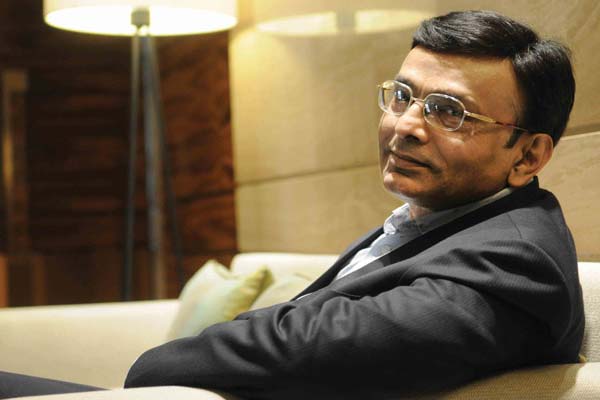










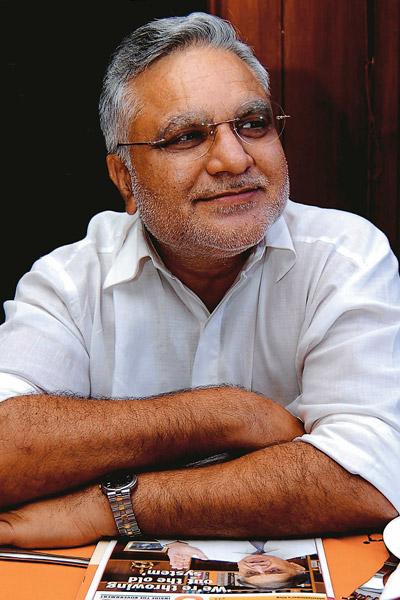
BELONGING to a middle-class family in Madras, I grew up imbibing certain values from my father, an accounts officer in the Comptroller and Auditor-General’s office, and grandfather, a Deputy Collector. My grandfather would tell me that procrastination is the thief of time. I realized that deferring a decision leads to crisis After schooling, I joined the Indian School of Mines, Dhanbad. In those days, getting admission there was a dream. I got a degree in mining engineering and became Assistant Colliery Manager at Kurasia Mines in Madhya Pradesh. I was 23. RS Krishnaswamy,an ICS officer,was Chairman,National Coal Development Corporation (NCDC). Like any other organization,NCDC was also beset with petty politics.My colleagues complained about me to the Chairman. Instead of firing me,he encouraged me to concentrate on my work and ignore them.After nine years in Madhya Pradesh, I joined the Umrer project in Nagpur.Managing the Umrer mines was a big challenge. But I did my job and drew praise from none other than Vasant Rao Naik, then Chief Minister of Maharashtra.
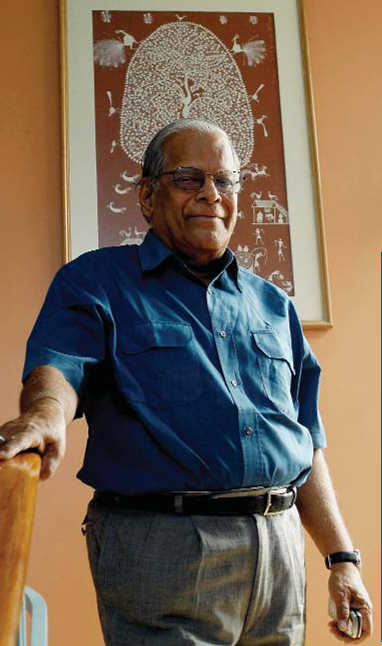
During the same period, Western Coalfields advertised a vacancy for a public relations officer which was turned down by the then Chairman.He said that, with MP Narayanan there,the post was not needed In 1971, Prime Minister Indira Gandhi took the big step of nationalization of NCDC and made it Coal India. All the coal fields and corporations came under its umbrella, making it a very powerful energy engine for the growth of India. I worked for 12 years with almost every good leader in the industry and learnt a lot from them. I recall JJ Kumaramangalam, brother of the late Mohan Kumaramangalam, who was Chairman of Coal India and a very quick decision-maker. Kumaramangalam had remendous faith in my professionalism and he made me instrumental in carrying out a secret mission – the preparation of the document for the nationalization of the coal industry.I completed the mission efficiently. From RC Dutta, Chairman of NCDC, I learned that whenever an aggrieved common man approaches the higher-ups, he must get justice.
During my next job as Director, Central Coalfields, I got a call from ABA Ghani Khan Chowdhury, the Congress politician from West Bengal, saying that Rajiv Gandhi – who had just entered politics – wanted to be briefed about the coal scenario in India. Chowdhury thought only I could do it. I went to meet Rajiv and we clicked at once.I always admired him as a person. I then moved to Neyveli Lignite Corporation in 1985 as Chairman and Managing Director and remained there till 1988. During these three years, the face of this corporation changed completely with the commissioning of 630 MW thermal power stations ahead of the expected commissioned date. The profitability and productivity also grew by 30 per cent. I also kept meeting Rajiv Gandhi off and on – with and without work. He was a keen observer and he kept track of my working in Neyveli. In 1988 he appointed me Chairman of Coal India. It was a big task – managing 426 collieries in seven states and employing 6.7 lakh miners/work force and producing 171.5 million tonnes of coal.
People who knew the coal industry across the globe always dismissed India’s coal production as a loss-making proposition. But I banked on my mar keting skill acquired during previous postings and proved them wrong. Coal India turned into a huge profit-making organization. Its profit as of now stands at a staggering Rs 8,000 crore.
The paradox is that the
triangle of businessman,
bureaucrat and politician
has a hold over the PSU.
They enjoy power with
out responsibility,
authority without
accountability
I have been a globetrotter and I feel that people everywhere are turning again to coal as a source of energy.India is the third largest coal-producing nation. China produced 37 million tonnes in 1947 but is now far ahead of us with 2 billion tonnes. We produce only 0.45 billion tonnes.
I think Public Sector Undertakings (PSUs) can perform better if the bureaucrats of this country can work on one principle – having selected a chairman of a PSU, give him freedom to work and trust him.The paradox is that the triangle of businessman, bureaucrat and politician has a hold over the PSU. They enjoy power without responsibility, authority without accountability. The government can recruit intelligent, capable and knowledgeable people on the boards of PSUs and at the same time allow the board to work freely and professionally.I am hoping against hope that a bright future awaits PSUs.The system will evolve and correct itself and the day is not far off when professionalism will be preferred over sycophancy.
Anil Tyagi is a distinguished Indian journalist. An alumnus of the Delhi School of Economics (M.Com) and the University of Delhi (LL.B), he brings decades of rich experience to journalism. He presently serves as Editor of gfiles.