
































For a predominantly agricultural country like India, in which 650 million of our 1.05-billion population earn meagre livelihoods, the effects of global warming will be catastrophic. Approximately 400 million farmers eke out a grim living on the 70 per cent of our cultivated land which is – intermittently – rain-fed. For these farmers, climate change will make such dry land agriculture even more risk-prone; it will cause floods, mid-season dry spells, land degradation and even more acute water scarcity.
Two world conferences on climate change took place in August-end 2007. The first was organized by the Climate Change Secretariat of the UN in Vienna, in which senior officials and scientists from 158 countries participated. The second was a gathering of the “15 Biggest Polluters” called by US President George Bush in Washington. The week-long UN conference concluded that the highly industrialized countries should “strive” to cut their GHG (greenhouse gas) emissions by 25–40 per cent of their 1990 levels by 2020. This “target” was described as a “loose guide” for the major International Climate Summit to be organized by the UN Secretary General in Bali, Indonesia in December.
In its submission to the Vienna conference, the government of India said it would cost $2.7 trillion to reduce carbon emission by 10 per cent of current levels by 2036. At the Washington meeting, the significant feature was Bush’s departure from his administration’s scepticism, side-tracking and denial of the very occurrence of global warming in making his first-ever categorical acknowledgement that climate change is a “real threat”. But what corrective actions did he propose to deal with this threat? The US intends to launch a “Technology Fund” aided by world governments to develop nonGHG-emitting energy sources and industrial processes. The US will also “support” the UN on climate change, though there was no indication of how. And the US will work on “advanced technologies”!
As long as they continue with
their rapacious, unsustainable
and environmentally disastrous
lifestyle, there is little hope of
stopping climate change
What Bush did not propose – which he could have easily done – was to commit the US federal government to do nationwide what the state of California had done as far back as two years ago. This includes mandatory GHG emission cuts for electric power plants, Japanese fuel efficiency standards for automobiles (US carmakers already meet those standards in cars they export to Japan), and a national as well as global R&D and mass manufacturing programme on all non-conventional/renewable energy sources.
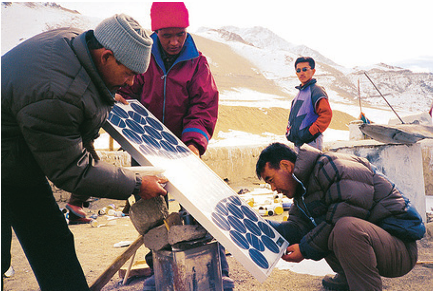
In India, we have a major operational programme in these energy sources, producing 10,500 MW of grid power and with around 2 million solar photovoltaic (light-induced) energy systems in rural and semi-urban areas. They cover around 20 different applications, including lighting for homes, community centres and night schools, village and town street lights, solar lanterns and so on. It is all based on indigenously developed R&D and technology, and is exported to 30 developing countries.
Technology, though necessary, is far from sufficient in dealing with climate change. The core issue is the statement Bush made. Global warming and climate change have been caused by the massively resource-intensive lifestyle of the US, followed by the EU and, to a lesser extent, Japan. As long as they continue with their rapacious, unsustainable and environmentally disastrous lifestyle and its “demonstration effect” on the rest of the world remains strong, there is little hope of stopping, let alone reversing, climate change.
The central remedy lies not in developing and applying on a mass scale clean, energy-efficient technologies across the board, important as that is, but in fundamentally redefining the prevailing development patterns and lifestyles globally. This has to start with the highly industrialized countries and move almost concurrently to the ruling elites in China and India with their commitment to a type of economic growth which is a copycat version of that which the highly industrialized countries have adopted since 1950 and which has led to the looming catastrophe of mostly irreversible climate change.