




















In Punjab’s political discourse, few assumptions circulate as casually—and with as little scrutiny—as the claim that the RSS–BJP combine is steadily spreading its tentacles across the state. According to this widely held belief, RSS shakhas are proliferating, Sikh religious institutions are increasingly falling under Sangh influence, and rival political formations—from the Shiromani Akali Dal to the Aam Aadmi Party and the Congress—are portrayed as either accommodating or surrendering to Hindutva in pursuit of power. The 2020 rupture between the Akalis and the BJP, followed by the BJP’s improved electoral performance since 2022, the fragmentation of Panthic politics, and the rapid decline of the Sukhbir Badal-led Akali Dal are routinely marshalled as evidence of this inexorable rise.
This reading of Punjab’s politics often culminates in a familiar conclusion: that the Modi–Shah juggernaut is unstoppable, and that the BJP stands on the brink of a breakthrough—or even victory—in Punjab by 2027. Running parallel to this is an even more sweeping assumption: that Punjab’s Hindu population constitutes a homogeneous political bloc, instinctively aligned with the BJP irrespective of differences of class, region, occupation, or historical experience.
Yet a closer examination of Punjab’s political history, social structure and cultural ecology complicates this narrative considerably. Punjab has long been characterised by layered identities, strong regionalism, and a political culture shaped as much by agrarian movements and federal assertion as by religious affiliation. Hindu political behaviour in the state has historically been fragmented, shaped by urban–rural divides, trading communities, caste hierarchies, and distinct regional histories rather than by a singular ideological pull. Likewise, the influence of the Sangh Parivar within Sikh religious institutions remains uneven, contested, and often overstated, constrained by the autonomy of Panthic traditions and a deep-rooted suspicion of external ideological control.
At the same time, the party has sought to soften its image among Sikhs, a community traditionally wary of the Sangh Parivar. Through the induction of Sikh leaders like Manjinder Singh Sirsa and the projection of religious commemorations such as Veer Bal Diwas and the martyrdom of Guru Tegh Bahadur, the BJP is attempting long-term image correction, particularly among urban and middle-class Sikhs.
Rise of the BJP in Punjab.
Since 2014, the Bharatiya Janata Party’s grip over Indian politics has increasingly been described as a “New One-Party Dominance System,” echoing—though not replicating—the Congress-led order that prevailed from 1947 to 1989. Unlike the Congress era, which drew legitimacy from the freedom movement, pluralism and broad organisational consensus, the BJP’s dominance rests on a different foundation: Narendra Modi’s personal charisma, tight narrative control, strategic polarisation, institutional consolidation and a vast welfare-delivery apparatus. Together, these have turned the party into an electoral juggernaut, capable of winning three successive general elections.
Punjab, long viewed as inhospitable terrain for the BJP, is now emerging as an important testing ground for this dominance. After its 2020 split with the Shiromani Akali Dal over the farm laws, the BJP embarked on a determined effort to expand its presence in the state. The gains, while uneven, are significant. The party’s vote share has climbed from 6–7 per cent to around 18.5 per cent, and in the 2024 Lok Sabha elections, it secured the highest vote share in 23 Assembly segments, indicating a structural shift rather than a one-off surge.
A central plank of this expansion has been elite induction. The entry of figures such as former Chief Minister Captain Amarinder Singh, Sunil Jakhar and Manpreet Singh Badal reflects a strategy of hollowing out rival parties while compensating for the BJP’s limited grassroots organisation in Punjab. This approach mirrors a national pattern in which the BJP functions less as a cadre-building force and more as a pole of attraction for politically displaced regional elites.
At the same time, the party has sought to soften its image among Sikhs, a community traditionally wary of the Sangh Parivar. Through the induction of Sikh leaders like Manjinder Singh Sirsa and the projection of religious commemorations such as Veer Bal Diwas and the martyrdom of Guru Tegh Bahadur, the BJP is attempting long-term image correction, particularly among urban and middle-class Sikhs.
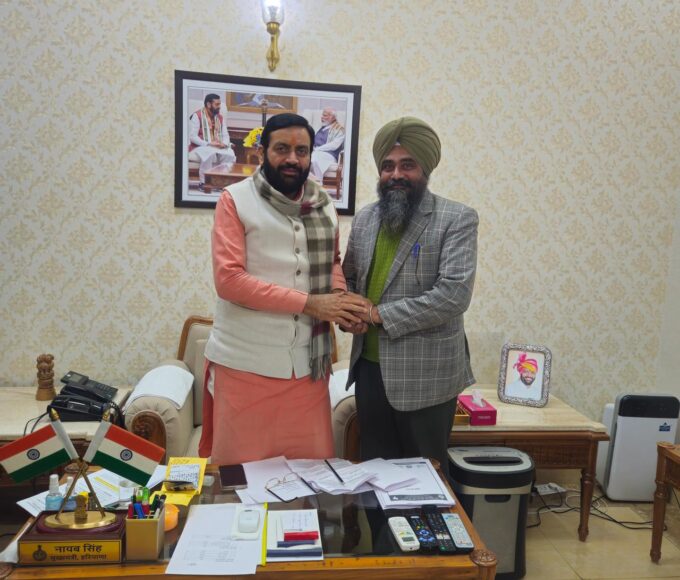
Social engineering remains another key axis. Borrowing from its “cow belt” playbook, the BJP has actively courted non-dominant caste groups such as Balmikis, and Sainis, often deploying Haryana Chief Minister Nayab Singh Saini in Punjab. The aim is to bypass the state’s entrenched Jat Sikh-centric political structure and assemble a new coalition rooted in welfare, grievance and aspiration.
The party has also engaged Punjab’s influential dera networks, including Dera Sacha Sauda and Radha Soami, seeking access to socially marginalised voters outside conventional party structures.
Parallel to this outreach is a relentless attack on the ruling AAP over law and order, gangsterism, drugs and stalled development. By projecting the “Yogi model” and the promise of a “double engine sarkar” and benefit of “central schemes” the BJP presents central alignment and muscular governance as the cure for Punjab’s malaise—an argument that resonates with sections of the urban middle class, even as it challenges the state’s tradition of negotiated and plural politics.
Why Punjab Remains a Difficult Terrain for the BJP?
Punjab is politically and socially distinct from much of north India, and it is precisely this distinctiveness that complicates the BJP’s ambitions in the state. The region’s political culture has been shaped by pluralism, strong regional aspirations, an agrarian economy, and a pronounced federal spirit. It is a Sikh-majority state with a long history of resistance—against colonial authority, centralisation, and perceived cultural domination. Alongside Sikh political dominance exists a significant Hindu minority and one of the most assertive Dalit populations in India. This layered social structure has historically resisted homogenising ideological projects.
Despite the early presence of the RSS among sections of Punjabi Hindus, the BJP—and its predecessor, the Jan Sangh—has long been perceived in Punjab as a Hindu upper-caste, trader-centric and centralising force, often viewed with suspicion by Sikhs and rural communities. Its ideological positions on nationalism, central authority and cultural uniformity have sat uneasily with Punjab’s federal consciousness and its lived experience of religious and cultural plurality. Unlike in parts of north and western India, the BJP has also struggled to transcend its image as being anti-Muslim, anti-Pakistan and culturally majoritarian, narratives that find limited resonance in Punjab’s social reality.
Electorally, the BJP has remained a minor player in the state for most of its history, hovering around 6–7 per cent vote share and functioning largely as a junior ally of the Shiromani Akali Dal. Its influence has been geographically narrow—confined mainly to urban centres and border districts adjoining Himachal Pradesh and Jammu & Kashmir—with little penetration in rural Punjab, where agrarian interests dominate political behaviour. Among major Indian states, Punjab has consistently ranked as one of the BJP’s worst performers, second only to Tamil Nadu.
In contrast, the Congress has been the dominant political force in Punjab for decades, with deep organisational roots in both urban and rural areas. Historically, large sections of Punjab’s Hindus gravitated towards the Congress, influenced by Arya Samaj traditions, the party’s early urban base, and its role during critical moments such as the Punjabi Suba movement and the militancy years. In cities like Ludhiana, Jalandhar and Amritsar, the Congress came to be seen as a safer, more accommodative political home than the Jan Sangh or BJP. Apart from Congress even Akali Dal has also made inroad into the Hindu vote in mandi towns of Malwa and AAP by portraying Kejriwal as a “Bania” who understands business.
This history also undercuts the persistent myth of a consolidated “Hindu vote” in Punjab. Hindu political behaviour in the state has been highly fragmented, shaped by region, caste, occupation and local histories. The preferences of Hindus in the hilly belt differ markedly from those in the Malwa heartland or major cities. Hindu Dalits, Dera followers and trading communities have often voted differently, making the idea of a monolithic Hindu bloc analytically misleading. Although the “Modi Phenomenon” has shown signs of leading to “Hindu consolidation” during general elections, pragmatic considerations have swayed most Hindus to other political parties during state elections in Punjab. Result of recent By elections largely reflect this trend.
The BJP’s structural problems in Punjab are therefore deep-rooted. During its long alliance with the Akali Dal, the party was constrained politically and organisationally, unable to expand independently. It has also lacked a charismatic state-level leader, a problem compounded by the marginalisation of Punjab leaders within the national BJP hierarchy. Figures like Navjot Singh Sidhu exited early, while others failed to gain mass traction. New entrants like Captain Amarinder Singh and Sunil Jakhar have struggled to mesh into BJP culture.
The party’s social base in Punjab remains narrow, largely confined to urban traders, sections of the middle class, and a few isolated pockets—particularly in the sub-mountainous belt and areas adjoining Rajasthan. Its organisational presence is weak and shallow, with limited penetration or resonance in rural Punjab. Moreover, the party’s recent attempts to consolidate so-called “non-dominant” castes, drawing from strategies employed in the Hindi heartland, are unlikely to produce comparable outcomes. In Punjab’s pluralistic, Sikh-dominated social order, caste identities are neither as rigid nor as politically mobilisable, reducing the effectiveness of such social engineering.
This weakness has been magnified by a persistent perception of the BJP as anti-Sikh and anti-farmer, especially after the farm laws agitation. The RSS has been effectively portrayed by its opponents as hostile to Sikh institutions, a narrative reinforced by the Centre’s handling of agrarian protests.
Compounding this is the widespread belief that the BJP has pursued anti-Punjab policies—from its farm laws and centralising tendencies to disputes over institutions such as BBMB (Bhakra Beas Management Board) and Panjab University, inadequate flood relief, and rhetoric that conflates Sikh assertion with separatism. National narratives centred on Pakistan or communal polarisation have limited appeal in a state with a small Muslim population and a strong egalitarian Sikh ethos that historically muted caste-based polarisation.
Organisationally, the BJP has also made tactical missteps. The induction of what critics term “political scrap” from rival parties—leaders such as Manpreet Singh Badal, Kewal Singh Dhillon —has damaged its credibility without delivering commensurate electoral dividends. Many Congress and Akali leaders who joined the BJP have reportedly struggled to adjust to its organisational culture and ideological framework, facing hostility from the Sikh peasantry and alienation within local party units. Recent signs of dissent involving figures like Captain Amarinder Singh and Sunil Jakhar underscore these tensions.
Electoral outcomes reflect these limitations. The BJP has suffered reverses in constituencies such as Gidderbaha, Barnala, Tarn Taran and Dera Baba Nanak, as well as in rural local body elections. As a result, pressure is mounting on the party to reconsider an alliance with the Akali Dal, despite the mutual distrust following their 2020 split.
If the BJP chooses to contest the 2027 Assembly elections alone, it risks severe marginalisation—if not near decimation. Punjab’s political terrain remains resistant to the BJP’s dominant national template, and without a credible mass base, organic leadership and cultural alignment, the party’s rise in the state may prove far more limited than its proponents assume.

Prof Harjeshwar Singh
Prof Harjeshwar Pal Singh is a veteran writer on Punjab History and Politics. Director, Punjab Thinks