




























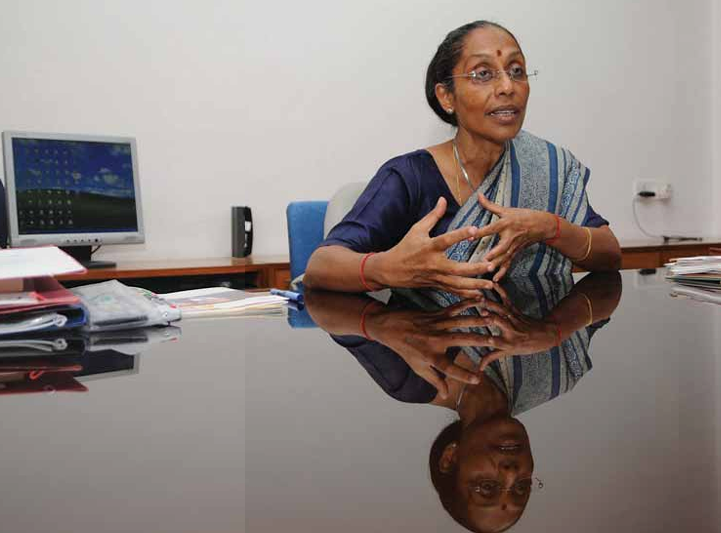
Appropriately, Shantha Sheela Nair – Secretary, Drinking Water Supply, Ministry of Rural Development – feels strongly about India’s water problems. A 1973-batch IAS officer of the Tamil Nadu cadre, she started her career as a Sub-Collector in Dindigul in 1975. As Chairperson and Managing Director of the Madras Metropolitan Water Supply and Sewerage Board in 1994, she resolved the chronic water problem of Chennai. The city used to spend a crore of rupees on buying water every day. Nair, who believes that rain water harvesting can tackle the problem of drinking water shortage in India, made it mandatory in the city. She also converted Chennai into an independ ent water civic authority. She was also Secretary to the Government, Municipal Administration and Water Supply Department, Secretariat, Chennai.
gfiles: Why should the matter of drinking water be such a priority for the government?
Shantha Sheela Nair: Drinking water is the prime necessity of life. When we look at the pre-Independence days, the source of water was community-based surface water with little and no treat ment available. After Independence, the government took respon sibility and established the Public Health Engineering Department. Until the 1970s, ground water was exploited for drinking and agriculture. The scenario changed when the country faced droughts and resultant drinking water shortage during the 1980s. Ground water became contaminated with fluoride and arsenic. Hydrological factor of the ground changed and the avail ability of drinking water in the country became a serious issue. To meet the challenge, Prime Minister Rajiv Gandhi launched his National Drinking Water Mission (RGNDWM). The government divided the problem into two: drinking water problem in rural areas and in municipal areas.
The National Drinking Water Mission was essentially a technology mission. Reliance on ground water resulted in wide-scale installation of India Mark 2 pumps. It was an era of hand pumps.
gfiles: You are talking about both availabil ity and quality of water. How are you going to ensure them?
SSN: We are dependent on ground water in the rural areas which is contaminated with fluoride and arsenic in various states. The ground water is also depleting rapidly. Extensive research convinced us that avail ability and quality of water can be main tained if we increase the water table by recharging it through rain water harvest ing. We are encouraging treatment of water for arsenic, fluoride, nitrate, iron and salinity. We are emphasizing commu nity participation in design of schemes, community ownership, pricing and tariff mechanism. We are solving the problem of over-dependence on a single source, ground water, by creating alternative sources like surface water and rain water harvesting.
‘If we improve rural sanitation, 50-60 per
cent of the water contamination problem
will be solved. Under the Nirmal Gram
Puraskar Yojna, villages which are free of
defecation in the open are awarded’
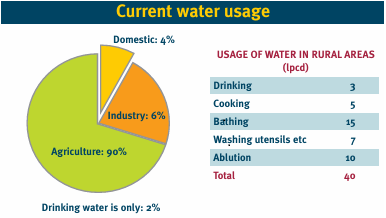
gfiles: Though 40 litres per capita per day (lpcd) is insufficient, how are you going to ensure even this meagre volume in rural India?
SSN: This is a static figure, not dynamic. As far as drinking water is concerned, we need only eight litres in a day. I must re emphasize that it is not only a question of the availability of water but the quality of water also.
gfiles: How are you going to solve the prob lem of contaminated water?
SSN: You know, 20,190 habitations in 17 states are affected by fluoride contamina tion. About 66 million people are at risk. Fluoride is threatening to enter the food chain. The arsenic problem is in Bihar, West Bengal, Uttar Pradesh, Tripura, Assam and Chhattisgarh, and 16 million people are at risk.
We have a focused strategy for full cov erage of all rural habitations by 2009 esti mated as follows: 55,060 uncovered habi tations, address and revive 3.31 lakh slipped back habitations, address the prob lem of water quality, ie, arsenic problem in 2,16,968 habitations.
gfiles: What water treatment facilities are available?
SSN: There are many technologies per taining to water treatment for arsenic. The most commonly used methods include oxidation, co-precipitation and adsorption onto coagulated flocs, lime treatment, adsorption onto sorptive media, ion exchange resin and membrane technolo gies. All these technologies have their own merits and demerits. Surface water is the best long-term solution. To address the problem of fluoride, traditional methods such as use of herbal extracts, crushed Thetan kottai, drumsticks seeds, amla seeds and nirmal seeds are in use. RGND WM has so far approved 138 R&D projects on water and sanitation of which 114 proj ects have been completed. Besides, we have a score of other technologies too.
gfiles: What are your strategies to address water quality problems?
SSN: The Government of India is work ing very hard to improve the quality of water. At a national workshop on R&D in Water and Sanitation organized in December 2007, it was revealed that about 1,00,000 habitations suffer from excess iron. This problem is tackled through dilu tion, roof-water harvesting, aeration and Terafil Filtration System. We have drawn out a concrete action plan for the states to address all affected habitations before March 2009.
gfiles: Defecation in the open owing to absence of a proper sanitation system in rural areas is the major cause of contamination of water. What are your efforts to solve it?
SSN: Yes. If we improve the sanitation system in rural areas, 50-60 per cent of the water contamination problem will be solved. We have introduced the Nirmal Gram Puraskar Yojna. Under it, villages which are 100 per cent free of defecation in the open are awarded. We started with 38 villages. In 2008, we have 35,000 appli cations for recognition.
gfiles: The problems you have been talking about are modern-day problems of rural India. Does this mean our village communi ties and district administrations do not take proper care of natural water bodies like ponds and wells?
SSN: In a way, yes. We have grossly neg lected the natural water bodies. Water is available but it has been contaminated by defecation in the open and mishandling of the water bodies by the rural communities.
gfiles : It is said the urban water crisis is more acute than the rural water crisis.
SSN: Let us analyse this whole scenario in a different perspective. In a metropolitan city area, 90 per cent of the water supply system is based on surface water and 10 per cent on ground water. In small towns, 50-60 per cent is based on surface water. In rural areas, 80 per cent is based on ground water. So you can see we have alto gether different problems in rural areas and in urban areas.
gfiles: We have as many as 604 districts in the country. So how are you managing the rural water problem?
SSN: The government’s role is support ive. The government is planning to move from overdependence on a single source of drinking water to multiple sources in order to reduce risk and slippage. Also, for rural drinking water security, 80 per cent dependence on ground water means that approximately 12 lakh habitations are straightaway at risk. We are in the process of reviving traditional water bodies and creating rural drinking water storage reservoirs. I want to end dependence on ground water and revive existing water bodies, and create a new surface system.
By harvesting rain water, Khari village of
Kutch, with annual rainfall of just 350 mm
and facing two or three droughts every five
years, has become self-sufficient in water’
gfiles : Is there any positive response to the government’s efforts from any community or from any part of the country?SSN: Yes. The problem needs to be looked at from three angles: government, village community and panchayat. By harvesting rain water, Khari village of Kutch, with an annual rainfall of just 350 mm and faced with two or three droughts every five years, has become self-sufficient in water. The village no longer needs water from the Narmada grid. The panchayat sells the water to the villagers.
gfiles: Why should water be sold in rural areas?
SSN: Of course it shouldn’t. But price mechanisms have been developed by the panchayat for two reasons. One, the water should not be misused. Second, the water should be continuously supplied to the population. And people are ready to pay if they are getting uncontaminated water. Kerala has a drinking water problem. They have rainfall amounting to 3,000 mm but they do not store. Their problem can be solved through proper planning and prop er storage.
gfiles: It is felt that the issue of water surveil lance has been distanced from the main agen da and therefore quality issues are lagging. What steps have you taken to tackle this?
SSN: A national water surveillance sys tem was evolved in 2005 with a focus on water quality and surveillance. We have formed a five-member team in every vil lage trained in quality testing. A district water testing laboratory was provided to test the water and 17,00,000 persons have been trained across the country. Now we plan to provide field test kits to be tested in high school laboratories.
gfiles: Water and sanitation are state sub jects. Implementation of schemes is often not up to the mark due to inefficiency of state agencies. What steps have you taken regard ing this?
SSN: I don’t want to comment on this aspect. I only want to emphasize that mon itoring water is not rocket science. It is simple. It is a continuous process of capac ity building posing great challenge. We cannot afford to keep this issue in abeyance. It is high time we plan and cre ate a budget for providing water to the nation. We have to empower rural people, employ communities and create aware ness in the country. We have till now 16,00,000 village habitations as far as water is concerned. We are in the process of putting on the Web water data relating to every parliamentary constituency.
gfiles: Monitoring of schemes is basically compilation of reports received from state gov ernments. Then how do you truly monitor performance?
SSN: We have a strong monitoring sys tem in different states and such problems are never encountered.
gfiles: Don’t you think the country needs a “Right To Drinking Water Act” on the pattern of the Right To Information Act?
SSN: Right without responsibility does not make sense. One can demand right, but without responsibility it will become redundant. Somebody’s right has to be curtailed, so that others’ right can be pro tected. Simply creating right to water is not going to solve the problem.
gfiles: Water is being dealt with by many ministries. Shouldn’t it be brought under one umbrella for proper coordination and a holis tic view?
SSN: When it was under one roof, people wanted many agencies to look after this subject. Now that it is no more a single agency subject, the demand to scatter it over different agencies is surfacing. I think the present system is working very well.
Anil Tyagi is a distinguished Indian journalist. An alumnus of the Delhi School of Economics (M.Com) and the University of Delhi (LL.B), he brings decades of rich experience to journalism. He presently serves as Editor of gfiles.