



















IN taking stock of the state of the civil services, it has to be conceded that the “bamboo” frame, despite hiccups and occasional bouts of insanity, has generally performed well in maintaining the integrity of the nation. Yet, though changes have been gradual and sequen tially unnoticeable, their cumulative effect over half a century has been profound.
The Indian bureaucracy is a two-dimen sional system with the x-axis defining the relationship of its members to the aspira tions of the people and the y-axis repre senting the dictates of their political mas ters. As in mathematics, the two dimensions are independent variables. Wherever and whenever equilibrium is struck as a straight line at an angle of 45 degrees at the origin, the result is a stable democratic paradigm. But, over the years, the line is increasingly tilting towards the y-axis.
In the early 1960s, when I entered the Administrative Service, the Collector of a district, however imbecile he may have been, was the undisputed leader of the local administration. His word was law for all the minions functioning in an area of about 1,00,000 square miles. When he gave a call for total bebaqui (realization) of government dues by a certain date, it was achieved regardless of politicians hissing and bellowing. In much the same way, the Cabinet Secretary in Delhi and the Chief Secretaries in the state capitals were con sidered “the old block”.
I remember an incident when the local legislator, aided and abetted by journal ists, succeeded in influencing my Commissioner to ask the state govern ment for my “immediate removal” from the district on account of my “incapability to deal with important people of the dis trict”. The Chief Secretary, after hearing my side of the story, not only retained me in the district for another two years but ordered the transfer of the Commissioner.
In the Central Government, the institution of the Cabinet Secretary was pivotal and unassailable. He tendered advice to the Cabinet and the Prime Minister and decided the postings of all senior officers. The Prime Minister’s “dhobi mark” was a mere formality.
When the politician and the civil ser vant started working together, it was expected that the respective roles would be defined and further refined. Intensifying democratic processes should have been accompanied by role definition, which unfortunately did not happen.
Merely saying that “the politicians take decisions and the babus advise and implement” was not enough. It left room for arbitrariness and sloth.
The vaguely defined rule of democratic supremacy of the political executive in decision-making unfortunately percolat ed into the lower echelons of government, where the role of the civil servants was crucial to the implementation of the deci sions taken upstairs.
Thus, the synergy between the political executive and the permanent civil service that existed in the 1950s and 1960s has been largely eroded over the years. It has had a very deleterious effect on the quali ty of governance in the states and also at the Centre. It has given way to mutual dis trust and even open conflict. The politi cians and the bureaucrats have together brought down the monolithic structure like a pack of cards.
The civil servant
respected the political
leader for leadership
qualities….The politi
cian respected the civil
servant for impartiality,
integrity and knowledge
of the subject
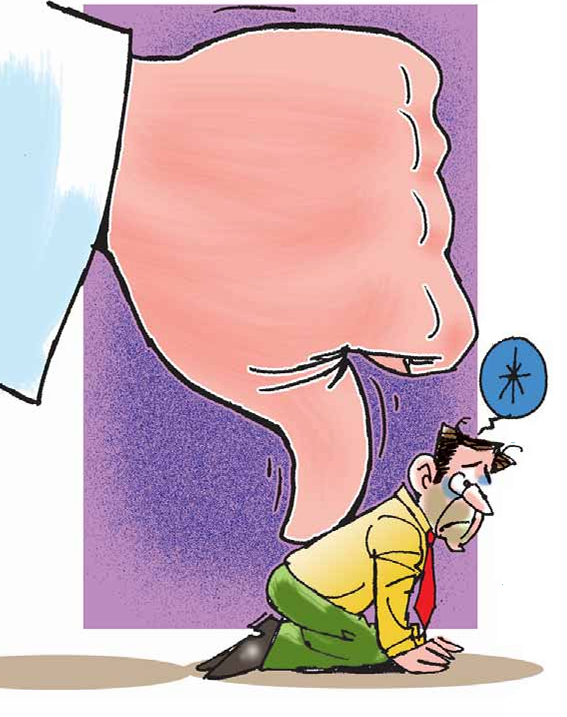
In the last three decades, this uneasy coexistence has resulted in near-total con fusion of the respective roles and respon sibilities. Both the arms of government have contributed substantially to this con fusion, and the country has suffered.
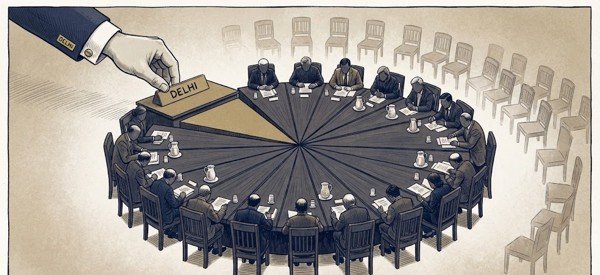
Now, democracy has seeming ly taken over the civil services. The desiversion of the spoils system of the United States has been ushered in. Today, Ministers select Secretaries, Additional Secretaries, Joint Secretaries and even lowly Deputy Secretaries in their respective Ministries. I am told that panels of candidates are sent to Ministers for their prior approval. A current Cabinet Minister is reported to have thrice rejected the panels for the post of Secretary submitted to him till he found a worthy candidate!
A number of states present a more pathetic picture. District Magistrates and Superintendents of Police are changed on the whims and fancies of MLAs, officers keep their holdalls packed to play musical chairs. Young officers are placed under suspension arbitrarily and then reinstated equall arbitrarily.
Perhaps these are the demands of a vibrant democracy. But I feel that when the mosquito net of Article 311 of the Constitution is removed – efforts for which are afoot – the bureaucrats would be well advised to seek the shelter of the nearest politician’s apron.
I think there is a strong need to re-establish the internal consistency of the government, if better governance is to become a reality.
The political executive in a parliamentary democracy is, by design, the instrument to translate the aspirations of the electorate into reality. They hold their positions because they have the verdict of the people on public policy. They are expected to be willing and able to work to see that the wishes of the people are carried out at the agency level in accordance with the law and regulations. They perform a critical function: working to translate the wishes of the people into policy initiatives.
Career civil servants perform a very different role. They implement policy, besides helping to make it. They provide continuity and specialized expertise based on institutional knowledge and experience. Traditionally, most of them spend their entire working careers in government, although in our country nowadays it seems to be changing.
I believe that these roles are separate, and it’s important to do all we can to keep them separate. My hypothesis is that a time has come for an institutional division of the competence and responsibility of decision-making between Ministers and officers. For instance, the Chief Secretary should have a 2-3 year tenure (as commanded by the Supreme Court but not followed by some of the states) and should be made responsible and accountable for administrative postings. Functional responsibilities could also be similarly divided.
Another consequence or by-product of the functioning of democracy has been a total disappearance of civil service leadership. Civil servants have always been in a privileged vantage position thanks to their education, training and status to provide leadership to the people, but they failed to assume the leadership role. They failed to give voice to the needs of the people. Ensconced in the security of their employment, they confined themselves to carrying out the dictates from above rather than attempting to ameliorate the economic and social injustices faced by the under-privileged and the exploited. The rare ones who do are disliked by their colleagues and politicians alike.
On the contrary, we find public leadership emerging in other professions. As democracy progressed, leadership qualities emanated from the ranks of mediapersons, lawyers, educationists, economists, social activists and businessmen. Today, they form the bulk of icons sought to be emulated by the youth. Hardly any civil servant is included in the list of such icons.
This is a matter of concern, and a lesson, for current civil servants.

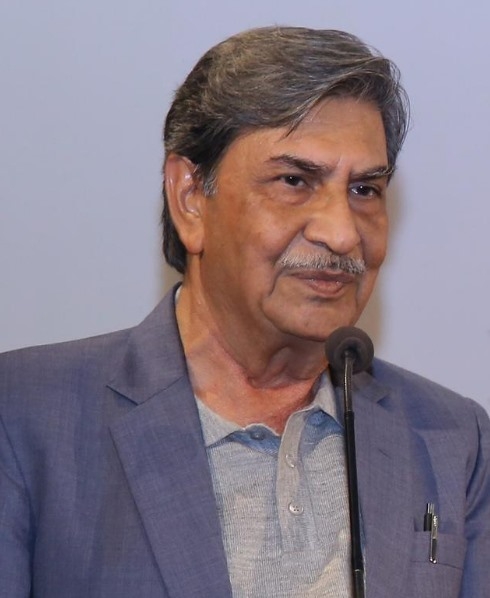
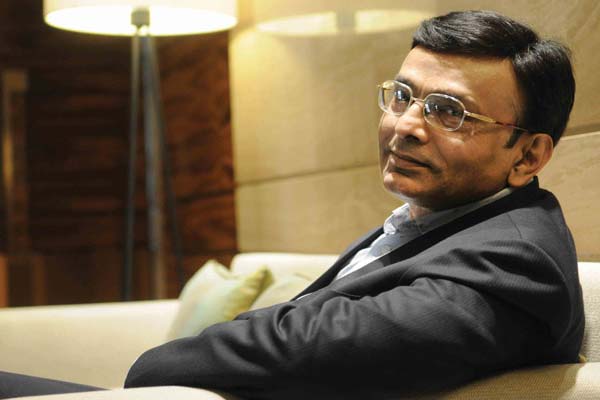
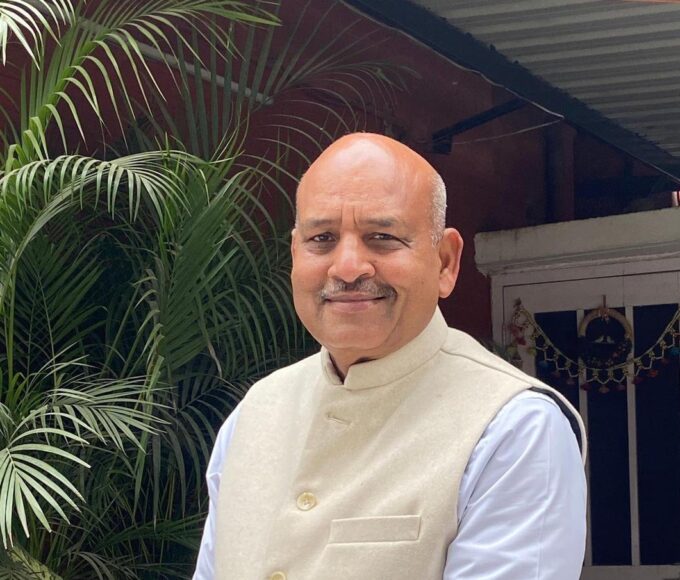
Prabhat Kumar is an Indian Administrative Service officer of the 1963 batch, he served as the Cabinet Secretary of Government of India between 1998 and 2000. Upon creation of the State of Jharkhand in November 2000, he served as the first Governor.