











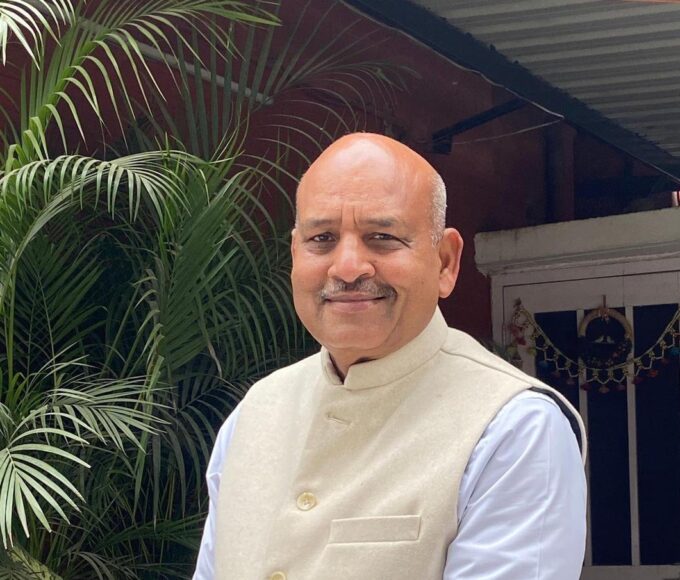


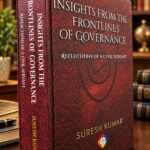








As a young student of history, I was always interested in travelling and adventure and knowing the cultures of other countries. My father and grandfather were lawyers in Bihar and I was schooled at St Xaviers’ in Patna. I came to Delhi in 1959, joining St Stephen’s College for BA (Hons) in history. Theatre, radio, TV, acting, directing and occasional writing were my hobbies.
After I completed MA in history in 1964, securing the fourth rank in Delhi University, I taught history and did theatre, radio and TV programmes for two years. We used to do plays with American and British theatre groups as well. We did a wonderful play called Abraham Lincoln in Illinois that travelled to Jodhpur and many other cities. I also acted in and directed many plays for Yatrik, a theatre group founded by us. My contemporaries included great theatre personalities like Habib Tanvir, Roshan Seth, Sushma Seth, Kulbhushan Kharbanda, Joy Michael, Kusum Bahl, Salima Raza, Om and Sudha Shivpuri, Kabir Bedi, Amitabh Bachchan, Madhur Jaffrey and many other National School of Drama alumni. I did not know Amitabh very well, but every time we met I would tell him, “Arre tum lambe bhi ho aur tumhari awaaz bhi achchi hai.”
One fine morning my father called me and said that everyone was wondering why I was interested in nautanki after higher education. This, alongwith some personal reasons, motivated me to pursue a different career. I had an academic bent of mind and even considered teaching as an option but my father persuaded me to appear for the IAS exam in 1965. I was among the top five. I opted for the Indian Foreign Service and have never regretted that decision although my father wanted me to join the IAS.
I completed my training while serving in Beirut where I learnt Arabic. The Government of India was planning to expand and open embassies in the Persian Gulf as the British were planning to withdraw from the east of Suez. I spent two- and-a-half years in Kuwait, covering the entire Gulf, and over three years in the Ministry of External Affairs looking after the same region.
During that time, the British withdrew their foreign and defence advisers, the United Arab Emirates was formed and India opened embassies in all the Gulf countries. It was an exciting period and I was part of the government’s team which facilitated in laying the foundation of the economic and political cooperation between India and the region –the fruits of which are now being harvested. Banks were opened, Indian companies entered the region in a big way, hospitals like Apollo came up in Chennai to treat patients from the region, migrant workers from India began going there in large numbers etc.
I served the Government of India by living and not “lying” abroad for a large portion of my 36 years of service, partly for personal reasons and partly owing to my differences with South Block on a number of administrative and policy issues. I was reluctant to serve in Delhi. The Ministry had increasingly become a travel agency and only worked from day to day. I had seen my colleagues getting frustrated when they were unable to contribute to policy-making and were only asked to implement policies they disagreed with.
A lot of money, effort and time were wasted on useless nonresult-oriented multilateral diplomacy at the cost of profitable and often urgent bilateral diplomacy. Bilateralism, which lies at the heart of successful pursuit of national interest, was ignored. As an envoy of the country abroad, at least I could run my mission the way I wanted and contribute substantially and visibly to building relations and the image of my country. I had the opportunity and satisfaction of doing so despite budgetary constraints imposed by our spending on huge delegations to international conferences. It was difficult not to express my disagreement with all this at times.
I did not entirely agree with our policy of giving so much importance to the Non-Aligned Movement as it did not always suit our national interest or serve it. In the initial days after Independence, we used to look at China as if we were still the British government of India which was clearly expansionist. After Independence, like all inheritors, we should have sat down with our neighbours who had common borders and frankly sorted the borders on a pragmatic basis. We chose not do so and are still suffering the consequences. Ironically, when Chou en-Lai said China had border disputes with India, we responded by saying we had none. Was it the right diplomacy on our part to deal with China in such a way?
New circumstances developed after Independence which required an entirely different way of dealing with all our neighbours. But we either ignored them or tried to dominate them or judged them by their attitude towards Pakistan. It would have been wiser to concentrate on solving bilateral issues with each neighbour separately. In fact, even now our borders with almost all our neighbours are not fully delineated – leaving room for conflict.
We were too busy carving out an international role for ourselves. Sometimes I feel we are still doing so – chasing after things like a permanent seat in the UN Security Council. A wiser approach would be to build our country, improve bilateral relations by removing irritants (for instance, give work permits to Bangladeshis) and concentrate on better governance and strengthening the economy. Then the world will ask you to become a member, you won’t have to go begging for it.

I consider my years in Lebanon the most fascinating and instructive of my career. In spite of some Palestinian refugees living in Lebanon, the place was free from the Palestine-Israel conflict. Ravi Shankar used to come and play at the American University in Beirut. It was later that the beautiful country suffered some of the most tragic conflicts of the last century. What happened there is a lesson for other countries – how one can be dragged into the conflict of others if one is not careful. Later I served in Iran and got a chance to look at the region from another angle. I was in Teheran during the Iraq-Iran war.
In Congo – then Zaire – where many Indians lived in the interior and traded, some of them told me that it was not possible for them to transfer money through banking channels to India or abroad in general and they resorted to purchasing gold and taking it legally to UK or Switzerland and paying taxes there. They said they would prefer to take it to India if India permitted legal entry of gold, and pay taxes there. I mentioned this later to one of our Ministers and was happy to discover that the policy of the government changed to permit this and the import of gold was liberalized.
When I was in Paris, I had the opportunity to follow developments in the Soviet Union. They were officially and fairly openly prepared for what happened and it was thus that they were able to achieve the disintegration with minimum bloodshed. Another lesson there, especially after the bloody disintegration of Yugoslavia.
France charmed me most. I consider Paris the most beautiful city in the world. The residents think of themselves as Parisians first and keep the city beautiful. Even during World War II they preferred to surrender than allow the city to be destroyed. The quality of sunlight in the city is very good and even the old buildings reflect the sunlight. This is perhaps one reason why painters adore the city so much. If we in India could change the administration of our cities and run them like the French do, we wouldn’t have the mess we have now. I once suggested it to an LG of Delhi but he had other preoccupations.
Good public relations skills make a good diplomat. Interest in foreign languages and in the culture of both India and other countries are essential for a successful diplomat. Adaptability and creativity are also essential. An officer who doesn’t like to travel or socialize and is not adventurous should not be made a diplomat. Diplomacy requires a positive attitude – solving international problems and reaching an agreement with other countries to mutual advantage is the crux. A diplomat’s primary role is to create a conducive environment for the country globally and interact with local people.
My last posting was in Argentina. I observed the financial mismanagement of Argentina from very close quarters. I used to meet editors and the Indian diaspora regularly. Due to lack of proper approach by the Indian government and private sector towards Latin American countries, many opportunities were lost. However, opportunities have a way of returning again and one only has to be ready to take them.
I fail to agree with the widely-held view that we have been hypnotized by the US at the cost of our old friends. Friendship with the US is not new. Old friends will understand that this friendship is not and will not be at the cost of old friends. If old friends cannot meet your needs at a given moment, if they are true friends they will understand that it is also in their interest that we revive and strengthen this so-called new friendship. And it is the job of our government and our diplomats to convince them of this.