

















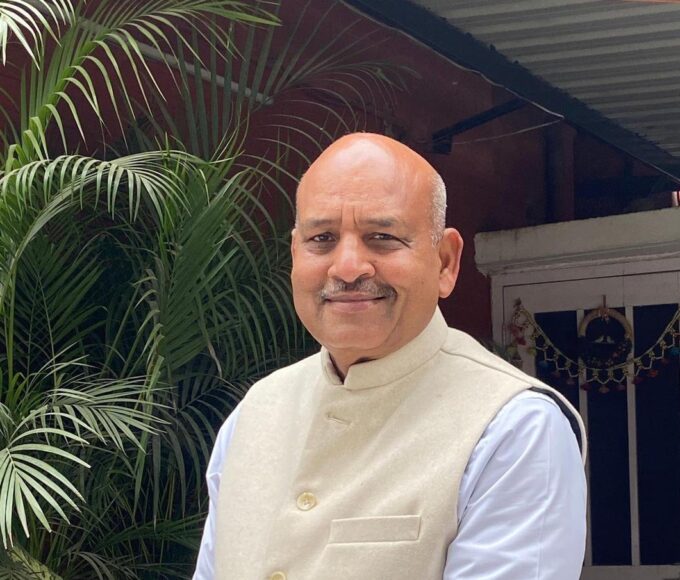












Vijay Shanker is an IPS officer of the UP cadre (1969 batch). Before becoming Director of the Central Bureau of Investigation (CBI), he was Director-General of the National Disaster Response Force and Civil Defence and also held Director-General, SSB. He has had a long association with the CBI, having been Additional Director and, before that, SP. He also served in the Border Security Force as DIG and IG, handling Kashmir terrorism at its peak in the early 1990s. He has also worked with the Ministry of External Affairs and served in an Indian mission abroad.
Shanker has served his home cadre as SP, DIG and Additional Director General of Police, heading the UP police headquarters and Provincial Armed Constabulary. He believes basic policing and professional investigation by agencies like the CBI are fundamental to the rule of law, good governance and are essential critical components of poverty alleviation and overall development.
interviewed by Anil Tyagi
gfiles: What is the great challenge before the CBI in the context of new-generation crime?
Vijay Shanker: The challenge is to ensure a high professional standard, transparency, fairness and objectivity. Maintaining this is a challenge as CBI is only one part of the whole criminal justice system. Unless we ensure that the cases that CBI registers for investigation are disposed of at the earliest possible, there is likelihood of the person being investigated not getting justice. Justice is ensuring that the person who has violated the provisions of law gets punished. As per law, justice is also to protect the common man and, more so, an innocent person is declared so based on the investigation at the earliest. In this context, pendency of cases under trial is a very serious concern. Any pendency, at any level, only leads to the common man’s belief that corruption flourishes because corrupt elements do not get punished.
gfiles: Whenever the CBI files a case, the media says it will not lead to a logical conclusion and justice will not be done. Why this phenomenon and why this image of the CBI?
VS: This perception is because some past cases involving the high and mighty did not reach their logical conclusion. In the criminal justice system, an investigating agency like CBI initiates the process of law enforcement through registration of First Information Report (FIR) and subsequently conducts an investigation into the allegations contained in the FIR as per law. The CBI only finds out the truth and collects evidence to prove allegations against the accused. The CBI does not sit in judgement.
In spite of all this, the CBI maintains the highest conviction percentage not only in India but comparable internationally. In the last five years, the conviction percentage of the CBI is 67 to 74 per cent. This, despite the fact that there are over 8,000 cases pending trial, some for as long as 20 years. The common man is so afflicted by corruption, lack of governance that he does not have patience any more to understand the intricacies of the criminal justice system. He wants improved standards of governance, improved governmental services. The majority of people obey the law and therefore they wish that those in authority, if they violate the law, be punished. This has not happened. CBI investigates only 1,000 to 1,200 cases in a year. It cannot handle more. Investigation, being a part of law and order, is the exclusive subject of the states and now increasingly states are asking CBI to investigate cases. You must understand what this means.
gfiles: That’s why the Prime Minister is talking about setting up a federal agency.
VS: No federal agency can take over the responsibility that is vested in the state government under the Constitution. A federal agency perhaps will be able to handle selected cases which have inter-state, international ramifications and perhaps the kind of sensitivity associated with integrity of the country and economic well-being of the nation.
gfiles: If a federal agency is set up, could you handle it?
VS: This is a complex issue. The media has been talking about it without proper research. Law and order, investigation and policing, as I said earlier, are the exclusive domain of the state government. Unless the Constitution is amended, it is not possible to create a federal agency. It also needs a political consensus.
gfiles: But would you be ready to take on the responsibility of the federal agency if it is set up or of the CBI is reconstituted into a federal agency?
VS: It is a hypothetical. The CBI has handled the most complex cases in internal security, scams and bank frauds, new-generation crimes like cyber crime, intellectual property rights, money laundering etc. In the Bombay blasts, the CBI has succeeded in conviction of 100 accused out of 123. Nowhere in the world has this happened.
‘Unless the Constitution is amended, it is
not possible to create a federal agency.
It also needs a political consensus’
gfiles: Cases like Telgi are pending
VS: Pending for trial. Investigation has been carried out in the shortest possible time. In four cases, conviction has taken place and Telgi and his collaborators have been sentenced for severest possible punishment up to 10 years. For the first time in the world, it was done only through electronic evidence, that means trial through video conferencing. There will not be a single case related to Telgi which will not end in conviction. In the chara ghotala, over 25 cases have been decided in which severest of punishment has been awarded. In these cases, over 100 accused have been sentenced to the severest possible punishment. Not a single case has been acquitted so far. It is not an ordinary thing.
gfiles: Well, in the chara case, everybody knows. What has happened?
VS: That is none of my business, my chargesheet is in the court and it is for the court to decide. If you want to know about it, why don’t you send the RTI application?
gfiles: RTI is all very well. But we have to ask the boss of the organization to know the real truth….
VS: No. I must tell you and you must write it. In India, corruption has not been debated enough. Corruption is not just a law enforcement issue. The joke is that the state of affairs is that “my corruption is no corruption but my rival’s corruption is corruption”.
gfiles: Do you think police reforms are necessary?
VS: Police reforms are an urgent necessity. The Centre has been considering the second National Police Commission recommendations. The Supreme Court has given specific directions in Prakash Singh’s writ petition. Police reforms are critical if the country has to retain all-round progress. It is the responsibility of the state government to protect the rights of the common man and give him a sense of security. This has not been achieved as the challenges are enormous. Only well thought out police reforms can bring about such change.
gfiles: What is the problem?
VS: Police personnel are being used as the personal army of the state ruling parties. Not even 1 per cent of our population interacts with the police. To restore public faith in the police, radical reform is a must. Unfortunately, every government has ensured that no reform in police takes place.
gfiles: Are you planning to educate the public about the CBI’s functioning?
VS: There is a huge vested interest in maligning the CBI and creating confusion in the minds of the people so that they have a question mark against the CBI.
gfiles: What qualitative change has a fixed term for the Director brought to the CBI? Do you feel CBI is independent?VS: Of course we are independent. The fixed tenure of the Director has changed the scenario. The government cannot transfer the CBI Director before a minimum of two years. During my two-and-a-half years’ tenure, the government has never given any suggestion till now. I myself give every instruction in writing. In the CBI, there is a single-file system. Every officer is encouraged to express his views freely and frankly and he is accountable for the same.
gfiles: What is the world crime scenario which is handled across the world by agencies like CBI?
VS: There has been a dramatic shift in the world crime scenario from conventional offences like theft, robbery, forgery, etc. to economic scams which fully or partially fall in the cyber domain. New-generation crime like financial market and capital market scams, insurance fraud, manipulation and falsification of computer records, and illegal access to information causing wrongful gain to individuals etc. are taking centre stage.
gfiles: How many cases are you investigating and how many cases are at Preliminary Enquiry level?
VS: As of 31.03.2008, 1165 cases were under investigation, out of which 40 are Preliminary Enquiries.
gfiles: What is the number of economic cases you are handling at present?
VS: The Economic Offences Division of CBI has 164 cases under investigation as of March 31, 2008.
gfiles: What is the success rate of cases which you filed in court?
VS: In 2007, the rate of conviction was 67 per cent. In 2006, it was 73 per cent. On an average, the conviction rate ranges between 65 and 73 per cent.
gfiles: It has been observed that in most cases the court observes that the CBI has not submitted the corroborating evidence or was unable to collect it. The case is weakened and CBI loses it….
VS: It is not correct to say that in most cases the courts have made such observations. In one or two cases, the court has made certain observations but then there is a mechanism for in-house examination of such observations and, if required, necessary steps are taken to improve our working. In a few instances, on appeal, the higher courts have appreciated our point of view with respect to the evidence adduced by the agency. The effort is to collect substantial and conclusive evidence in every case and, wherever necessary, corroborating evidence is also gathered to strengthen the prosecution’s case.
gfiles:Policing experts say CBI is an organization of deputationists. People come and serve and go back to their parent cadre so the real growth of the institution suffers.
VS:Senior police officers come on deputation from their parent cadre to CBI for four to five years. They enrich the organization with their vast experience in their state police and help immensely in providing necessary momentum to the organization. An organization decays if it is not able to adapt to the growing challenges. Deputationist officers, who have field experience of supervising a large number of diverse cases, help CBI investigations in grappling with various intricacies of investigation. Also, though investigation is carried out centrally, the trial goes on in the court in the state. There are slight differences in the court procedures of various states and deputationists provide the necessary versality required by the organization in dealing with trial courts all over the country. Moreover, getting officers on deputation provides the necessary flexibility in maintaining regional and linguistic balance. You must appreciate that CBI has the capability to carry out investigation all over the country. The chargesheet may be filed in a particular language, but the investigation requires the organization to be proficient in various languages.
gfiles: Due to the lack of trained manpower, the CBI is not able to deliver what is desired by the country.
VS: Yes, there is definitely shortage of manpower in CBI. The sanctioned strength of CBI is only 5,960 including technical officers, legal officers and Group D employees. Even with this small strength, CBI has been able to deliver very effectively and efficiently. Within this 5960, there has been a vacancy of about 1450 posts, including around 1000 posts of investigating officers and legal officers. The expectation of the country from CBI is increasing because of its performance and more manpower would definitely help in coping.
gfiles: CBI said that the counterfeit currency problem can be solved if we stop printing currency on imported paper. Has anybody taken note of this n the Finance Ministry?
VS: Yes, there was a suggestion given by CBI. A number of intelligence and interrogation reports have suggested that illegal presses printing counterfeit Indian currency are running outside India. There were also intelligence reports that some agencies outside India were successful in importing optically variable ink used for printing Indian currency notes by misrepresentation of fact. There is a single company, said to be supplying currency printing paper to both India and Pakistan. Therefore, it will do more good than harm if indigenous paper and ink are used for printing Indian currency notes. I am not aware of any further development regarding this suggestion.
gfiles: How does CBI help the country in governance?
VS: There can be no governance with rampant corruption. Any form of governance with unabated corruption will ultimately transform into an anarchy. CBI’s enormous success in unearthing scams and taking them to logical conclusion, in catching public servants, including those in high positions, has resulted in a salutary and cascading effect on the other public servants. CBI has successfully and continuously instilled fear in the minds of the corrupt and with each successful case has been able to plug some loopholes in the system.
