























All those who care about good governance and the rule of law must be dismayed, nay shocked, by the cumulative effect of several seemingly isolated events. I am referring, one, to the filing of charges against a former Minister of External Affairs, Madhav Singh Solanki, for attempting to subvert the course of law in the notorious Bofors case. Another development is the filing of charges against a senior Indian Foreign Service official, Rakesh Kumar, for indulging in human trafficking, when he headed the Indian Council for Cultural Relations. The third is the conviction of an Indian Administrative Service official, currently Chief Secretary of Jharkand, ——- in the celebrated Bihar fodder case, with which the current Railways Minister is also linked.
So we have the spectacle of a senior leader of the oldest political party in the country and two members of the most coveted civil services of the country facing the wrath of the law for acts of commission in contravention of the oaths of office they undertook to uphold the Constitution.
And, if this was not enough, we have had the sordid spectacle of political bribery (the naming of Lucknow airport after Charan Singh, to quote one example), political chicanery, alleged misuse of the government’s investigative agencies, and the shameless and brazen deal-making preceding the vote of confidence in Parliament on July 22. The horse trading that went on converted one of the most august institutions in the country into, so to say, a meat market!
There is an apparent rule of law but it operates in
a strangely Indian way: ‘Show me the man and I
shall show you the Law.’ The political authority
and the ruling class lack credibility and respect,
and discipline is breaking down everywhere
What are we to make of all this? It is apparent that the system of governance and the entire value system that should go with it are in terminal decline. In the 58th year of our Republic, the institutions of governance are hollow, eaten up by the termites of corruption, apathy, cynicism and the strange Hindu sense of resigned acceptance. While each one of us individually and collectively should be concerned about this abject state of affairs, the common refrain one hears is “So what’s new!”, “Sab chalta hai”, and “What do you expect of our ruling class?” and so on. Others put on a brave face and say that this too shall pass and India will eventually emerge stronger!
It’s a strange optimism, defying logic, for how can India emerge stronger if its institutions are dying? The absence of any sense of shame and outrage at these shenanigans speaks volumes about our national ethos, if any.
We can trace the beginning of the decline of the institutions so assiduously built and nurtured by the sensitive and visionary Jawaharlal Nehru to 1973 when, ironically, his own daughter began the assault on the institutions of the Republic to institute personal supremacy. In the process, by various acts of omission and commission, she gradually managed to destroy her own party, the independence of the civil services and the judiciary.
This chipping away at the institutions reinforced the latent tendency of feudalism which is still at the heart of the Indian polity and society. The fracturing of the Congress monolith gave rise to parochial regional satraps who demanded their pounds of flesh for support to national political parties.
The tendency to capture power at any cost gradually gave rise to a new “Culture of Entitlement” in which politicians and bureaucrats sought to acquire power and wealth for themselves and their hangers-on under the general rubric of democracy. The ends justified the means.
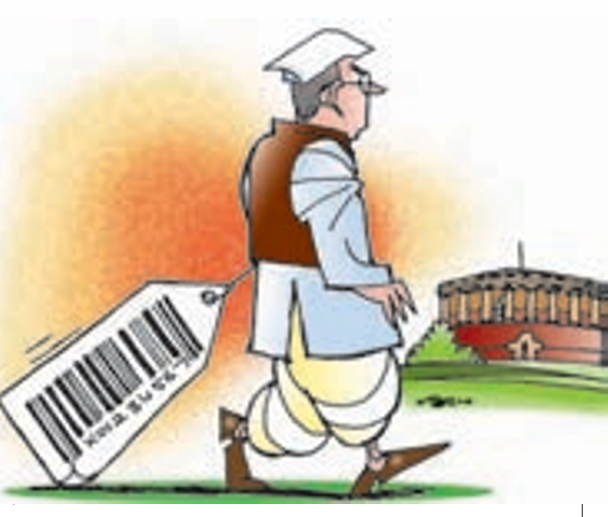
This Culture of Entitlement in turn spawned a “Culture of Extortion”. Anything to do with the government, be it getting a ration card or a driving licence or a building permit or an import licence, began to involve paying a premium. The worst affected class has been what is generally referred to as the “aam adami”, by whose name every politician and every political party swears.
A recent survey in the Hindustan Times (July 21) showed that Delhi’s poorest paid enough bribes over the last 12 months to buy 10 Mercedes Benz cars. Extrapolating this on a national scale, the figure for the Culture of Extortion would be mind-boggling.
The Culture of Entitlement and the Culture of Extortion have become an integral part of the life of all of us, whether an individual citizen or a corporate entity. And there seems no escape from it!
There is an apparent rule of law but it operates in a strangely Indian way: “Show me the man and I shall show you the Law.” Therefore, the political authority and the ruling class lack credibility and respect, and discipline is breaking down everywhere – on the roads and in Parliament (witnessed live on TV over July 21 and 22. Every Indian has only two options. To hang one’s head in shame for allowing things to come to this pass and bequeath this dubious legacy to the next generation, or do something, however small in measure, to uplift the country from this quagmire.