


















Though the present-day Indian Railways dates from the division of the railways of the subcontinent in 1947-48, the railways have a historical and physical continuity. The major part of our railroad system was built in the second half of the 19th Century. It came as a part of the British Empire, as an imperialist tool for colonial expansion and rule, for movement of troops, arms and ammunitions, and for trade. Indian Railways was the first industry which came as a vanguard of the capitalist system, releasing labour from feudal bondage, creating consciousness of rights and introducing a new class structure. Indian Railways has been the main instrument in creating a single identity geographically, leading to the concept of a nation. It is difficult to think of industrial development, new urban habitats and the sense of the modern without the contribution of the railway.
Significantly, the railway became a reality in India just 28 years after the first train in Britain in 1925. Before Partition, the railway network was 71,555 km. After Partition, Indian Railways was reduced to 53,000 km. Within a month, it moved 7,00,000 displaced people; 40,00,000 or four million were moved for resettlement over long distances. The snapped link to Assam and the Northeast was reconstructed by building a line of 227 km in two years and opened on January 26, 1950. Rawalpindi and Lahore, the railheads for Jammu and Kashmir, were now in Pakistan. A new link from Mukerian to Pathankot was opened in April 1952. The major seaport for maritime trade, Karachi, was also now part of Pakistan. Indian Railways constructed a 274-km line on the West Coast to the new port of Kandla in two years and 10 months, opening it in 1952.
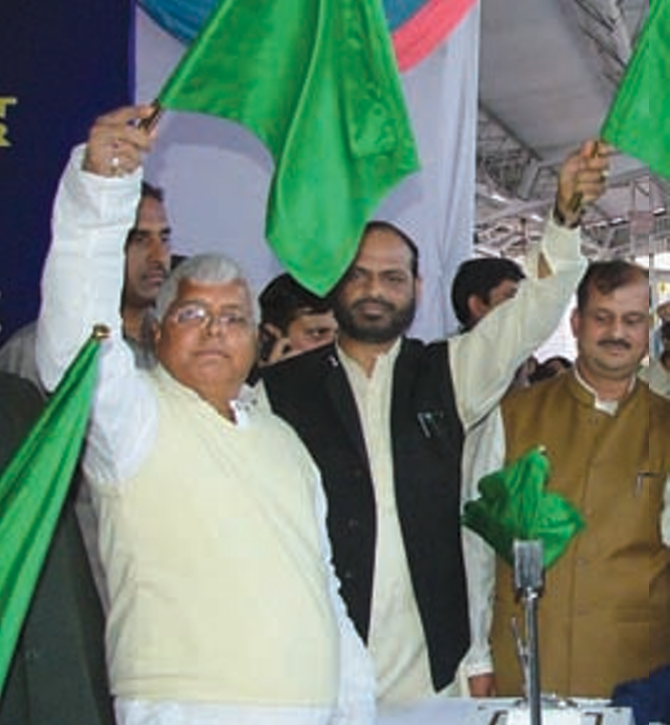
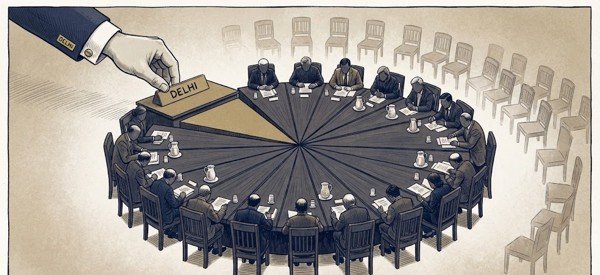
One of the great post-Independence achievements was the reorganization of the railways. In 1947, the railways had 42 rail systems, big and small, which included major government railways such as East Indian, Great Indian Peninsula, Bombay, Baroda, and Central India Railway; several major state railways; and small systems of the princely states of Rajasthan and Gujarat. In 1951-52, the network was consolidated in six zones, and expanded to eight shortly afterwards by making South Eastern and Northeast Frontier as separate zones. In 1966, the ninth zone of South Central was created. In another reorganization 50 years later in 2002, seven more zones – East Central (headquarters at Hajipur), North Central (headquarters in Allahabad), North Western (headquarters at Jaipur), West Central ( headquarters at Jabalpur), South East Central (headquarters at Bilaspur), East Coast (headquarters at Bhubaneswar), and South Western (headquarters at Hubli) – were created for decentralization and streamlining management. The merit of this reorganization is disputed by some who think that the exercise, which increased unproductive expenditure, was a populist step satisfying regional aspirations. It has been called reorganization in reverse – balkanization of the railways rather than consolidation.
Amartya Sen says infrastruc
ture cannot be a business.
Railways are heavily subsidized
by the state even in the US,
Germany and France
Post-Independence, the railways have many significant achievements such as setting up of production units for self reliance, introduction of diesel and electric locomotives, and construction of major bridges. Rajendra Pul at Mokameh across the Ganga opened for traffic in 1959, Saraighat bridge on the Brahmaputra in 1962, and another bridge on this river at Jogigopa in 1999. Two outstanding projects are the Konkan Rail Project and Operation Unigauge, the conversion from metre to broad gauge. The 760-km broad gauge line of the Konkan Rail from Mumbai to Mangalore was constructed in eight years and opened for traffic in 1998 – a saga of engineering expertise, devotion and untiring effort of a dedicated team under E Sreedharan, former Member, Engineering of the Railway Board and currently Managing Director, Delhi Metro. The idea first occurred to WF Sinclair, Asst Collector, Colaba (now Raigadh) in 1882 but became a reality 114 years later with a 6.5-km tunnel and long bridges across the Mandovi and Juari rivers in Goa. From 1992 to 2002, 11,000 km of metre gauge was converted to broad gauge, removing a bottleneck, reducing distances, and opening alternative routes.
Chittaranjan Locomotive Works was set up in 1950 for production of steam engines which were earlier imported from Europe and the US. It produced 2,351 engines. It was perhaps the only locomotive works in the world to be converted from steam-engine production to electric-engine production in 1971-72. It has produced over 3,000 electric engines of 12 designs. CLW also produced 842 diesel engines. Electric traction is the mainstay of train operation today.
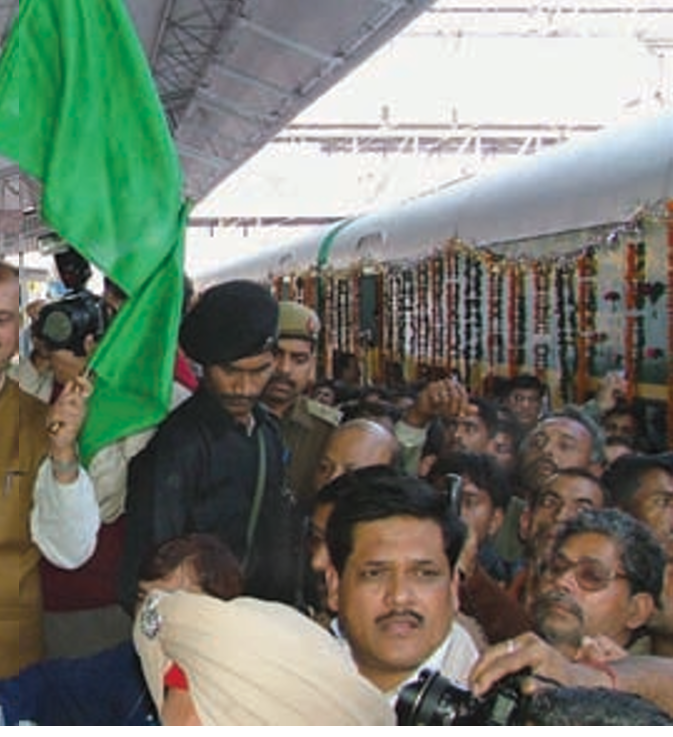
The Integral coach factory at Perambur opened by Prime Minister Jawaharlal Nehru on October 2, 1955 has an annual production capacity now of 1100 coaches. The coach factory at Kapurthala, set up in 1935, has produced over 12,000 coaches or 35 per cent of the coaches in service.
The Diesel Locomotive Works, Varanasi deserves special mention. In the 1950s, diesel traction saved the economy, and the railways. DLW was started in 1961 in collaboration with American Locomotive Company (ALCo) and rolled out its first engine in 1964. It has produced over 4,500 locomotives with an annual capacity of about 150 engines. In the context of self-reliance, the wheel and axle plant at Bangalore and the diesel components works at Kapurthala, which were set up later, also deserve mention.
The introduction of diesel and electric engines was among landmark decisions which, coupled with planned production of engines, brought about a quantum jump in capacity and performance. In 1950-51, the total operation of Indian Railways was by steam locomotives, except for 388 km (including Bombay area and a strip from Madras to Tambaram). There were 72 electric engines and Electric Multiple Units (EMU) which operated suburban services. The number of steam locomotives was 8,120 which increased to 10,312 in 1960-61. Industrialization and expansion of trade and travel were taking place, and steam traction was not equal to the task.
Simultaneously, from the late 1950s, electrification of heavy trunk routes started. By 1970-71, 7,447 km of track was electrified. By 1990-91, it was 18,954 km. Today, 33,623 km stands electrified. The Railways have 4,816 diesel engines and 3,294 electric locomotives, many of which are heavy-duty, high-speed units.
Passenger and freight services have grown phenomenally. From 1,280 million in 1950-51, the number of passengers has reached 6,219 million in 2006-2007. Freight traffic has gone up to about 750 million tonnes a year. In terms of assets, the total investment of the Railways stands at Rs 1,30,168 crore from Rs 850 crore 60 years ago.
But Indian Railways’ progress has been
incremental, a result of chasing the demand
and, as a monopoly, providing service as a
favour. As road traffic, the alternative mode
of surface transport developed, the railways
continued to lose their share which now
stands at 20 per cent in passenger and
about 40 per cent in freight traffic
Expansion of air conditioned services with a number of Rajdhani and intercity Shatabdi express trains, computerization of one of the world’s largest reservation systems, and of freight operations information systems are key areas of modernization of which the Railways can certainly feel proud.
But Indian Railways’ progress has been incremental, a result of chasing the demand and, as a monopoly, providing service as a favour. As road traffic, the alternative mode of surface transport developed, the railways continued to lose their share which now stands at 20 per cent in passenger and about 40 per cent in freight traffic. Until recently, by protecting the monopoly of the Container Corporation of India (Concor), the railways have been virtually throttling export and import traffic and pushing it to long hauls by road to ports. One hopes that the recent unshackling of container train operation will bring about a change in the modal split and encourage traffic.
The new economic regime did not encourage the railways to change their monopoly mindset of a government department which is also an industry. This duality gives the system unbridled freedom in matters of policy and implementation. This monolith required to be restructured and corporatized, as the Rakesh Mohan Committee recommended. But what IR did was spatial reorganization, carving out seven more zones and several new railway divisions. The railways continued to be totally insular, with production units, design and all the services captive under monopoly control. The inevitable fallout is low speeds, low-capacity wagons and indifferent service.
IR is the country’s biggest mode of transport. It constitutes essential infrastructure, the wheels of the economy. But the government considers it a business. As Amartya Sen says, infrastructure cannot be a business. Railways are heavily subsidized by the state even in the US, Germany and France. In our neighbourhood, China has built a railway line in Tibet. It can boast of passenger services at 250 kmph and developing technology aimed at 300 kmph and beyond.
The McKinsey Report (1999) lamented the sloth of incremental growth. Typically, IR usually crosses the bridge when they reach it or build one when they discover to their horror that it is not there! The Rakesh Mohan Committee (2002) said railways is a sunrise industry. There has been a resurrection of railways globally.
Privatization would perhaps be too abrupt and not practicable at this stage. Where are the takers for this capital-intensive transport system, with long gestation periods, subsidized fares and antiquated, effete structure? The Report, therefore, recommended restructuring and reorganization. The core business of IR is transportation. So it should concentrate on the core and spin out the rest. Core business and infrastructure should be separated; the vertical division of technical (infrastructure) departments should be removed.
After seminars, high-level meetings and discussions, the Report was accepted and dumped. The political leadership and the railway bureaucracy did not want to part with power. The departmental fiefdoms faced dismantling. For the political leadership IR is an instrument of populism for doling out subsidy in passenger fares, new trains, stations, uneconomic rail projects responding to local and regional aspirations.
There are heavy arrears of track renewal, with over 5,000 km of track getting added on every year. Conjuring up profits and dividends is a comforting thought; but where is the capital for investment?
Several decisions have lately been taken for faster network expansion and modernization. Dedicated (double-line) freight corridors between Delhi and Mumbai, and Delhi and Kolkata (Howrah) on two arms of the Golden Quadrilateral for 5,500 km on a time-bound basis is an ongoing ambitious mega-project. Financial help for it is coming from Japan.
The recent Rail Budget holds out many promises. People are happy to hear that freight rates and fares will not be increased. The Budget talks of Railway Vision 2025, modernization of signalling systems, bulk handling terminals, 6,000 automated ticket vending machines, 50 big passenger terminals, CCTV at stations, green toilets in trains, and stainless steel coaches. It announces a Rs 250,000-crore plan for technical modernization and of Rs 75,000 crore for infrastructure upgradation. The Budget also declared a time-bound plan of developing 20,000 km of high-density network. These declarations certainly inspire optimism. After all, there is the new directorate to look after public-private participation, the Rail Vikas Nigam, dedicated Freight Corridor Company (or Corporation!).
For a yesteryear railwayman, it is easy to lambast gleefully, to be a repository of knowledge, ideas and all solutions. The one thing he does not seem to know is structural changes. So the structure created by the Raj survives, like elsewhere in the government. And the system rumbles along.
According to the principles of aerodynamics, the bumble bee cannot fly. The bumble bee does not know this, so it flies anyway.
