














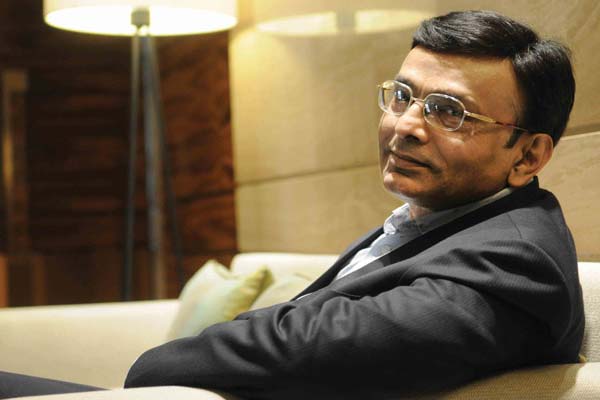













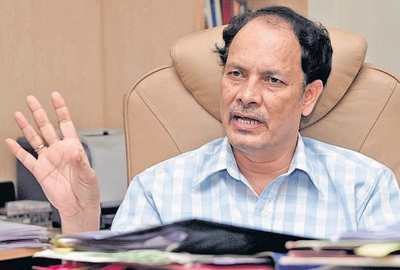
The betterment of rural life is the favourite subject of ANP Sinha, the Secretary, Ministry of Panchayati Raj, who still has two-and-a-half years of service left. When he went to the UK for further training in 1987, it was for social planning. Sinha’s early upbringing was undertaken mostly by his mother as his father was a busy man, working in the education department. Sinha studied at Netarhat Public School. By the time he graduated, Bihar was afire with the JP movement. He appeared for the IAS examination and cleared it in his first attempt.
The 1974-batch IAS officer has travelled a long way from serving the districts of Bihar in the late 1970s and early ’80s. He joined the Central government’s Food Processing Ministry as Joint Secretary in 2001. He became Secretary in July 2008.
gfiles: What has the common man got till now from the Panchayati Raj system?
ANP Sinha: The greatest achievement of India post-Independence is grounding democracy and panchayats have played a key role in deepening democracy. I do appreciate that grounding panchayati raj is not easy, but there has been a good start and with the Constitutional amendment and the commitment shown to panchayati raj by the government things should be much better.
gfiles: What economic and social change has panchayati raj brought in?
ANPS: Under Article 243 (g) of the Constitution, the panchayats are supposed to plan and implement schemes for social justice and economic development. In one sense , you are right that this role has not matured. We have advised the states to do activity mapping, devolving three years for functions, funds and functionaries so that each level of the panchayat is given a very specific role, both in regard to social justice and economic development. We have also requested the Central Ministries to amend guidelines of their Centrally-sponsored schemes to ensure panchayats get the appropriate role under the principle of centrality and subsidiaries. I am hopeful that in time, as and when Centrally-sponsored scheme guidelines get amended and implemented, the panchayats will have lots of responsibilities in social justice and economic development.
gfiles: So the government has just started?
ANPS: We have been trying for the last few years. I would say the absolute implementation of the Constitutional amendment, which was passed in 1993, started in earnest during the last two to three years.
gfiles: There was no serious effort before 1993?
ANPS: By the Central government. It is essentially a state subject. The role of the Central government is to create enabling conditions.
gfiles: So where have you reached till now?
ANPS: In some states the grounding of panchayats is very good. Some states have made a good beginning. I would not like to name any states. Some states are not doing well and we are focusing on them.
gfiles: You have just started working and you are observing how the states are implementing panchayati raj…
ANPS: There are two things. One, the whole issue of governance which has many dimensions. Two, planning and implementing schemes of social justice and economic development. We have been monitoring and advising.
gfiles: India has 6 lakh villages but only 2.36 lakh panchayats? Why this disparity?
ANPS: We have 2.36 lakh gram panchayats but about 6000 intermediary panchayats and 600 zila parishads so the actual number would be 2.5 lakh. Villages have very diverse populations. They can be tiny or big. The main thing is the size of the panchayat. It depends on the geographical area. If you look at MP and UP, the village panchayats are fairly small. There is a dilemma. If the panchayat is too big, it loses representational character. It is unviable. The national average is 5,000 inhabitants per panchayat. The viability also depends on terrain. It is very difficult to recommend the rational. UP has 52,000 smallest panchayats. Some are very large and some are very small.
‘The gram panchayat is an actuary body, it has so happened that the actuary body has become too dominant and the villagers feel helpless. Our effort is to make the gram panchayat responsible to the gram sabha’
gfiles: Mahatma Gandhi’s call for gram swaraj (local self-government) got forgotten just after Independence. Will the village be a viable, forceful and commanding unit? The government is reviving that.
ANPS: If you really want this self-governance, the gram sabha is more important than gram panchayat. My personal effort is to bring the gram sabha to centrestage. The gram panchayat is an actuary body, it has so happened that the actuary body has become too dominant and the villagers feel helpless. Our effort is to make the gram panchayat responsible to the gram sabha.
When we framed the Constitution, the gram panchayats should have been made into three-tier governance. Article 40 of the Directive Principles says the State “shall” empower the panchayats. In 243(g) the word has become “may”. Our society was so fragmented and fractious the fathers of the Constitution must have thought that was not the best time but in retrospect I feel it was the best time to empower the village. Also, the political leadership and bureaucracy resist the devolution of three tiers. Both the Central and state governments have not built the capacity of panchayats. Unless you provide them reasonable buildings, essential manpower, essential infrastructure, how will they really function? This year our agenda is to provide these capacities to panchayats.
gfiles: There was a fund to build the capacities but you did not use it.
ANPS: First, the funding is of low magnitude. Second, take the example of the Backward Region Grant Fund (BRGF) – our flagship programme. It is in 250 districts and is involved with the kind of work left entirely to panchayats. They give priority to their daily needs, like a link road or drinking water source or anganwadi. Capacity building got neglected. Therefore, our main agenda is to give priority to capacity building.
gfiles: In the allocation of funds under BRGF, you have less funds for capacity utilization. Why?
ANPS: Last year, under BRGF the allocation was Rs 4,670 crore for 250 backward districts. Because of capacity constraints, the expenditure was Rs 3,890 crore. So our system cannot absorb funds in a meaningful manner. We can’t blame anybody.
gfiles: How do you distribute BRGF funds when you don’t keep track of the utilization?
ANPS: BRGF has two components – untied development grant for development and capacity building. The latter is allocated as Rs 1crore per district. This does not go to the panchayat, it is up to the state government how to utilize these funds.
BRGF has three basic objectives. One, build capacity of panchayats, under which the government allocates Rs 250 crore annually for 250 districts. Second, allocate the untied development grants to bridge the gap which remains unfulfilled by the existing schemes. Most important, there has to be participatory bottom planning. If you look at what is happening now, there are schemes for every purpose like primary education, total sanitation, drinking water etc. The feeling is that these are sectoral departments, they all plan in isolation and there is no convergence. Unless you plan in a convergent manner, you are not going to get results. At the grass-root level, how will you ensure teachers are present in schools, health staff is present in respective centres etc. The general feeling is that the present hierarchy is not able to ensure this. Our hope was that BRGF will create a conducive atmosphere for decentralized planning so that all schemes converge and produce a better outcome.
gfiles: What is the ground reality regarding panchayats?
ANPS: In some states, it is very good. Of course, that needs to be backed because vested interests constantly undermine the position of panchayats. In many states, panchayat culture is yet to start. The panchayat is formed but empowerment through three-tier devolution and capacity building has not taken place.
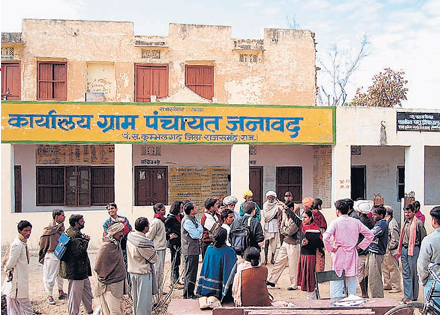
‘One room is not a panchayat ghar. There should be rooms for officials, records, computer operator. We have a scheme to connect all villages through e-governance. The government will give computer facility and connectivity. It will be a powerful method ensuring transparency’
gfiles: Are you building panchayat ghars this year?
ANPS: We plan to build satisfactory panchayat ghars in all panchayats within three to five years. You may have a panchayat ghar in one room, but that should have sufficient accommodation facility. One room is not a panchayat ghar. There should be rooms for officials, records, computer operator. We have a scheme to connect all villages through e-governance. The government will give computer facility and connectivity. It will be a powerful method ensuring transparency.
‘The BRGF philosophy is to mitigate regional disparity. The state government is supposed to pinpoint backwardness when disbursing its funds. Suppose Bihar gets Rs 500 crore a year. Where should this money go, in which village, for what purpose?’
gfiles: This relates to government policy but is there any substantial gain on the ground regarding economic conditions?
ANPS: The BRGF philosophy is to mitigate regional disparity. The state government is supposed to pinpoint backwardness when disbursing its funds. Suppose Bihar gets Rs 500 crore a year. Where should this money go, in which village, for what purpose? The state government has to devise very good norms to see that these funds go to villages or for schemes meant for backward people. One may argue that the funds are not sufficient to mitigate the backwardness.
gfiles: You have launched many schemes – Yuva Khel Abhiyan, Panchayat Youth Abhiyan, Panchayat Mahila Shakti Abhiyan, etc. How much have they achieved?
ANPS: Khel Abhiyan is not a panchayati abhiyan. Panchayat Youth Abhiyan is our programme and it has not taken off. Our focus has been Panchayat Mahila Shakti Abhiyan. We have a scheme to raise consciousness among women representatives, enable them to create a charter of demands, pursue that charter, ensure the training of those women. Somehow we have not succeeded in this. We have proposed modifying the scheme.
gfiles: How does the Government of India visualize villagers’ needs?
ANPS: We have a plan for every need – bijli, sadak, pani, health, education, sanitation, nutrition. The question is, in spite of 50 years of planning, what is the extent of the poverty and deprivation? Until we treat panchayats as three-tier governance and ensure disintegrated participatory planning and pool our resources through panchayats, we won’t be able to achieve our targets in the near future. Panchayats should be given funds and functionaries, then will the dream of every Indian being taken care of be fulfilled – not through the bureaucratic hierarchical efforts.
gfiles: Do you have a social audit system to evaluate your schemes?
ANPS: Two things. Collectors are not monitoring panchayats. In states where the panchayati raj system is weak, the state government has to depend on collectors for implementing their programmes. And, there are many states, including Kerala, Maharashtra and West Bengal, where panchayats are autonomous in their domains.
gfiles: When the panchayat is autonomous, who is the governing agency?
ANPS: In Kerala, there is a provision for an ombudsman. It is up to the state what provision it makes, whether it gives power to the Secretary, Panchayati Raj, the Divisional Commissioner or ombudsman.
gfiles: How do funds reach the village?
ANPS: There are three options. One, being a federal structure, funding goes from the Central to the state consolidated fund. Second, over the years, the states have created a number of special purpose vehicles like state societies, district societies. Funds go directly to them and down the line. Third could be funds going directly to panchayats from the Centre.
The second method is dominant. To my mind, it is not the correct one because states have been diverting the funds. The funds should go to the state consolidated fund and the state should follow financial discipline. Sending funds directly to the panchayats is not feasible. With electronic systems, the states can transfer to panchayats. There will be speed, transparency and monitoring.
gfiles: How much money is required to ameliorate the condition of panchayats?
ANPS: We have a Rs 4,780-crore outlay. Under BRGF, we have Rs 4,670 crore and Rs 110 crore for other schemes put together. It is too little. BRGF is highly process-intensive. Under the guidelines all funds have to make an integrated convergent participatory plan. Consolidation is by the District Planning Committee. It goes to the high-powered committee to be headed by the Chief Secretary. The process lies in preparing the plan of each panchayat. There is delay in releasing the funds.
gfiles: There is talk of reserving 50 per cent seats in panchayats for women. What is the rationale? When will it happen?
ANPS: The President of India said in a speech the women in panchayats are the future leaders. We are bringing the Bill in during the next Parliament session. We have 28 lakh panchayat functionaries. One-third are women, and 80 per cent of women belong to SC/ST. After the Bill is passed, women functionaries will number 14 lakh. The day will come when women will be socially and politically more empowered.
gfiles: What is your model for gram swaraj?
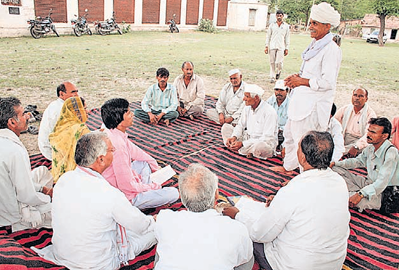
ANPS: My model would be to devolve all 29 functions listed in the Eleventh Schedule and give them funds and functionaries. The issues of vested interests opposing such devolution and of capacities of panchayats have to be addressed. That is our responsibility.
gfiles: What three things do you want to do in this year?
ANPS: Implement e-governance in panchayati raj. Second, accounting systems in panchayats need modernization. Third is training programmes.
gfiles: How long before we will see gram swaraj?
ANPS: If the state governments and Centre decide collectively today, it will be there in five years.
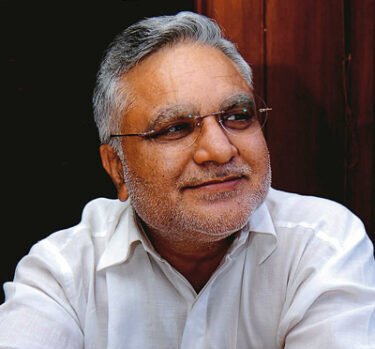
Anil Tyagi is a distinguished Indian journalist. An alumnus of the Delhi School of Economics (M.Com) and the University of Delhi (LL.B), he brings decades of rich experience to journalism. He presently serves as Editor of gfiles.