
























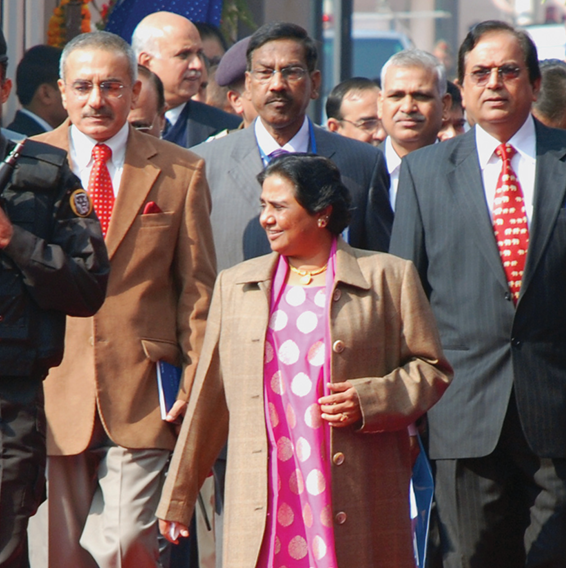

When Mayawati became the first Dalit woman to be Chief Minister of Uttar Pradesh, many people naturally assumed that her ascendancy would prove a boon for both Dalits and women. Two years into her current stint in power, neither category appears to have benefited. In fact, both sections of society languish pitiably in the largest state of the country.
In administration, Mayawati has done precious little to share power with women. Her jumbo ministry includes not a single woman Cabinet minister. Her office on the fifth floor of Lal Bahadur Shastri Bhawan has not a single woman bureaucrat. As far as field postings go, only one woman, Radha S Chauhan, has been made Commissioner in Meerut. And the appointment of Neera Rawat as police chief of Kanpur city recently is the proverbial exception that proves the rule.
The National Human Rights Commission has expressed concern over increasing crime against women in UP. According to the State Crime Records Bureau, cases of eve teasing and molestation have increased 12 times. In the state capital alone, there were over 300 incidents of eve teasing and molestation last year. Worse, the men in khaki were found involved in some cases.
Yet, Mayawati seems to place little faith in her women officers in tackling the problem. The state government recently removed IPS officer Beena Bhookesh as SP, Shahjahanpur without any reason and sent her to the 47th battalion of the Provincial Armed Constabulary (PAC) as a commandant. Shachi Ghildiyal, who was SP, Chandauli, has been brought to Lucknow and assigned an insignificant post. Chandauli had earlier, during a posting in Chitrakoot, built a reputation for taking action against dreaded dacoit Dadua.
In a state with 71 districts, just six women IAS officers hold the post of District Magistrate – K Dhanlakshmi (Farrukkhabad), Kanchan Verma (Balrampur), Anita Meshram (Unnao), Pinki Jovel (Lakhimpur Khiri), Ritu Singala (Jyotiba Fule Nagar), and Aparna U (Jaunpur).
Ministhy Dileep, DM of Mainpuri during the Parliamentary election, stood up to Mulayam Singh Yadav, who contested the seat. She faced his ire for cancelling the arms licences of some SP workers
A seventh woman, Ministhy Dileep, who was DM of Mainpuri during the Parliamentary election, stood up to Samajwadi Party chief Mulayam Singh Yadav, who contested the seat. She faced his ire for cancelling the arms licences of some SP workers. Mulayam reportedly said, “Since you are a woman, I am restraining myself…had you not been a woman, you would have faced the consequences. You should know that I am contesting the election here.” Dileep sent a report along with a CD containing video footage of Mulayam’s speech to the state election office, which in turn passed it on to the Election Commission in New Delhi. Mulayam was forced to deny his remarks in Lucknow to avoid controversy.
In her short bureaucratic career of about six years, Dileep has emerged as a tough officer and symbol of women’s empowerment. An engineer by education, the Keralite officer joined the IAS’ UP cadre in 2003. Her action boosted the morale of young bureaucrats facing challenging situations in the state. However, after the election, she was removed from the post. She is now Special Secretary in the Agriculture Production Commissioner’s office.
In general, UP’s women bureaucrats are far from comfortable under the Mayawati regime and are opting for deputation to the Government of India. About two dozen are currently on deputation. The prominent ones include Rita Sinha (1973 batch), Dr Rita Sharma (1974), Rita Menon and Jayati Chandra (both 1975), Loretta Mary Vas (1977), Stuti Narayan Kacker (1978), Johra Chatterji (1979), Aradhana Johri (1980), Anita Bhatnagar Jain and Shalini Prasad (both 1985), Renuka Kumar and Leena Nandan (both 1987), Juthika Patankar (1988), Monica Sehgal Garg and Dimple Verma (both 1989), Kalpana Awasthi (1990), Nivedita Shukla Verma (1991), V Helali Zhimomi (1996), and Neena Sharma (1998).
More senior women IAS officers like Sunanda Prasad (1974), Veena Upadhyaya (1976), Neeta Chaudhary (1977), and Vrinda Swaroop (1981) are virtually sidelined. Chaudhary was earlier Principal Secretary, Health and was such a tough boss that she earned the nickname of “Don” in her department. She introduced several reforms in the health sector. She had headed the department in the Mulayam government as well until then Health Minister Vinod Pandit complained to the CM that “Madam does not listen to me”. She was then sent to the Planning Programme Implementation department. Swaroop recently returned from deputation and has been given charge of the significant Technical & Vocational Education department in an unexpected move by the Mayawati government.
But the vast majority of women officers continue to find themselves on the fringes of the establishment. A year ago, Archana Agrawal (1990) was dealing with the all-important Public-Private Partnership (PPP) Projects besides other significant industrial sectors. However, it did not last. The disappointed officer is now on long leave.
During the tenures of Mulayam, Rajnath Singh, Ram Prakash Gupta and Kalyan Singh, six to 10 women officers had served on field duty. Under Mulayam, Anita Singh was appointed Secretary to the CM and Aradhana Shukla was made DM of Lucknow. In contrast, under a woman Chief Minister, they are largely isolated.
Women officers point out that there seems to be an element of distrust towards them on the part of the CM. A senior official concedes that Mayawati harbours a belief that women bureaucrats are less hardworking
Unwilling to come on record, disgruntled women officers point out that there seems to be an element of distrust towards them on the part of the Chief Minister. A senior official attached to the Chief Minister’s Secretariat concedes that Mayawati harbours a belief that women bureaucrats are less hardworking. While some officials do feel that women officers try to avoid field postings, by and large the women’s brigade is resentful of their present assignments and points out that field exposure is vital at crucial junctures in an officer’s career. This section is being hit hard professionally by the Chief Minister’s misgivings.