























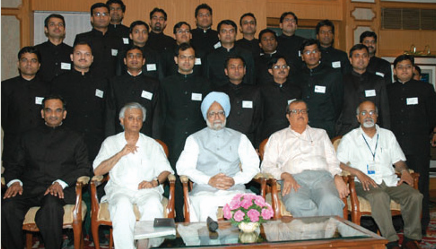
I have many things to say to you. Some of them may not be very nice to hear, some of them are in fact a cry of anguish and despair of our countrymen at the miserable quality of governance your peers and predecessors have given them. But I also speak with a sense of hope because I share the belief with the rest of our countrymen that for all the degeneration of our public life and morals, for all the exposes about corruption scams, for all the painful images of RK Sharmas and Subhash Sharmas and Anurag Vardhans being produced in court, your institution still represents our collective hopes for a better and fairer future.
One of the most conscious choices the Founding Fathers made while deliberating on the Constitution of India was to retain the Civil Services of the Raj in their entirety. The debates of the Constituent Assembly in this regard were passionately argued on both sides.
The detractors argued that with their colonial ethos and autocratic mindset, the Civil Services were unsuited to serving the needs of a democratic, independent India. The proponents, including Pandit Nehru and Sardar Patel, argued that a lifetime spent in the freedom struggle had left their generation ill-equipped to manage the nuances of everyday governance. They believed that with their discipline, dedication and sense of esprit de corps, the Civil Services would rapidly rise to the challenge and continue to provide a steel frame to hold together an otherwise fissiparous idea of India. To underline this faith they introduced Article 311, literally an article of faith in human virtue over greed, faith in a sense of public service over private gain, and faith in moral and intellectual integrity over weak and decadent character. Fifty-six years is perhaps enough time to test the validity of this extravagant faith.
One begins to understand the reasons why the Founding Fathers took that leap of faith in preserving the Civil Service. What they could not of course foresee is that they thought they had placed their faith in an institution whereas in fact they had placed their faith on the warrior-scholars of a particular generation born and bred of a specific historical legacy and social sensibility that would wither away before the onslaught of the released energies of a demanding and partially democratic India. The very Constitutional protections that were provided to guarantee the moral and intellectual resilience of the steel frame would be suborned by impatient successors to drive a devil’s bargain with their counterparts in the political and business class. It could not be otherwise. In a poverty-stricken independent India, shackled by ideology, protected by government jobs with low demands of accountability and efficiency, and high returns from dowry and loot, the Services were bound to attract men of high intelligence and higher aspirations.
Ambitious men, who inherited a tradition of vision, hard work and meticulous scholarship and replaced it with their own brand of low cunning and lower morals, who treated the powers granted to philosopher kings with the base instincts of petty thieves and conmen.
The manners and courtesies of that era have long gone and have been replaced by the civility of the robber and the grace of the thief. Men who will exercise their mind for private gain at the public expense now succeed men who produced remarkable works of scholarship. Because they passed the most difficult exam in the country, they must now have the licence to loot and ravage the public exchequer. The perpetuation of the privileges and powers of the Civil Services was an act of profound faith at the time of Independence. Their continuation in the face of non-performance, incompetence, corruption and acts of outright criminality is possibly the most profound betrayal of the ideals of our Republic. The challenge on your generation is therefore, much the greater. Not only do you have to prove yourself, but in an era of globalization and liberalization, where the very rationale of government is being questioned by sceptical voters and taxpayers, you have to restore our collective faith in the instruments of governance and government. So when, a few years down the line, you are tempted with your first bribe, when you are offered that astronomical amount for dowry or when you are simply asked to look the other way while some irregularity is being committed, pause for a moment and reflect that what you would sell if you were to succumb would not just be your individual soul and conscience but also the collective hopes of a nation. Many of you would, alas, be prepared to pay that price, but I do hope for all our sakes that a courageous few amongst you would dare to be different.
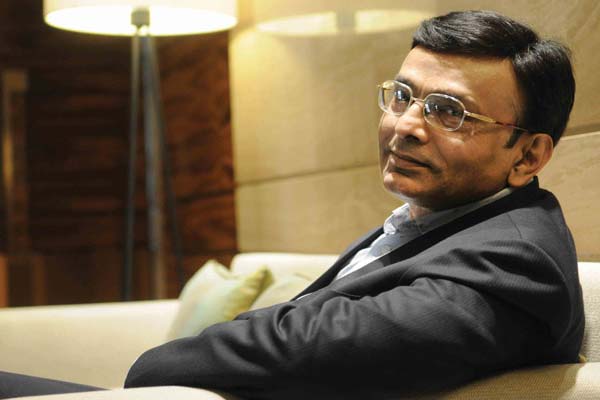
Excerpted from an address by Governor Sudarshan Agarwal at the valedictory function of IAS Probationers
‘When, a few years down the line, you are tempted with your first bribe, when you are offered that astronomical amount for dowry or when you are simply asked to look the other way while some irregularity is being committed, pause for a moment and reflect that what you would sell if you were to succumb would not just be your individual soul and conscience but also the collective hopes of a nation’