





























Registering agents without singling out defence purchases is a likely solution
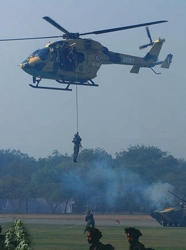
The recent cancellation of the Eurocopter deal due to the alleged presence of agents adds another chapter to India’s long list of aborted procurement proposals. The government remains tied up in knots of its own making while the Armed Forces remain starved of newer and safer equipment. Cheetah and Chetak helicopters, the major workhorses of the Army Aviation Corps, are the lifeline to remote and inaccessible areas of the Himalaya. Both are vintage machines and need immediate replacement.
It is an accepted fact that agents are ubiquitous in all international trade transactions. All government departments have been regularly dealing through agents without any apparent problems. Their functioning has been duly regulated and the agents have been receiving their legitimate commissions. But it is the role of agents in defence deals that has attracted much media attention of late and the Indian intelligentsia resents their presence. The Ministry of Defence (MoD) recognizes that agents cannot be wished away but considers it politically inexpedient to accept their need or acknowledge their presence. The dilemma is acute as all earlier efforts to deal with the issue have proved futile.
The role of agents in import transactions was first taken up for study by the Public Accounts Committee in 1974-75. As a follow-up of its recommendations, directions were issued by the Department of Supply in July 1976. Subsequently, exhaustive policy guidelines, titled “Indian Agents of Foreign Suppliers – Policy on”, were disseminated by the Ministry of Finance (Department of Expenditure) in January 1989. As these instructions were primarily applicable to civil imports, the MoD issued supplementary instructions in respect of defence purchases in April 76. However, due to a spate of allegations regarding the role of agents, they were proscribed in early 2001 to take a fresh look at the entire issue. Advice was sought from a number of agencies including the Central Vigilance Commission (CVC). The CVC strongly recommended that defence agents be officially registered for transparency and probity.
The MoD accepted the CVC recommendations and issued a fresh policy directive in November 2001. It allowed employment of agents, albeit with provisions which many consider too stringent and intrusive to be realistic. Information required to be submitted by a foreign vendor spans the complete gamut of an agent’s past business activities, current professional dealings and financial profile. Even details of his Indian and foreign bankers have to be intimated. Additionally, the agent has to be acceptable to the MoD and paid commission as per the official policy. Whereas the policy guidelines issued by the Finance Ministry in April 1989 aimed at conserving precious foreign exchange and preventing evasion of tax, the MoD instructions were totally directed towards scrutinizing past records of agents and regulating their conduct. The agents were resentful that the tone and tenor of instructions painted them as unscrupulous and scheming characters.
As was feared by many sceptics, not a single agent came forward for registration as they did not want to lose their shield of anonymity. They felt that the details sought transgressed professional privacy and infringed upon economic confidentiality. Agents were also apprehensive that the information could be used by different government agencies to harass them by opening old cases. They were also worried that public knowledge of their dealings would make them vulnerable to extortion demands, both from the political parties and the underworld. Most important, they feared that the prevailing trend of probing all defence deals negotiated by the previous regime would unnecessarily drag them into vengeful inquisitions and protracted court cases.
Without repealing the government orders on the registration of agents, the new defence procurement procedure has effectively reversed the policy and banned the use of agents. Every foreign seller is specifically forbidden to appoint agents and pay any commission. He has to assure access to his account books in case the government suspects a breach of undertaking.
Interestingly, most government functionaries concede that agents render invaluable service by performing the following functions:
◗ They act as an interface between the MoD, the services and the vendors. They help resolve irksome issues that crop up during protracted contractual discussions and pave the way for negotiating a mutually acceptable contract.
◗ Since agents have permanency of interest, they ensure responsive after-sales support during performance and warranty periods, and even thereafter.
◗ During field trials over varying terrain and climatic conditions, agents provide assistance to foreign vendors to import, maintain, transport and position their equipment as per the trial schedule.
◗ Offsets have been made mandatory for all defence contracts over Rs 300 crore. A foreign vendor has to take the help of local agents who are conversant with available opportunities to identify suitable offset fields and local partners for the purpose.
◗ As the government has permitted Foreign Direct Investment in the defence sector up to 26 per cent, all prospective investors need local agents to advise them about industries with envisioned prospects.
◗ The services often seek inputs from agents as regards the latest equipment available in the world market and their indicative costs. It helps them formulate pragmatic qualitative parameters and make budgetary projections.
Prime Minister Manmohan Singh, while returning from Helsinki on October 14,2006,stated in response to a question, “The assumption that one can do without agents, I think, needs some reappraisal.” He further suggested, “If no alternative to middlemen was possible, it might be worth considering whether such agents could be either registered or a mechanism devised so that their functioning becomes apparent to the authorities. ”However, the dilemma for the government is complex. Understandably, it wants to tread warily in this highly politicized and sensitive matter. It knows that agents are integral to world trade and will continue to thrive under all circumstances. Outlawing them will not result in their elimination, but will force them to function in a covert and clandestine manner. Therefore, it is so much more prudent to accept their presence and regulate their functioning, thereby imparting much needed transparency to the whole process. It will also ensure that commissions are paid in Indian currency and duly subjected to taxation.
Defence agents are in business to make money. Just because they promote their principals’ products to earn commissions does not make them unethical and ignoble. The MoD must change its attitude towards agents to draw maximum benefit from their presence, rather than shunning them and forcing them to go underground. To state that agents can corrupt officials shows a total lack of confidence in the integrity of government functionaries. It amounts to a tacit admission that all officials dealing with defence procurement are predisposed to corruption and hence must be kept away from temptations offered by agents. It is certainly not a fair portrayal of all procurement functionaries. Most are highly upright, conscientious and diligent officers. In any case, the government cannot forbid agents just because it is distrustful of its own functionaries. It is for the government to find functionaries whose integrity is beyond reproach and who can resist all enticements.
Just because agents promote their principals’ products to earn commissions does not make them unethical and ignoble. The MoD must change its attitude towards agents to draw maximum benefit
An ideal way out of the current quandary would be to register defence agents as per the procedure followed by other government departments. There is no need to single out defence procurements. The monitoring mechanism can be further strengthened and the functioning of agents regulated to enhance transparency and eliminate unscrupulous dealings. The government must adopt a long-term policy to convince the environment of its earnestness and instil confidence. There should be no knee-jerk reaction to every allegation that appears in the press. Frequent changes in policy act as the biggest deterrent for overt and legitimate functioning of defence agents.