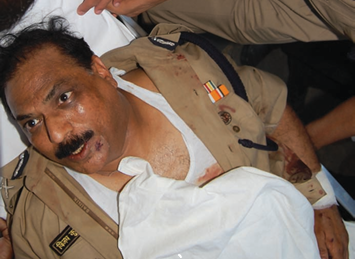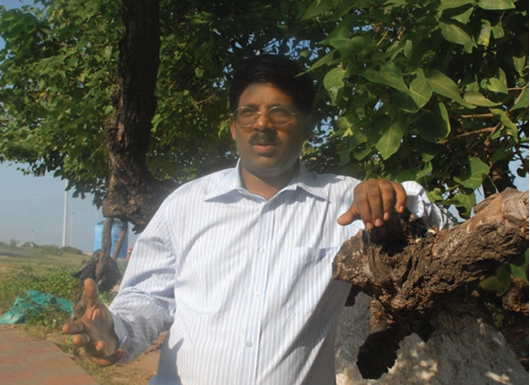





















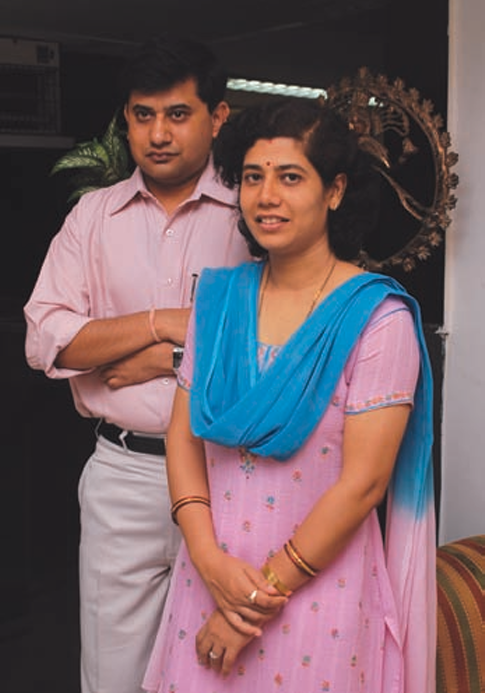
The missionary zeal of Kamal Kishore Soan and Aradhana Patnaik, both 1998-batch IAS officers, is bringing about a sea-change in the lives of poor tribals in Jharkhand’s worst Naxal-infested districts. The husband-wife duo, travelling to remote tribal villages in their respective districts without security cover, is over whelmed by the warm response from villagers: “It’s honesty of purpose, mutual trust and commitment to develop the socio-economic status of the tribals that keeps us safe in their hands. In fact, they provide us human shields.”
Soan, Deputy Commissioner of Ranchi, has started a help line to remain in touch with the masses. Prime Minister Manmohan Singh’s ambitious programme under the National Rural Employment Guarantee Act (NREGA) got off the ground in Ranchi district on February 2, 2006. “Ranchi was not covered under the National Food For Work Programme and therefore lacked awareness. But we took up the challenge, starting from scratch, and worked hard to formulate and execute the NREGA,” says Soan.
The job cards of wage earners issued by gram sabhas under NREGA carries the mobile phone numbers of Soan as
well as all other relevant officers down the line. Besides, the administration can now be contacted via sms to ensure that, if a particular phone is switched off, the message reaches the officer later. Soan himself attends to the people’s grievances every day between 6 and 8 pm. “Once a daily wage earner called and asked me about the statutory minimum wage so that he could assert his right before his exploitative employer,” he says Soan’s initiative has resulted in a quantum jump in job card holders from 60,000 families in September 2006 to over 2,55,000 in June 2007 under NREGA with more than 5,00,000 persons having been registered.
There was concern that, in the absence of Panchayati Raj institutions, the role of the gram sabha would be insignificant and NREGA implementation would suffer. The optimistic officer saw a silver lining in this dismal scenario and turned gram sabhas into vibrant democratic institutions by assigning them crucial responsibilities. They have also been given a key role in selection of anganwadi workers and teachers under the Sarva Shiksha Abhiyan.
In Lohardaga,another tribal district,a silent revolution is brewing in the poultry and dairy cooperatives.The archi tect is Patnaik, the dynamic Deputy Commissioner of Gumla.Lohardaga’s economy is based on subsistence agri culture. But dependence on the weather god makes agri culture production erratic. Patnaik, during an earlier stint in Lohardaga from 2004 to 2006, realised that the rural poor needed a self-sustaining project. She decided to start self-help groups in the poultry and dairy sectors Studies revealed that the capital of Jharkhand, Ranchi, has a huge market for poultry.About 20 tons of live birds are sold in the city daily but only 5 tons come from the sur rounding areas.The shortfall is filled by supply from neighbouring states. PRADAN, a local NGO, was engaged to set up poultry cooperatives – initially in Kuru block of the district. The first venture, the Lohardaga Grameen Poultry Cooperative Society, was formed in November 2002 with 160 members.The state government provided Rs 28.35 lakh to the cooperative.
Encouraged by the cooperative’s success and the huge demand from villagers, the district administration led by Patnaik then decided to take up poultry farming on a large scale – 400 units were set up in 2004-05 and another 400 in 2005-06. The funding came primarily from the Rashtriya Sam Vikas Yojana (RSVY), bank loans and members’ contributions. To sustain the poultry cooperative and reduce production costs, the administration constructed a feed plant and hatchery with a capacity for 3 lakh chicks per month.Arrangements were also made for training under RSVY and to fight the bird flu menace The cooperative members include women from Scheduled Castes and Tribes belonging to different self-help groups. “The poultry cooperatives have become self-sustainable, have empowered women, reduced migra tion, created social binding and a sense of collective own ership among the women,”says Patnaik.
At present, there are 861 farmers (all women) and the cooperative has an annual turnover of Rs 653 lakh with the average monthly income per member having gone up by Rs 2,000 to Rs 2,500. The officer has also encouraged women’s self-help groups to form milk cooperatives.After two years of rigor ous effort, the under-utilized milk chilling and pasteuriz ing plant known as Shankhdhara, which was procuring only 1,500 -2,000 litres per day (LPD) against its capacity of 10,000, is now getting 5,000 LPD from milk coopera tives and will be able to run at its full capacity soon