






















Delhi’s burgeoning population of cars needs stringent measures to facilitate traffic movement, parking, and curbing of accidents
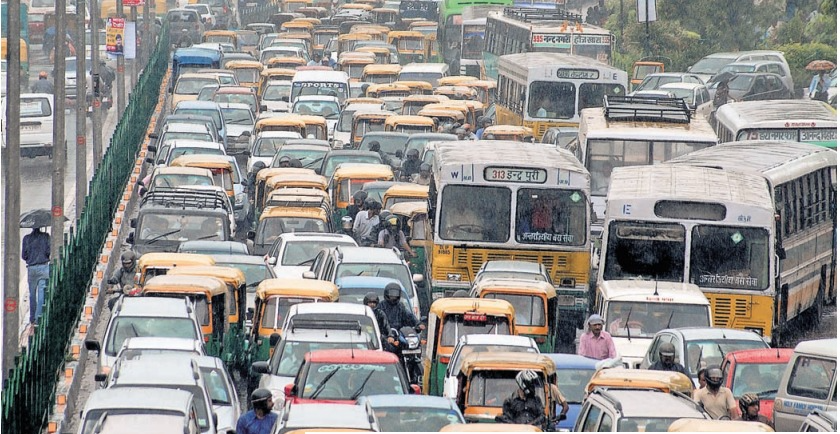
Delhi has 5.6 million vehicles on its 1,122 km (as of 2001) of roads, which occupy 21 per cent of its landmass. Of these, 1.8 to 2 million are four-wheelers. The number of vehicles in Delhi is much more than the combined vehicle population of Kolkata, Mumbai and Chennai. Some of the roads are eight-laned and there are several flyovers or underbridges, overbridges and bypasses and clover leaves – built over the past 30 years to facilitate and accelerate movement.
The total length of the roads is expected to go up to1,340 km by 2021. Delhi’s population, which was 12.79 million in 2001, is expected to reach 23 million by 2021. Buses will increase by two-and-a-half times while cars will increase three times. Delhi adds 2,00,000 personalized motorized vehicles every year. Thus, while the roads will increase marginally (and there is a limit up to which they can increase!) the population will more than double and the number of vehicles will grow even faster.
How then can Delhi roads cope with this massive hike in the automobile population?
The Metro rail will surely take away part of the burden but it grows slowly and at heavy costs and one has seen how much resistance there is from various lobbies to its free expansion. Environmentalists, status-quoists and the so-called preservationists raise objections and the projects get delayed. It must be acknowledged with gratitude on behalf of Delhiites that the Metro has grown fairly quickly despite all the hurdles and has become one of the most frequented modes of transport in Delhi. But very few, if any, have given up use of their personal transport in favour of the Metro.
Other modes are being explored, examined and are “under consideration” for years. Decisions on them are not taken quickly because there are so many authorities and so many lobbies involved and any one of them is enough to halt or delay the project. I remember that a presentation for the Sky Rail was made way back in 2001 but it still remains “under examination”. Another scheme by a private automotive multinational which offered to run 10,000 air-conditioned buses, replacing them gradually over every four years, was stalled on condition that fares will be fixed by the government and would have to be competitive with those of the Delhi Transport Corporation. Bus Rapid Transport (BRT), a hair-brained scheme from the beginning, with all the heavy costs involved, is hardly a solution for a city the size of Delhi.
Also, let us not forget that Delhi has a multitude of transport modes. Buses, trucks (although they are not supposed to enter Delhi during peak hours, according to a Supreme Court order), light heavy vehicles, cars, taxis, phut phuts, three-wheeler scooter rickshaws, two-wheeler scooters and motorcycles (almost no traffic rules apply to them and they can overtake you from left, right or wherever), bicycles and tongas, not to overlook the herds of cattle that may suddenly emerge on the road from nowhere. Compared to other metropolitan cities, Delhiites are given to ignoring traffic rules with far greater nonchalance. All this complicates an already messy problem.
The number of accidents and fatalities on Delhi roads is already something to worry about and, despite the harsh intervention of the courts, there is no improvement. There are just too many vehicles on the roads and too many traffic jams. Most people have time schedules and/or deadlines to meet. Everybody tries to get ahead and accidents are a natural consequence. If the number of vehicles continues to grow, accidents will only increase. No wonder road rage cases are multiplying.
Ad hoc steps like starting of new transport schemes, checking drunken driving for a few days, enforcing more traffic discipline, or putting red lights at crossings with the word “RELAX” are no solutions, only publicity stunts. These in any case have to be made a regular feature of our traffic work. But some drastic steps are required immediately:
• We cannot restrict the inflow of population to Delhi but we can certainly restrict the addition of vehicles. This is done in many countries, notably Singapore. In Delhi also, while the first car for a family (and family should be suitably and restrictively defined) should be taxed at normal rates, the second car should be taxed at prohibitive rates. One family in my colony, living in one house, has 14 cars, most of them parked outside. Why does each member of the family need a separate car, which is almost always parked on public space?
• All car-owning houses, by and large, have or are supposed to have parking spaces within their compound. Yet almost all colony roads are choked with cars parked on the roadside. All cars parked outside the houses on municipal land should be required to pay a parking fee. This, even at the moderate rate of Rs 100 per car per month, would bring a huge income to the MCD. An estimated 1.15 million cars exist in Delhi. Even if half the number of cars are parked on the roadside, an estimated revenue of Rs 69 crore per annum would accrue.
• Building plans of any construction, commercial or residential, should be rejected if a sufficient number of parking spaces are not provided for vehicles. Those constructions where such spaces are not available should either be forced to create such spaces or should be compelled to pay heavily for using municipal space.
• Rates of parking in municipal sites should be steeply revised and enforced. In Hong Kong, people pay HK$15 per hour (about Rs 90) for using such a facility. In Delhi, people pay Rs 10 for unlimited parking time. I know of people who leave their cars at the railway station for days and go out of station. At the airports, we pay Rs 130.
• To bring symmetry and a system to running of buses, two or three large operators should be invited to run the buses, replace them on a regular basis and charge market-competitive fares. Delhi Transport Corporation could be allowed to continue its services with only its own buses and charge whatever rates. The experience of charter buses has shown that people are willing to pay more for convenience. Blue Lines, and other Lines, should be abolished. The number of buses, according to a 2004 estimate, was 53,000 and this should be gradually brought down instead of being allowed to go up.
• If the New Delhi Municipal Corporation could ban cycle rickshaws and tongas, why can’t it be done in all of Delhi? The question of providing them alternate employment should be examined simultaneously.
• Instead of providing a separate corridor for High Capacity Buses (BRT), planning should be done for a separate corridor for cyclists. This will cause much less expense and confusion. Users of cycles on a regular basis remain numerous and this step will only encourage the use of this environmentally friendly mode of transport.
• The Metro Rail should be encouraged and provided all necessary clearances to expand rapidly and a high-level fully-empowered group should remove all hurdles in its way.
• The encroachments on Delhi roads should be removed with a heavy hand. Traffic movement on even wide roads is restricted because substantial parts of the roads are encroached upon by vendors, shopkeepers and illegal parking.
(The writer is a former Chief Secretary of the Delhi government)
A scheme by a private automotive multinational which offered to run 10,000 air-conditioned buses…was stalled on condition that fares will be fixed by the government
Everybody tries to get ahead and accidents are a natural consequence. If the number of vehicles continues to grow, accidents will only increase. No wonder road rage cases are multiplying


