














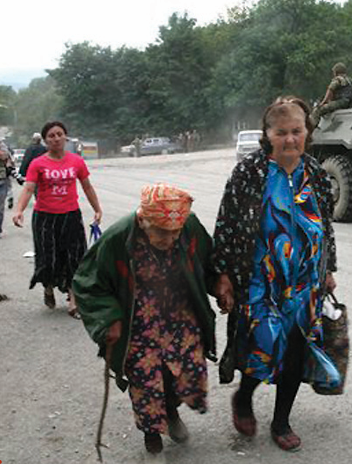
Not much is known about Georgia in our part of the world except perhaps that Stalin came from there. It is located on the eastern side of the Black Sea and has Russia to its north, Azerbaijan to its east, Armenia to its south and Turkey to its southwest. Measuring 69,700 sq km and with a population of 4.4 million, not counting the two breakaway regions, it is largely mountainous with the two Caucasian ranges passing through its territories. It considers itself part of both Asia and Europe. It is a member of the Asian Development Bank and has been working to become a member of the European Union (EU) and NATO. There are two important pipelines running through the country, an oil pipeline known as the BTC or Baku (Azerbaijan)-Tbilisi-Ceyhan (Turkey) pipeline and a parallel gas pipeline. Georgia also plans to develop its harbours to become a transportation hub for oil and gas from the hinterland. The economy wasn’t doing well till aid from the EU and the US arrived.
One of the three Caucasian Republics, Georgia is known as an ethnic and religious maze which in modern times lost its independence when its last king gave it to the Russian Tsar in 1800. It was governed by Russian proconsuls until 1917 when it became independent with some help from British troops. It was reconquered by the Soviet Union.
It declared independence once more in 1989 after a failed upheaval in 1972. Eduard Shevardnadze came from Moscow to become President and was re-elected in 1995. He joined the Commonwealth of Independent States and conceded to the Russians the right to keep forces in Georgia and help train its army. Elements unhappy with his policy of close ties with Russia and seeking instead close ties with the US and EU agitated against him. On November 23, 2003, in what is described as the bloodless Rose revolution, Shevardnadze was made to resign and the current President, Mikheil Saakashvili, was elected on January 4 , 2004. Saakashvili has studied in the US, has a Dutch wife and advocates membership of EU and NATO. He decided to strengthen Georgia’s army, get US trainers and start the process of joining NATO. He also sent troops to Iraq to serve with the American troops. Internally, it has not been smooth sailing. In 2007, there were protests and he had to declare an Emergency. The President resisted calls for his resignation and instead brought forward the next elections, cutting short his term by a year. He was re-elected in January 2008.
The Russian military action seems to
have sent a strong message to other former
Soviet republics. It has clearly prompted
Poland to finalize its missile agreement
with the US. It has also brought together
several of the East and North European
former Soviet republics
There are two autonomous regions on the borders of Russia and Georgia –Abkhazia and Southern Ossetia, the latter also known as the Tshinvali region.The third autonomous region is on the Turkish border but has been brought under Georgian control. It is in the first two that Georgia has been facing discontent and rebellion. There was a war in Abkhazia in 1992-93 when about 200,000 Georgians were killed or chased away – making Abkhazia a de facto state. In Southern Ossetia (Northern Ossetia being in Russia), there are many Russians – both as residents and as peacekeepers between Georgians and the locals. Georgians claim the Russians are encouraging them to break away while the Russians claim that the Georgians have been killing the locals and the peacekeepers.
In July 2008, the Ossetia militia and Georgian armed forces clashed – leading to a fullfledged attack by Georgian forces. Russia claimed that 1,600 Ossetians were killed. On August 8, Russian troops supported by air power entered South Ossetia in support of Ossetians and those described as Russian peacekeepers already stationed there. They went into Georgia to about 30 km from the capital. Georgia left the CIS on August 14.
The Georgian President sought help from the West. President Nicholas Sarkozy of France flew to Moscow and negotiated a ceasefire. Georgian troops withdrew and the Russians agreed to withdraw once the area is secure. US Secretary of State Condoleezza Rice visited Georgia, promised humanitarian assistance and called for a peaceful solution. US President George Bush criticized Russian intrusion and said that the territorial integrity of Georgia was non-negotiable but added that differences have to be resolved peacefully.
At present it seems that neither Europe nor the US are interested in a physical confrontation nor in any revival of the Cold War despite pressures from some quarters who would like to punish Russia for attacking an independent democratic state. However, both Russia and the West need each other and the former is being gradually brought into the global system. Therefore it is likely that, while noises will be made especially since this is election year in the US, matters will hardly go beyond that. A slight chill may develop between the two resulting in atmospherics over some issues like the Olympics but cooperation on terrorism, nuclear proliferation and economics is too valuable for relations to get seriously affected. Georgia will have to talk with Russia either directly or/and under the auspices of the UN /EU about the two breakaway regions. Russia seems determined that they should remain separate from Georgia and seek their own future. Pressure will grow on Russia to withdraw early from Georgia. What form these pressures will take and how Russia handles them is to be seen.
Georgia has been described as an East-West faultline like Serbia and is perhaps more important because of its proximity to Russia and the two pipelines which pass through it. It is possible these pipelines could ensure peace as any disruption could prove very expensive for all concerned.
The Russian military action seems to have sent a strong message to other former Soviet republics. It has clearly prompted Poland to finalize its missile agreement with the US. It has also brought together several of the East and North European former Soviet republics who have been trying to strengthen ties with the West in the face of opposition and suspicion from Russia. Russia has made its point to Georgia, but it will now need to use diplomacy. There is talk of international peacekeepers.
As for Georgia, it has been part of the Persian, Ottoman, Russian and later the Soviet empires. It now wants to be part of the Western empire. Such changes, history indicates, are rarely peaceful unless gradual.