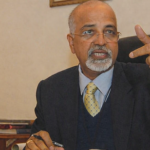


















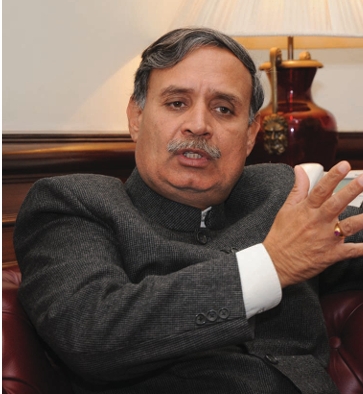
Minister of State for Defence Production Rao Inderjit Singh was formerly Minister of State for Foreign Affairs and has been a successful lawyer, agriculturalist and sportsman. He spoke candidly to gfiles about a wide range of issues concerning governance of the Indian defence system.
gfiles: Do you think the Indian Army needs to opt for conscription to meet the present shortage of officers?
Rao Inderjit Singh: I do not want to comment on an individual opinion. We must not forget that we are running a professional Army wherein a soldier is employed for 15 years while an officer can put in as much as 30 years of service. If we were to open the doors, there is no shortage of people. The problem primarily is that we do not wish to lower our qualitative standards. Our Army has always led from the front. If we look at the number of officers and jawans who have died in the 1965, 1971, 1999 conflict or against terrorism, our officer casualty is among the highest in the world.
Today, unfortunately, everything has become money-driven. Time honoured values of honour, dignity and tradition no longer count for much among youngsters. The only language they seem to understand is money and how much they have in their bank account. Joining the Army is not about owning a substantive bank account; it’s about leading a certain kind of life, showing commitment to certain values which, I believe, form the foundation of our lives. There is no doubt that, historically, those who joined the Army generally came from families who possessed substantial land holdings. That income supplemented their salaries. Today, land holdings have shrunk and families can no longer depend on an additional income from the soil.
The Army is trying to redress this situation. The greatest shortage of officers is at present being faced by the Indian Air Force. Today, IAF officers are allowed to put in their papers after having served for 25 years. We are now working to create a situation where they can fly for the first two years of their career. This will satisfy their urge to fly — after all there is a great thrill attached to this job. They can then revert to doing other duties and will be allowed to retire after 15 years of service. This will help remove the feeling of “I’m stuck for life”.
Another of our initiatives is to start services. more than one Sainik school in every state. This will ensure that more students join the Armed Forces. We have also stressed the need to substantially increase salaries to the Sixth Pay Commission. For the first time, the Forces have made representations directly before the Pay Commission, unlike earlier, when the bureaucracy spoke on behalf of the services. The Armed Forces personnel alone know what kind of odds they have to struggle against. Look at our naval personnel who live in submarines for weeks on end. Conditions there are both claustrophic and cramped. In the same way, look at the difficult circumstances under which jawans have to survive in places like the Siachen Glacier. The situation has worsened over the years. Earlier, the Armed Forces were expected to deal with incursions but today they have to deal with insurgency both in the Northeast and in J&K.
gfiles: Isn’t that a source of worry for you? The fact that the Indian Army has been bleeding all these years.
RIS: Of course it is a source of worry. But this is something that the political establishment needs to be concerned about. Every time the Army has stood to gain on some front, the political establishment has forced it to give it up. Despite the fact that the Army has been bleeding for the last 20 years, we continue to remain one of the greatest armies in the world. Look at the feedback we have received from all the recent exercises we have conducted with other armies and navies. Recently, there have been joint exercises with the navies of France and Russia. Our Navy is as good as theirs both in terms of manpower and equipment use. We have received the same feedback about our Army. The problem with defence is that it is one ministry with which politicians are constantly playing politics. The Defence Ministry is used as a springboard to achieve power. Defence scams are used as springboards to elect people to power. The last government did that with the Bofors scam. In all this politics, defence preparedness suffers.
gfiles: One of the biggest defence deals, the Eurocopter deal, was cancelled recently. What do you have to say about that?
RIS: The cancellation has proved a huge setback for the Army. The Army is perforce going to continue using the Chetak and Cheetah helicopters which are 35 years old. These are based on Russian technology devised during World War II. This is not the only deal we have had to cancel. We have cancelled technological tie-ups with several other countries. Our defence purchase policy states very clearly that agents cannot be involved in defence deals. If they are, the CBI and CVC will get after us. And because these deals have been cancelled, huge funds remain unspent. When this happens, the Ministry of Finance gets after us. At one point, the Defence Minister was so upset that he asked them to negotiate deals on our behalf. Of course, they declined.
gfiles: Aren’t you being unrealistic in insisting that no agents be involved in defence deals?
RIS: Experience tells us that it is impossible to sign a defence deal without involving an agent. There are so many nitty gritty details involved. It was with this aspect in mind that the Defence Procurement Procedures manual was amended in 2006. I believe we need to amend and update this manual again in 2008. The Prime Minister has also questioned our present policy of not involving middle men. In 2000-01, the Defence Ministry had asked for applications from middle men. The idea was to regularize this whole process. The Ministry received hundreds of applications but no decision was taken regarding their registration. There is a debate raging within the UPA about reviving this whole process. They cannot be banned. By implication, they need to be involved but soliciting is something over which we have a great deal of concern. Soliciting on behalf of a company is prohibited.
gfiles: I understand that huge defence contracts are on the anvil.
RIS: The multi-role combat aircraft (MRCA) deal is one such deal. By the time it goes through, it will cost us over Rs 44,000 crore. We expect the aircraft to start reaching us in the next 8-10 years. This deal also involves technology transfer and HAL will be building this aircraft. It will take 22 years for us to both buy and build these 124 planes. My experience tells me that by the time the last planes come in, they will be completely redundant. This is because technology changes every five years. Instead of buying 124 jets at one go, it would have been wiser to order 30 jets at a time and then opted to buy the newer versions.
gfiles: Why wasn’t it done that way?
RIS: A defence deal is a very complex affair. Many factors play in these deals. Defence production and technology transfer plays a pivotal role. A certain amount of value addition is being done by HAL. They have to ensure the offset policy does not flounder. The Defence Offset Felicitation Agency is also actively involved in assessing these projects.
gfiles: Are you happy with HAL’s performance? Do you see greater private-public partnership in the future?
RIS: We have identified 41 factories from the private sector. These will go under the title of Raksha Udyog Ratnas and will have an equity of around Rs 1000 crore. These companies will be involved with defence production and will assume the role of system integrators of large weapon systems and also produce various weapon platforms required by the Armed Forces. In India, unfortunately, technology has flown from the top downwards. Most other countries follow the reverse process. Across the world, the R&D prepare the prototype and then it is manufactured by two or three companies. Here, the opposite takes place. The technology is first prepared and then passed on to be manufactured. I believe it is not the government’s responsibility to transfer technology. The world has opened up. We should now accept middle level technology from the best provider and allow DRDO to produce very specialized products.
gfiles: There have been a lot of cost over-runs with the Gorshkov submarine.
RIS: The Gorshkov submarine was first sold to us for $700 million. Now the amount has gone up three times to $1.2 billion. This is not acceptable to the Navy and they are negotiating.
gfiles: In the West, a great deal of defence research is being done in universities
RIS: We are also moving in that direction. Having just one monolithic research agency means its keenness has been lost. We have begun working with the private sector. We have involved Jambeshwar University in Hissar for the Nano project. We are considering other universities but I would like to point out that no one wants to give up his turf.
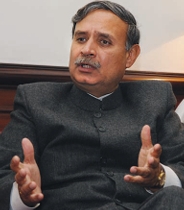
‘The Defence Ministry had asked for applications from middle men. The idea was to regularize this whole process. The Ministry received hundreds of applications but no decision was taken regarding registration’
gfiles: What about the anti-missile system that is being worked upon?
RIS: We are working to develop a strong anti-missile system which will neutralize enemy missiles. Missile technology acts as a strong deterrent. The Agni I range, for example, is 3000 km.
gfiles: Are you concerned about developments in Pakistan?
RIS: It is a matter of concern. Experience has taught us that whenever they have domestic problems, they try and divert the attention of their people by stepping up terrorist activity in India. We are living in a difficult neighbourhood, whether it be Bangladesh, Nepal, Sri Lanka or even China.
gfiles: What about the stepping-up of incursions by the Chinese Army?
RIS: The problem is that the British used the McMahon line to create a watershed between the two countries. Both nations interpret this line in a different way. Now that we have accepted the Tibet autonomous region, the Chinese maintain that all those places which had a religious allegiance to Tibet are part of China. Our stand on this issue is very clear. We are not going to kowtow before any pressure. The Chinese today cannot do with us what they did in 1962. We are working on building our infrastructure in these areas and should have much of our logistical support in place by 2012.
‘Joining the Army is not about owning a substantive bank account; it’s about leading a certain kind of life, showing commitment to certain values which form the foundation of our lives’