

























India’s government is teeming with honest officials who break their backs to do a good day’s work. Yet, the perception persists that the government is 100 per cent corrupt.
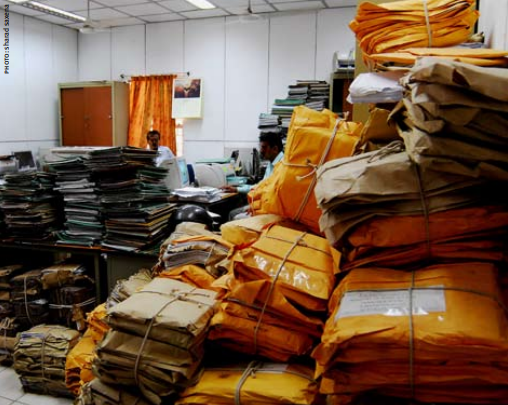
Dealing with the Indian government cannot be done at one point. The system sees a file moving from a receiving clerk to a dealing assistant, section officer, undersecretary, joint secretary and sometimes to a minister before orders are passed back down the chain.
The process is very demanding of time and effort and even the most enterprising politician or senior officer has difficulty in getting files to move faster. Unremoveable babus have nothing to fear on account of delay for they know that if they do nothing, they do nothing wrong. In the circumstances, no honest Indian or foreign company can do any business involving the government.
In every state government has a large retinue of liaison staff in the capital to steer its own papers through the corridors of power India without agents or liaison officers who follow the progress of their files. As most reputed companies are unwilling or legally barred from this onerous task, they have to rely on agents to achieve these valuable services out of their fees or commissions. The ultimate proof of the absurdity of the system is evident from the fact that every state government has a large retinue of liaison staff in the capital to steer its own papers through the corridors of power.
Corruption will continue until India can push through drastic administrative reforms. This means reducing the many
layers of government, retiring about 75 per cent of their subordinate staff, slashing rules and laws, and making government officials accountable for delay and failure to achieve targets. No party has the courage to take such steps as these would undermine the entire system of political patronage. If any government can achieve such reforms it would release the nation’s huge reservoirs of creativity and enterprise. As this is unlikely to happen, India will steadily fall behind while the rest of the world races to prosperity and progress.
NOTHING MORALLY WRONG
Corruption is endemic throughout all civic, court or rural services. The official rates for land measurement, registration, mutation, water and electricity connections are so out of date that petty officials augment these and their poor salaries by charging institutionalized higher rates. These are willingly paid by upright citizens and received without qualms. The more greedy and venal thus expect gratifications as a perk of government service.
There are dishonest companies who offer big bribes. These are clear deals where an official or politician is offered large sums in exchange for lucrative contracts or concessions.
A recent study on corruption in Asia did not find the rate of corruption in India as high as in some of our Asian neighbours but found the corruption in India the most inefficient. Elsewhere, if a politician or officer accepted a bribe he would usually get the work done through much simpler bureaucratic systems and if he was unable to deliver would usually refund the money. In China, individuals and companies do not have to account for 15 per cent of their expenditure and in Indonesia and Thailand, bribe-takers often give official receipts. This is viewed as simple speed money untainted by any moral judgement.
The reason corruption thrives in India is because of the complexity of government itself with its huge edifice of rules and laws.