










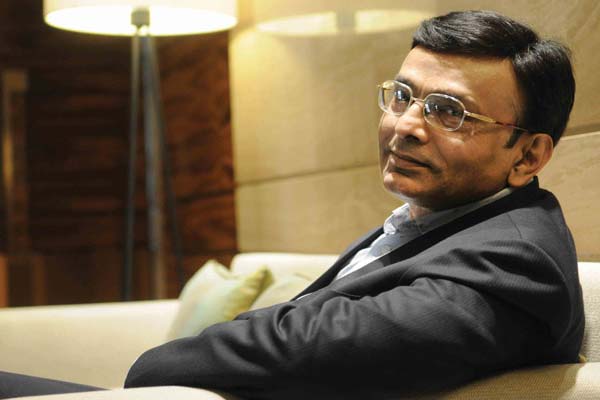













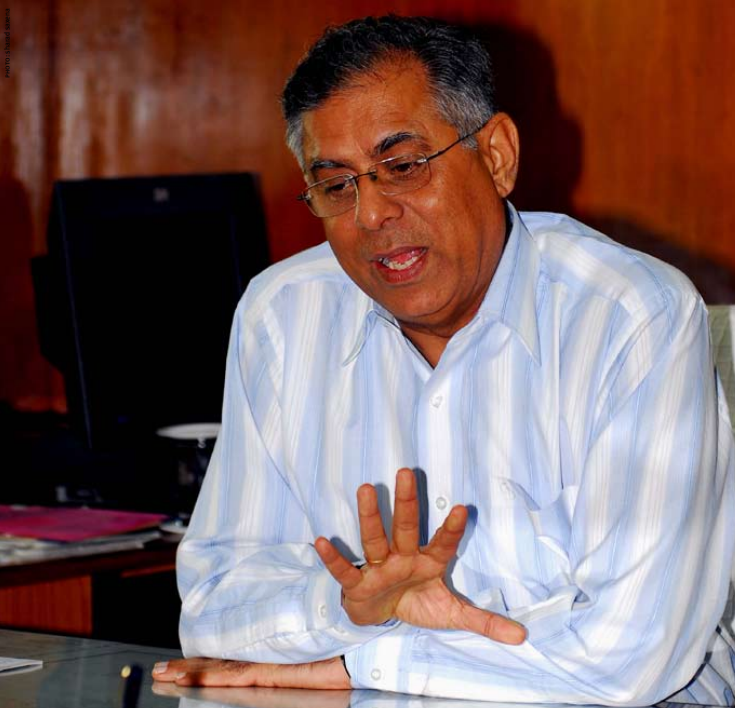
JP Batra served in the Indian Army before joining the Indian Railways, where he has had a 35- year career and held key general management positions. Currently Chairman of the Indian Railways Board, he has extensive experience in training, human resources, freight transportation, tourism and catering policy planning. He also acts as Principal Secretary to the Government of India and serves on various state coordination committees
gfiles: What is your asset?
JP Batra: The sheer size of Indian Railways is my asset. Its 14 lakh employees are my asset. They are my partners in achieving good results. If we are given the right environment to work we can produce better results.
gfiles: So you don’t have the right environment?
JPB: I’m not saying that. The environment is there, the atmosphere is there but still there is a lot of scope for improvement.
gfiles: So you feel a need for correction?
JPB: We are on the job. Better training is required. It is a gradual process. The work environment has to be improved. Safety maintenance has to be improved. In Indian Railways, safety is still dependent on human input. It has to be mechanized. We are paying attention to these things.
gfiles: What about liabilities?
JPB: (Long pause) Difficult question. Old, overaged assets are in the process of being replaced at a fast pace. I don’t consider that there is any liability in the Railways, it is a challenge. With my experience, I can say it is an evolving organization. But we have to change the mindset, the attitude. And that is not easy.
gfiles: What do you you mean by attitude?
JPB: Well, attitudes towards service, customer, work. And towards the all-important factor of customer satisfaction for the price paid for the service.
Stations will be as clean or dirty as the people using them allow them to be. People throw garbage and relieve themselves on the tracks.
gfiles: It has been proved that 83 per cent of rail accidents are due to human error. What are you doing to correct this?
JPB: Let us look at the facts. In 2001-02, there were 423 accidents. Last year, we had 195. Internationally, accidents are measured per million train km. An average of 1.5 accidents per million train km is the internation norm. We have 0.28 accidents per million train km. At present, we have 53 per cent accidents due to human error.
gfiles: Your officials say 0 accident rate cannot be achieved, it is unrealistic.
JPB: It is not unrealistic. It can be achieved. We have a success story before us. On fast tracks, Japan has 0 accident rate. Our efforts are on. Also, it requires technology to minimize accidents.
gfiles: The Railways makes it possible to travel India six times. In our country, 630 crore people travel daily. Obviously, managing this edifice is a gigantic task. You have to tackle accidents, delays, strikes….
JPB: Problems are there. We are getting feedback that we should empower the personnel in the field to take on-the-spot decisions. A lot of proposals from all levels come to the Railway Board. At present, governance is very important. The motivation of rail personnel has to be enhanced. Training is our main area which has to be governed very efficiently. Induction of new technology, of funds has to be handled. The Railways is an evolving organization and an evolving organization has problems.
gfiles: You have introduced freight corridors. You are investing Rs 29,000 crore in this. What is the revenue model?
JPB: We envisaged the freight corridor because we are industrializing very fast so we have to cope also. The first phase is from Delhi to Mumbai, the second is from Ludhiana to Sonnagar, Bihar – which may be extended to Kolkata later. At present, we are carrying wagonloads of 23 tons per axle. But on freight carriers we plan to carry 30 tons per axle. We have taken care of the revenue model also as, according to our estimates, 15-18 per cent revenue will be earned on the investment.
gfiles: Fourteen companies have been enlisted with the Railways for container movement. Are we going to see private participation in the Railways?
JPB: It is a new era for industry and Railways. We are starting public-private partnership in the Railways.
gfiles: There is a public perception that your tracks are old, bridges dilapidated…that you have an ageing infrastructure…
JPB: It is not ageing today. The Government of India created a special Railway Safety Fund with a corpus of Rs 17,000 cr. We should have spent that money by last year but there were problems so we extended the period by a year; 93 per cent of the task is done. After the current financial year is over, we will have fresh and sturdy infrastructure.
gfiles: You are accused of overloading, leading to cracking of tracks and violating safety norms. You are allegedly doing this under pressure from Railway Minister Lalu Prasad Yadav.
JPB: First, there is no pressure from the Minister with regard to extraloading (overloading). It is a purely technical decision. Before taking it we had pilot studies and we got clearance from the Commissioner of Railway Safety. We have not done it for the first time. We were doing it in a small way earlier. Our tracks are of world standard and we are taking full advantage of that.
gfiles: What about these charges? The Railways is the biggest pollutant. Your stations are dirty….
JPB: This is incorrect. As per world studies, 60-70 per cent of pollution is caused by roadways and airways. We will introduce biodegradable toilets by December 2007.
gfiles: But why is the customer not happy with railway stations?
JPB: This is a challenge we are facing. Stations will be as clean or dirty as the people using them allow them to be. People throw garbage and relieve themselves on the tracks. We have developed gangs to look after cleanliness and prevent people from misusing the stations. I can say most of our stations are clean.
gfiles: With reference to the Sixth Pay Commission, your employees are looking to you. What will you give them?JPB: We have to strike a balance between salary and expenses. We are processing a case to present before the Commission by June-end. My employees will not be disappointed.


