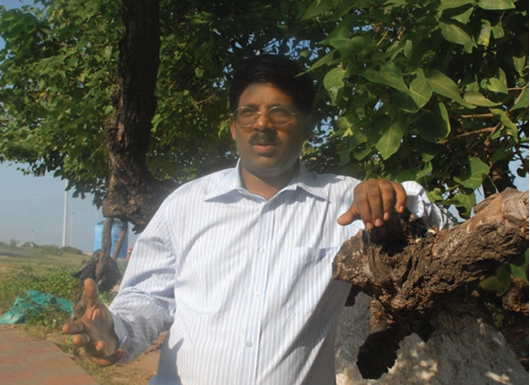




























After engineering the Green Revolution in wheat and rice in the 1970s, the scientists of the Indian Agricultural Research Institute (IARI),Delhi,are set to repeat their success story with fruits. Prominent among them is Dr AK Singh of the Indian Agricultural Research Service, the youngest-ever head of the Division of Fruits and Horticultural Technology Singh has achieved many goals in his career. “With a rural background from eastern Uttar Pradesh, I reached Delhi in 1983 and was selected for MSc in horticulture at IARI. The architect of the Green Revolution, Dr MS Swaminathan, was my role model and IARI was my dream,” he recalls modestly but fondly.
Most of the commercial varieties of mango are salt-sensitive and alkaline soil adversely affects crop yield.This problem has posed a great challenge to the country’s agricultural scientists. Singh took up this challenge and the first two years of his research during post-graduation resulted in assessment of a number of germplasms inherently resistant to saline conditions, which is now significantly boosting mango production.The Division of Fruits and Horticultural Technology, utilizing his research findings, has embarked on an ambitious project to assess more such germplasms.
During PhD work at the same department, he shifted focus to another high-value crop—grapes. Through tissue culture technology, he was able to develop micro propagation protocol for large-scale multiplication of elite varieties of grapes. A large number of tissue culture-raised plants were successfully transplanted and gave excellent yields.
Using tissue culture, he was able to produce over a million plants of different horticultural species and execute their adoption across the country
Following his doctorate, Singh joined the Indian Agricultural Research Service and travelled to other countries for his continuing research. He spent seven years at the Tata Energy Research Institute (TERI), Delhi, and, using tissue culture again, was able to produce over a million plants of different horticultural species and execute their adoption across the country. Thus, mass propagation of horticultural crops became a suc cess story in India The scientist’s research stint at the University of California saw him identifying 102 genes while studying the use of cit rus gene chip. These identified genes are induced after virus invasion of citrus plants. The Quick Decline viral disease of citrus plants is the single most serious disease of commercial citrus crops globally. Singh’s work in this area has provided insight into the citrus virus interaction at the level of gene expression. This, coupled with the fundamental plant defence mechanism against Quick Decline,is of vital impor tance in developing new strategies to protect citrus orchards from this deadly disease.
Aptly called a scientist of the soil, Singh left lucrative foreign and private assignments to work in India’s interest. He asserts that the Indian agricultural research system is comparable with its counterparts in developed nations, and actually better in many respects Singh has made a significant contribution to DNA finger printing of indigenous fruit crops. Using DNA markers, he described the distinctive characteristics of the DNA of the ber fruit. It is the genes of ber that enable it to grow in harsh conditions. He is also a consultant and Member Secretary, National Task Force, Protection of Plant Varieties and Farmers’ Rights Authority—involved with developing DUS (Distinctness, Uniformity and Stability) test guidelines for mango, guava, litchi and banana. This taskforce has been constituted mainly because India is a signatory to WTO and is a very rich country in terms of biodiversity of fruit crops and a large numbers of non-fruit crops too. Currently Singh’s focus is on building and utiliz ing genetic resources and conducting educational outreach in fruit crop genetics.