









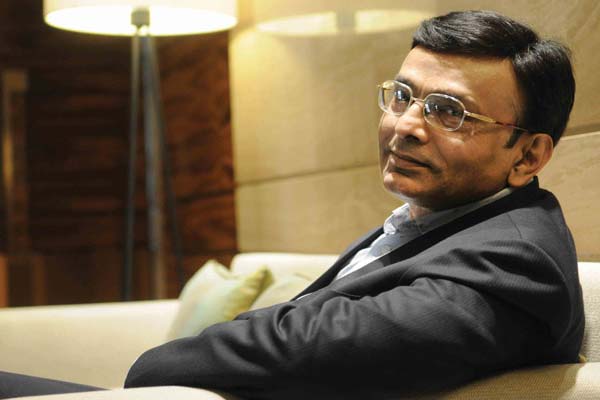












gfiles:You have served the government for 37 years. How do you evaluate this period in terms of governance?
Yogendra Narain: This has been a period of growth accompanied by accountability – middle- and higher-level bureaucracy being definitely more responsible. During the 1950s and ’60s,the Indian Civil Service was known for being more of a steel frame, non-responsive and authoritarian. However, as time went by, realizing the power of democracy, civil servants became more accessible. Their perception and mindset transformed qualitatively, enabling them to communicate comfortably with the masses.
gfiles: India has 603 districts.It is said the growth engine of democracy passes through District Magistrates. How can the gateway of DMs bring about growth and prosperity?
YN: First,the British initially set up our administration. District Magistrates do not require any political help. District administration is a continuous process marked by hierarchical structure.It is a paradox that the District Magistrates move out from districts and manage the state and country when 65 per cent of the population lives in rural areas. Prime Minister Manmohan Singh asked me what could be done to improve the administration. I suggested a separate Indian Administrative Rural Service. We cannot be part-time travellers. District administration should be set up as per the permanent structure for rural administration, where we can have region-wise grouping of officers within the state. A responsive administration system has to be evolved.
system has to be evolved. India is globalizing. The officers need expertise on WTO, currency, financing, banks. IAS officers should have specialized training in these areas and become specialists. This will enable them to discuss governance with visiting bureaucrats from advanced countries in a global perspective. A level playing field has to be provided.
gfiles: But why are only IAS officers chosen to man technical ministries?
YN:The Ministry’s role is managerial
gfiles: Does the bureaucracy provide vision to elected politicians?
YN: Civil servants play a vital role in the state and at the Centre. Politicians always believe in end results without appreciating the intricacies of planning and implementation of schemes. In the state, the bureaucracy is always the initiator. At the Centre, it plays a complementary role.
gfiles: Does the bureaucracy really play a significant role in development?
YN: Yes. I was Chief Secretary, UP. We see to it that schemes are implemented in letter and spirit. People often say UP is backward whereas data proves otherwise. UP is among the top milk, sugar,
vegetable producers.
gfiles: But is the civil servant meant for general or specialized administration?
YN: When Sardar Vallabhbhai Patel advocated the need for the Indian Administrative Service, he meant generalized administration. So we copied the British system. Japan has specialized
ministry-wise cadres for administration where officers join, perform, grow and retire without having to move out
gfiles: Is Indian bureaucracy keeping pace with the times?
YN: I think we are. Topics on global issues have been included in the Lal Bahadur Shastri Academy syllabus. In the 1960s, it was just CrPC law and general administration.
gfiles: But the bureaucracy is still not responsible…
‘The administrator population ratio comes to around 1:60, which is the lowest in the whole region. Every day you are announcing new schemes, new programmes and the machinery is the same. You are opening the door for corruption’
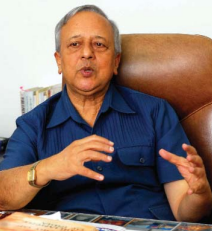
YN: Our system was based on mistrust in the early days. Files needed to move along a long trajectory. If something amiss happened, there was always a CVC on one’s head. But it is always a
joint success and joint failure. We have to see how we can perform better within the given system. But we cannot afford to lag behind in fine-tuning our system.
gfiles: Do you think the IAS machinery is a suitable instrument in the hands of government for growth?
YN: Of course. The instrument is changing and is no more static. It’s responding to local and global needs and pressures. The response might be low but it’s there significantly. We are communicating with media better, more transparently. In the 1970s,bureaucrats were asked not to attend private parties and mix with businessmen. Happily, things have changed.
gfiles: Did being founder Chairman of NHAI and Greater Noida help you deliver as an administrator?
YN: Yes. New concept, new ideas, new management perceptions were successfully implemented without having to carry baggage of past organizations.
gfiles: Is the bureaucracy’s present strength adequate to administer the country?
YN: The workload is too much. The bureaucracy is reeling under pressure. The Centre has already reduced its employees from 38 to 34 lakhs. The total bureaucracy comes to approximately one crore 50 lakh. The administrator-population ratio comes to around 1:60, which is the lowest in the whole Asian region. Every day you are announcing new schemes, new programmes and the machinery is the same. You are opening the door for corruption. We need more bureaucrats to make India’s growth engine more productive.
gfiles: Civil servants are now allowed to serve private business houses and then rejoin the service. If the private job is so attractive, shouldn’t he resign from the government?
YN: No. Times are changing. We have to bring in required changes in the system in a competitive world. You must understand the problem of the bureaucracy. We have to be well acquainted with the problems and culture, management techniques and technological upgradations of the business houses and private entrepreneurs. We learn after joining them. As Chief Secretary, UP, I allowed this mobility with the condition that rejoining the cadre was a must. This arrangement was made to ensure that the positive aspects of the private sector were ploughed back into the government. The Canadian bureaucracy has had this arrangement for long. As Chairman, NHAI, I visited the US and found their highways well maintained. Once I stopped at a highway gas station and asked a staffer the economics of highway management. He said, for every unit of gas 30 cents are charged from the customer. The idea struck me and, on my return, I proposed that 50 paise be charged per litre for improving highways. It was accepted and increased to one rupee per litre. As a result, we now have Rs 8,000 crore in the highways kitty. Bureaucrats are essentially change agents.
gfiles: You worked with three CMs and one Governor under President’s Rule in UP. Did this help you as an administrator?
YN: Yes. Files moved fast with almost no bottlenecks. But, basically it is not an individual who works in the system, it is team work. Yet, power helps civil servants deliver and improve the system.
gfiles: You worked with Sripati Mishra, Kalyan Singh, ND Tiwari as CMs and Motilal Vora as Governor. How do you evaluate them?
‘We (bureaucrats) have to be well acquainted with the problems and culture, management techniques and technological upgradations of the business houses and private entrepreneurs. We learn after joining them’
YN: All were different and had strong points. Sripati Mishra was nice, simple and unassuming. Though he never interfered in the administration, he knew ground realities. ND Tiwari had brilliant ideas and plans. Instead of taking advice from bureaucrats, he guided them. Kalyan Singh was a very firm administrator and always meant business. He was concerned about law and order problems and ensured that developmental schemes were properly implemented.
gfiles: Which bureaucracy do you like the most in the world?
YN: I still love the British bureaucracy. The British understood India’s problems well simply because they stayed here long. And we borrowed their administrative set-up. We understand each other better than any other countries. Unfortunately, the US bureaucracy is unable to understand us.
gfiles: Given a chance, which bureaucratic set-up would you like to have in India?
YN: A new orientation is required. When Kamal Pande was Cabinet Secretary, he initiated the grouping of ministries and wanted bureaucrats to move within those ministries. I would also like to go for clubbing of ministries. However, the posting within the group should be rotational and start from Joint Secretary level.

Editor, gfiles