










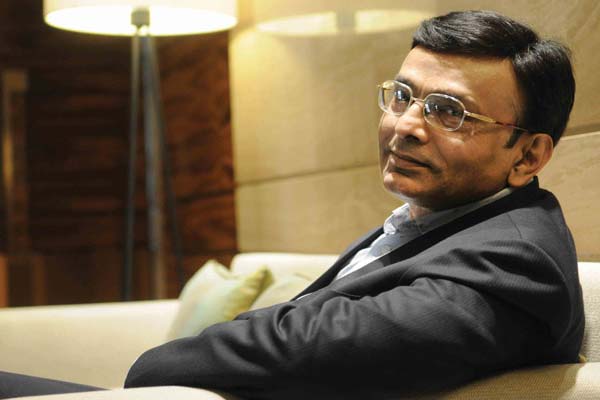

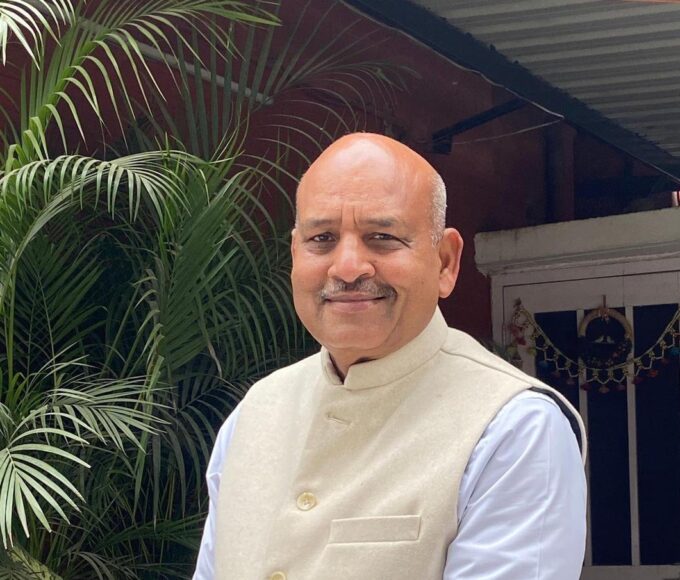












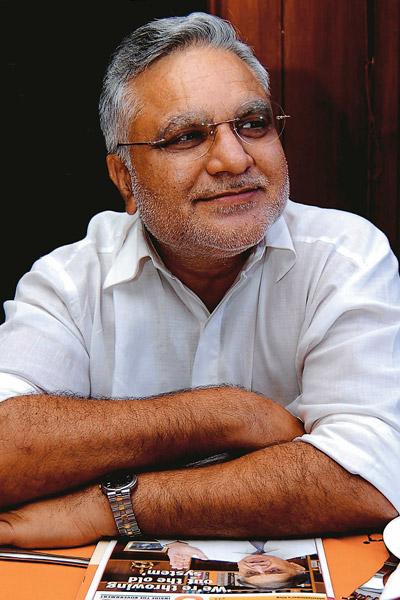
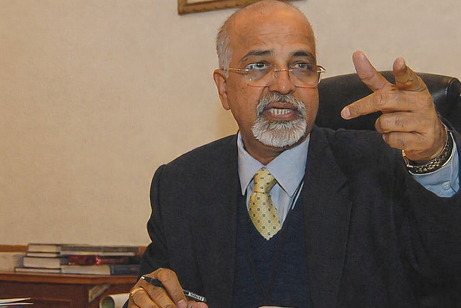
From a humble background in Orissa, Satyanand Mishra is an IAS officer of the 1973 batch, Madhya Pradesh cadre. He has an MA (English) from Utkal University, and an MPhil in public administration and MSc in policy planning for developing countries from the London School of Economics. He began his career as a probationary officer in the State Bank of India but later joined the civil service. He has worked for nearly seven years in the Department of Culture in the state as well as at the Centre, where he formulated cultural policy and implemented a variety of projects. He has been Managing Director of the Madhya Pradesh Film Development Corporation.
Mishra is fond of films and is a regular moviegoer. He has had two stints in the Government of India and spent over two years in the Ministry of Personnel. With his easy accessibility, in person and on the phone, Mishra is a valued, vibrant and forward-looking bureaucrat.
gfiles: How do you find your new job?
Satyanand Mishra: Twenty years ago, I worked here and before joining as Secretary, I was an Establishment Officer here. It is a nodal Ministry to manage human resources. In spite of a heavy workload, we manage affairs.
gfiles: What is the biggest challenge in this Ministry for you?
SM: This Ministry’s role is ensuring accountability in the government and accountability to the people. The government’s priority is to deliver to the people. The government is doing its best to reach down to the common man and convince him that it really means business. We are working on two fronts. First, overhauling of accountability of individual employees, attitude, and outlook. Second, simplification of the present system for the benefit of the common man to make it more transparent and integrity-oriented.
gfiles: The Right to Information Act is playing a vital role but the desired result from its implementation is yet to come.
SM: The Act is only two years old. It will take time for results to come. The government is satisfied with the progress. We have observed that most of the beneficiaries of this act are none other than the government and its employees.
gfiles: When Dr Manmohan Singh took over as Prime Minister, he was very enthusiastic about administrative reforms. But the zeal and enthusiasm seem to have slowed. Why?

SM: That is not correct. The Prime Minister and government are not only keen, they are working continuously on administrative reform. Administrative reform is a continuous process. It cannot be seen in isolation. The Prime Minister has categorically said that delivery of services should be smoothened. We have received the recommendations of the Administrative Reforms Commission partly and 75 per cent of them have already been acted upon. The Cabinet Secretary, the Minister and the Group of Ministers are taking keen interest in reforms. Translation of recommendations into detail and implementation will take time. All of us have been put in place to see that delay in this regard is minimized.
It was realized that the process of consultation in three Ministries – Finance, Law, and Department of Personnel – is long and time-consuming. It was felt that we are risk-averse and, to overcome this drawback, we must try to reduce the “process of consultation”. There is a 10- tier structure of consultancy prevailing in the government. Starting from the clerk, we move vertically up to the Section Officer, Under-Secretary, Joint Secretary, Additional Secretary, Secretary, Minister and finally the Cabinet. The Prime Minister says we must simplify things and take decisions without fear. We are on the job. We have done it partly, in vigilance cases where the process of clearance has been simplified. We are creating a conducive environment for this. Since the dawn of public-private partnership (PPP) projects, the need to take bold decisions has arisen. We have empowered our officers to take decisions without fear. We are of the view that, even if the decision is wrong, the officer concerned should not be punished – unlike in the past. The government’s approach is that decisions should be fast and transparent.
gfiles: The global governance-population ratio is 4 per cent. So, to govern a population of 100 crore, we need 4 crore government employees. In India, the ratio is 2 per cent; 2 crore employees are governing 114 crore people. Is this not responsible for lethargy, incompetence, corruption and delay?
The private sector will naturally take personnel from the government. I don’t view it as an exodus. I treat this as exploitation of opportunities by the talent available
SM: I have not studied this aspect in India. There are many arguments on this issue. The size of the government should be commensurate with the population. I don’t think you need this percentage everywhere. Of course, there is no compromise in the areas of security, health, education and basic services. Most important is that our government does not outsource any activity. The problem is that people blame us if anything goes wrong. So our responsibility is much more than in non-governance sectors.
gfiles: There is mounting dissatisfaction among government officers over the issue of pay parity in comparison to other sectors.
SM: I don’t think we should compare salaries with the private sector. In the private sector, every activity of every individual is monitored in monetary terms. In government, such a system does not exist. Here, work is work. The fundamentals of private and government jobs differ. The government is socially oriented while private entrepreneurs are profit oriented. After implementation of the Fifth Pay Commission, the pay structure has changed considerably. The Group A-service officers get transport, accommodation, telephone and job security.
gfiles: Have you suggested any major change to the Sixth Pay Commission?
SM: The Sixth Pay Commission will submit its report in March. We were the first to interact with the Commission. I told them what my colleagues feel. Our present pay scale is incremental. But, when you start your career you need more money for marriage, old parents and growing children. Ironically, when the requirement is high, the money is less. After 30-40 years of service, you have money but the requirement is less.
gfiles: You are not getting good teachers in the Lal Bahadur Shastri National Academy of Administration. Did you tell the Commission about this?
SM: Yes, the Academy is the primary institution for the administrative services.I have requested the Commission for a lucrative package to attract more and experienced faculty.
gfiles: There is an exodus of IAS and IPS officers, especially technocrats. Why?
SM: Before the economy was opened, fewer opportunities existed. Now, people look for career growth and money in different sectors. The private sector has the problem of finding experts as every single job was being done by the government. Infrastructure, revenue, engineering, telephones and so on, were with the government. The private sector will naturally take personnel from the government. I don’t view it as an exodus. It is an exploitation of opportunities by the talent available in the country.
gfiles: What reasons do these officers give for resigning?
SM: Before the 1980s,people with subjects like physics, mathematics, history and political science had only two options – to join the government or teach. This changed in the mid-1980s as those from the IITs and the medical stream started joining government service in large numbers. It changed the orientation of the civil services. We have 5,600 IAS officers and those with a technical background have opportunities to prove their talent. The officers who leave say they want job satisfaction, to stay at one place, and to give better education to their children. More officers are going on leave and rejoining.
gfiles: Do you plan to stop the exodus?
SM: No plan as such but on November 28 last year we sent a circular to the effect that no IAS officer can work in any company registered under the Companies Act. This was done after we noticed conflict of interests. Now they can work only with Public Sector Undertakings and semi-government organizations. We observed that when, after a stint in a private organization, an officer was back in a government department of a similar nature as Joint Secretary, a sense of mistrust prevailed. Another problem arose in distinguishing between companies in infrastructure, energy and telecom sectors and allowing the officer to join one of them. So we decided not to allow IAS officers to work with private companies.

gfiles: IAS officers feel that your department discriminates regarding foreign assignments. There is favouritism and politically connected officers get plum postings.
SM: This allegation is not correct. The government decides postings to international agencies, such as Technical Adviser to the World Bank, Executive Director of the Asian Development Bank, embassies and tea boards. There is a selection method and we keep objectivity in mind. In our department, the Establishment Officer prepares a list of names from data stored in the computers. Officers with 15 years’ experience or more are eligible. When the World Bank or Asian Development Bank or any economic wing of an international agency asks for an officer, the choice naturally falls on officers already having experience in finance, economy or revenue. However, no officer is allowed to join a foreign agency if he has officially dealt with it in the past five years. The principle of equity and justice is the primary consideration in selection. For Joint Secretary-level officers, no short-term consultancy is allowed. The idea is to ward off allurement and keep foreign agencies from influencing decisions.
gfiles: Officers from the Dalit community also complain of discrimination. There are very few Secretaries from this community.
SM: The allegation is baseless. Though the issue is in our minds too. The government believes in equitable representation from all sections of society. The
I have requested the Pay Commission for a lucrative package to attract more and experienced faculty for the IAS academy
problem lies at the entry level. A Dalit officer enters the civil services at 28-32 years of age. He is able to become Additional Secretary/Joint Secretary by 58 or 59. Because of late entry, not enough Dalit officers are available. The government does not have a policy of quota promotion in Group-A services. The Constitution is very clear about evaluating all efficiency parameters in Group-A services.
gfiles: In the changed political scenario, it is felt that political victimization of civil servants by their political masters is rampant.
SM: It is true. In the government, we are discussing the issue of transfers. The Prime Minister himself is concerned. We are trying to emphasise a two-year tenure for all the cadres. We are also asking state governments to record justification of transfers before the two-year tenure ends. The Supreme Court is clearly for fixing of the term in the Prakash Singh case. The Ministry is working towards this end.

Editor, gfiles


