



















MUCH has been said about globalization, its pros and cons, its promises and failures, and how it can or cannot help developing countries like India to follow the trajectories of development charted by those who have already achieved the distinction of being officially called “developed nations”.
The debates have centred on the pure economics of it: the merits or otherwise of market econom ics based on international trade and investment, with resource allocation mediated by international free market forces.
In more senses than one, this debate is irrelevant for countries like India or China; not because, as protagonists of globalization argue, India and China have been the biggest beneficiaries of this phenomenon, but because they were the first to initiate this: India and China were the first globaliz ers in the ancient world.
Until they handed the baton to others who replaced free market with the task of colonization and empire-building.
To return to the current round of globalization, there are two important factors that are overlooked in most dis courses although these have potential to make the most significant impact on the lives of billions of people in these coun tries whom globalization has simply passed by, or who have been handed its bitter fruits.
First, when Britain and America led their brand of globalization in the 18th to the 20th Centuries, they ensured that they were themselves not “globalized” — they developed their domestic markets and capacity of the masses to play their role in the market.
This helped in broadening and deepen ing the effects of globalization by making sure that the ben efits were not confined to the rich and the moneyed who went out to “globalize”.
The second most important departure from previous globalizations, and perhaps the one that holds out the most prospect for the poor and the powerless, has been in the con cept of global rights, especially in the global policy regimes on rights to development and application of humanitarian laws. Just as globalization drew the world closer in terms of free market mechanism and unfettered capital flows, it also brought about a realization that basic rights to protection, assistance and development as enshrined in different human rights conventions and international humanitarian laws needed global application.
These are often referred to as sec ond generation rights involving universal minimum welfare entitlements, as opposed to the first generation rights which relate to individual liberty and freedom on which a univer sal consensus ideology is yet to emerge. You could not have economic growth and prosperity for some, while turning a blind eye to the denial of basic rights to life and protection for a large majority of the world. The Millennium Development Goals (MDGs) and reshaping of the interna tional aid architecture following the Monterrey Consensus are part of this global agenda.MDGs are not just a wish list for donor agencies or governments,but reflect commitments to ensure that various instruments under the international humanitarian laws and International Covenant on Economic, Social and Cultural Rights (1966) are met by governments in the first instance.
For the first time in the history of humanity,the language of rights entered the frame of discussions and policy-making at national and international levels in the past decade.The economic, social and cultural rights include a number of claims like claims to social security and a certain standard of living, adequate food, clothing, hous ing, healthcare, sanitation, education, etc.Prior to this,despite having various conventions and protocols agreed and ratified by governments, these hardly provided any strong reference point when it came to implementation, especially in developing countries.
The introduction of rights in development discourse recognized that access to good healthcare is not just something a good government ought to provide,it is a right of the villagers to demand it. Tsunami-affected families had a right to receive assistance in the form of food, shelter and livelihood from national governments, international humanitarian agencies like the UN, and international and national non governmental organizations.
It is no longer a case of “a good government”doing a favour to its chosen subjects,nor a poor woman surviving on the generos ity of a large-hearted NGO.There are rights,duties (duty of care) and obligations that come into the equation.
This has been the most significant achievement of global ization: the recognition of individuals as “subjects” of inter national law, and so of international concern, and bringing into the development equation the economic,social and cul tural rights which national and international development processes ought to strengthen.
This is easier said than done.More so in a country like India where collective identities — be it religious,ethnic,caste,lin guistic or regional affiliations — predominate over individual rights, and mediate the notion of what is just and fair.This explains why in a country which aspires to play a leading role in a globalized world, like in the days of medieval chieftains or as now happens in clan-based societies like Somalia or Afghanistan, a Chief Minister of modern-day India can set the entire state machinery upon one community — seeking to unlawfully kill and maim as many as possible,and then go on to proudly justify his actions which earn him approbation and a second term in office. And another chieftain, failing to provide what can be called decent administration under his command, sets his goons on a farming community in Nandigram, and then rewrites with the help of his comrades Manu’s code of legality and ethics to proclaim to the world that the actions of his rapists, killer brigades and mass grave diggers were “morally and ethically justified”.
These were, in the parlance of the Geneva Conventions, crimes against humanity — unlawful and deliberate killing of innocent civilians by a state.
What’s more, within the country, the outrage, if any, against these pall-bearers of “justice” and “moral” standards was sub dued.
These are serious failures of the system: the use of polit ical or communal tribalism as an instrument of state rule, the failure to protect those whose lives the chieftains were required by law to protect, the failure of the Centre and the judiciary to take cognizance of the fact that these were mass murders engineered by the state and hence crimes against humanity for which similar perpetrators elsewhere have been successfully prosecuted at the International Court of Justice. And the failure of the media and civil society at large to feel outraged not simply at the crimes but also how these crimes were shamelessly defended, and defended with pride, reminds one that, much as we would like to think that the likes of this happen only in Darfur, Somalia, Afghanistan, and Iraq in the 21st century, these medieval moral codes and Talibanized attitudes are still part of India’s body politic.
The most significant achievement of globaliza
tion: the recognition of individuals as ‘subjects’
of international law, and so of international con
cern, and bringing into the development equa
tion the economic, social and cultural rights
which national and international development
processes ought to strengthen

This has not been missed by the global media or the public in the globalized world who take an interest in what’s happening in the developing world. Thanks to globalization, global media and public opinion, the renewed commitment to providing basic needs of life and livelihoods as a matter of right has meant that governments can no longer hide behind the curtain of sovereignty and still maintain a facade of a nation governed by the rule of law, both national and international. China could get away with the Tiananmen massacre in 1989, but Chinese businesses and government would shudder to think what would become of their global dreams if the same were to occur in the 21st century.
These weaknesses in the body politic of India are a reflection of a weak civil society. By civil society, we mean not just the NGOs and trade unions, but all entities which give pri macy to the principle of individual rights, as opposed to col lective bodies and associations based on collective identities of religion, caste, ethnicity etc. A civil society, while cherish ing individual rights, also holds the state accountable for these.
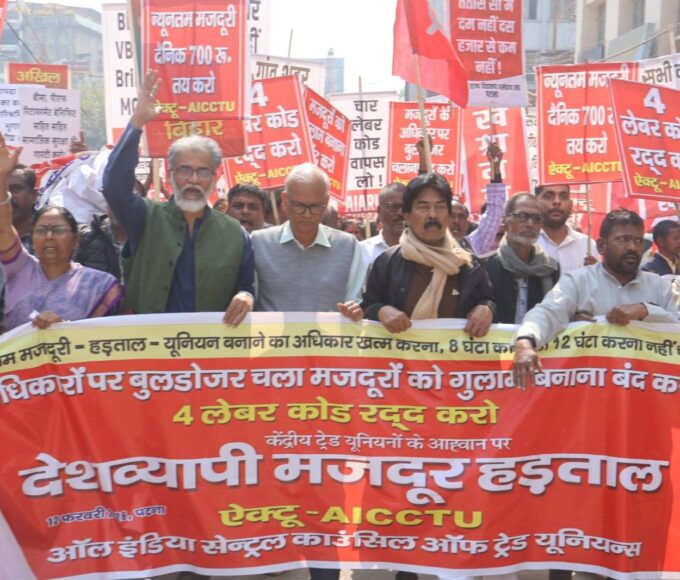
In India, the only agency of civil society that can be said to have matured to play this role effectively has been the media in the country. The judiciary through its “judicial activism” has also tried to play a critical role in recent years, despite all its weaknesses. The trade unions, though suppos edly meant to uphold their individual members’ rights, have often had identity crises and fallen into the culture of polit ical tribalism that subsumes individual rights into collective identity.
NGOs, barring a few in the country, are too weak or ineffective to make a serious impact. However, on the brighter side, the emergence of various movements, of the farmers and the displaced in Narmada, of the quarry work ers and mine labourers in Northern India, of the forest pro duce gatherers in central India, of the vendors and self employed women in Gujarat, of the factory workers in Chhattisgarh, to name a few, are gaining strength. Don’t just dismiss them as obstructions in the path of globalization; they are genuine aspirations of a strong civil society and can only strengthen globalization in the long run.
The challenge for the state and businesses is to work together with the forces of civil society, and strengthen these forces on the one hand, and for civil society on the other to view itself not as an entity opposed to the state or private sec tor but as part of the body politic that constitutes the state, the market, the businesses, the NGOs, the judiciary, and all those whose raison d’être is to promote the rights of individ uals in consonance with the national and international com mitments the country has made.
