
























It was a political decision to go to the people but it wrought a revolution in the Indian economy
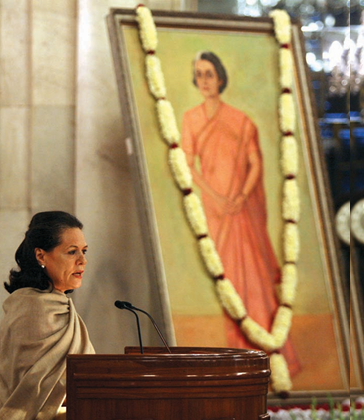
When mighty global banks were crashing under the weight of their own greed and seeking bailouts from their governments, Sonia Gandhi made a significant observation – that Indira Gandhi’s decision to nationalize private banks had shielded the Indian financial system during the global meltdown. This July marks the 40th anniversary of bank nationalization – an astute political move that came to mean smart economics as well. In subsequent years, politics again came to the rescue – blocking several attempts to reverse bank nationalization by prominent policymakers in the present and predecessor governments.
On the day man first landed on the moon, India’s government took the first step along the road to climbing the “commanding heights of the economy”. That July, 40 years ago, witnessed intrigue and power struggles within the Congress. Economics became the handmaiden of power and influence. After Prime Minister Lal Bahadur Shastri’s death in early 1966, swift political currents began to reshape the Indian polity. Congress power-brokers installed Indira Gandhi as PM by defeating Morarji Desai in the prime ministerial poll.
In the first general election of the post-Nehru era in 1967, the Congress lost power in many states and the Opposition ranks in Parliament swelled, especially those of the Swatantra Party – representing ex-royalty and business – and of the Jan Sangh. The Congress was seemingly losing its traditional social and regional base and also the support of business and industry. In the new Congress government, Desai was made Deputy Prime Minister as well as Finance Minister. While Gandhi opposed his proposal to tax farm income, Desai stalled her suggestion for bank nationalization with his “social control” – a system of token oversight over banks.
The All-India Congress Committee (AICC) session in the summer of 1969 at the glass-house in Lalbag, Bangalore became a watershed. Party president Nijalingappa, associated with the old guard, gave a call for pro-business policies in his opening address. Gandhi countered with her “stray thoughts”, outlining a more pro-people line that hinted at a greater role for government in the economy.
When the post of President of India fell vacant in May, after the death of Dr Zakir Husain, the rift within the party became unbridgeable. Gandhi and her supporters opposed the nominee for President of the party old guard (dubbed the “syndicate”). On July 14, the PMO notified the news agencies that Desai had been stripped of his finance portfolio. On being shown the news flash in his office, Desai called for his personal car and went home. On July 19, Gandhi, who had taken over the finance portfolio, announced in a radio broadcast the nationalization of 14 private banks. It was a master stroke. She was going to the people for support over the heads of party power-brokers who wanted her to be their “gungi gudiya” or dumb puppet.
Until nationalization, a few business houses – in order to maintain their dominance – managed a cosy arrangement with commercial banks and general insurance, since they were also their owners. A Reserve Bank of India report on rural credit had bared the stark reality of rural poverty and the total neglect of agriculture and rural sector by private banks. Desai’s “social control” appeared to have done nothing to correct this situation. The officials assigned to work on nationalization could not even lay their hands on any reliable official records for determining the size of banks to be nationalized. They reportedly took the cue from a newspaper article that categorized banks on the basis of deposits – Rs 50 crore or less.
Then, some senior officials in the Finance Ministry changed and a new banking department was added to it for exercising broad policy oversight over banks. Under Prime Ministerial supervision, Finance and other economic ministries came up with a series of policies whose traces are present in most sectors of the economy even today. Many such policies – for the broadening of the industrial base, entrepreneurship, advances in agriculture and allied occupations, and measures to change the face of rural India – would perhaps not have been possible without this single decision 40 years ago. Bank depositors have overwhelmingly preferred the safety offered by public sector banks, even while foregoing some of the blandishments held out by their private competitors.
Whenever the subject of expansion of access to banking, particularly in favour of under-served areas, crops up, arguments are advanced for opening up of the sector to private and international banks. It is rarely noted that even the nationalized banks needed to be cajoled and lured to move into difficult areas and sectors. They had to be shepherded to unfamiliar rural and other sectors with a definite policy of priority lending.
While there is a wealth of research damning the effects of bank nationalization (much of it partly motivated and undertaken when rainbow economic conditions prevailed), objective research is sparse. The all-pervading economic gloom of the present, is perhaps an opportunity for a proper appraisal of the politics of the ideological debate over bank nationalization, and the road ahead. This needs to be separated from the other debate over government dominating the “commanding heights of the economy”!
On the day man first landed on the moon, India’s government took the first step along the road to climbing the ‘commanding heights of the economy’
Many policies – for the broadening of the industrial base, entrepreneurship, advances in agriculture and allied occupations, and measures to change rural India – would perhaps not have been possible without this single decision 40 years ago