















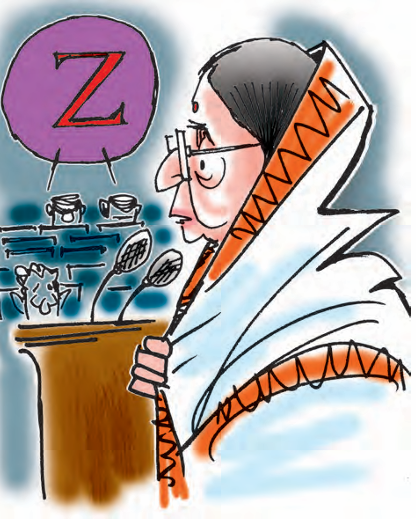
The first overseas tour of President Pratibha Patil was marred by unprecedented goof-ups, protocol glitches and controversy which regaled television audiences and newspaper readers at home. There were some misconstrued and laughable attempts at glossing this over through inspired leaks in the media. An article in a prominent national daily cooed fawningly how the President learnt some Spanish particularly for the visit!
Another article sought to put the entire blame on the Ministry of External Affairs (MEA) for poor attendance at the President’s joint address to the Brazilian Parliament and the cancellation of a similar address to the Mexican Parliament. Of course it completely escaped the writer that it is not in the power of the MEA to compel Brazilian members of Parliament to listen to a proforma address by an Indian President who does not enjoy any particular national, let alone international, standing; she is merely a provincial factotum of the feudal set-up of the Congress Party. The cancellation of the joint address in Mexico was the result of intra-party squabbles in the Mexican Parliament over which the MEA has not even remotely any control.
Members of Parliament all over the world, including in India, are a law unto themselves. They are generally not given to protocol niceties. During my tenure as Chief of Protocol, many a times I have seen vacant seats at Presidential banquets for foreign heads of state when MPs failed to turn up after accepting the invitation from the President of India.
The President’s failure to salute the Mexican flag while inspecting the Guard of Honour cannot be blamed on the MEA as she must have been briefed by her Secretariat and the MEA. For every foreign visit, the Chief of Protocol prepares a detailed and voluminous dossier on the events, ceremonies, personalities, etc so that there are no major embarrassments or goof-ups.
The failure of the President’s son to turn up for the Mexican President’s State banquet and the consequent vacant seat with his name card at the table must have embarrassed the accompanying MEA officials and the Indian Ambassador to Mexico no end as this was an unpardonable breach of protocol. Instead, he was off to Miami on personal work and then had the temerity to justify his absence stating that he was not part of the delegation but only a family member. If he was not part of the delegation, then why should the Indian taxpayer pay for his travel to and stay in the three countries visited by the President?
Another controversial feature of this visit was the inclusion of five doctors in the delegation, including one whose only function reportedly was to administer eye drops to the President. This could not be a delegation from a country where a vast majority still strives to survive; it smacks of the Mughal durbar. Why must Indian taxpayers foot such outrageous bills?
In the old days Presidential visits were solemn occasions but now they have degenerated into mere jaunts for the President and the family and other sundry favourites to escape the summer heat of Delhi. Is it not strange that a majority of Presidential visits take place in summer?
The time has come to evaluate the usefulness of such visits and to introspect whether such visits bring about any tangible benefits to the country considering that vast amounts are spent on such visits, sometimes at the cost of causing inconvenience to the general public by withdrawing two jumbo jets from Air- India’s operating fleet. In the old days, when we were a new nation, such visits were necessary to build up an international identity. Also, persons who occupied such high office then were towering personalities in their own right.
When we were a new nation, such visits
were necessary to build up an international
identity. Also, persons who occupied such
high office then were towering personalities
Nowadays such Presidential jamborees have no distinct advantage either for the nation or the host country. First of all, since the President of India is not the executive head of the government, the visit does not have much significance for the host country; it is merely a ceremonial state occasion full of pomp but devoid of substance designed to create that elusive goodwill, which nobody has been able to define precisely. Hence, such visits do not create the excitement a Prime Ministerial visit creates when the two executive heads of government could conduct serious business. Why invest so much in empty pomp at huge expense to the national exchequer? Instead, it would be more productive if the President visited at frequent intervals the remotest area of the country away from Delhi to ascertain how the majority of our citizens live and to learn about their concerns and aspirations first-hand.
Second, is it not curious that most Presidential visits are to countries of Europe and Latin America and that there have been only a handful of visits to our neighouring continent, Africa?
Third, the composition of the Presidential delegation leaves much to be desired. Presidential visits are not to be treated as vacations abroad for the extended family. Each member of the delegation must be carefully chosen for his ability and usefulness to contribute substantially to the strengthening of relations with host countries. The durbar mentality does not work and should not be allowed to flourish in the 21st century.
However, one is not too sure about any substantial changes in the near future. For, of all the institutions left behind by the British, Rashtrapati Bhawan or the Viceregal Lodge has not changed or evolved with the modern democratic set-up and ethos. It is perhaps the most anachronistic and feudal institution in the country. Otherwise, why should a “people’s socialistic democracy” continue with the institution of the Military Secretary to the President? Such an institution was necessary for the Imperial Raj but in 21st-century India it has no place. For, the Military Secretary, who is generally of the rank of Major General, only does bandobast which could be done by any logistics person. Similarly, the institution of the ADC to the President and the Governors is another Raj relic which must be removed to be in tune with modern democratic times. Even a formidable military power like the United States does not have such institutions from another time warp.