













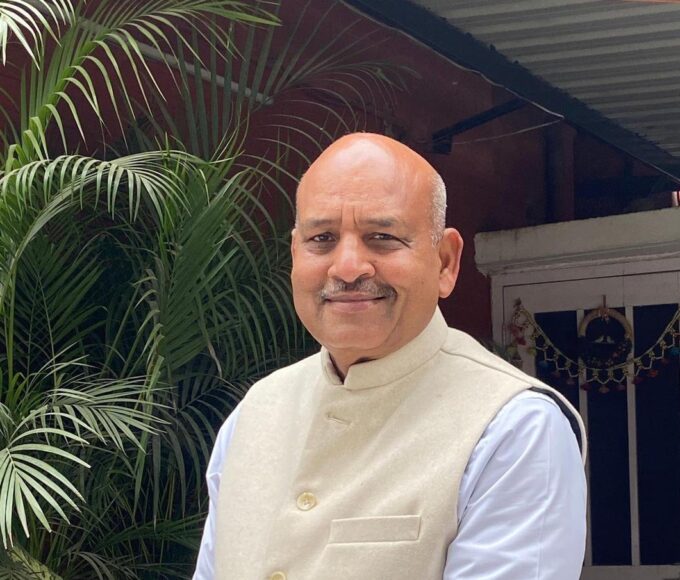














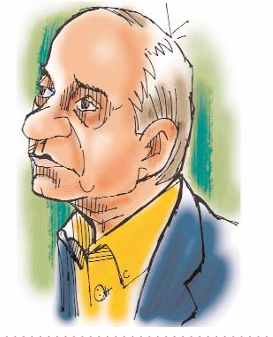
Eminent jurist BN Srikrishna entered private practice in Bombay High Court in 1967, specialising in labour and industrial law. Appointed additional judge of Bombay High Court in 1990 and permanent judge in 1991, he assumed charge in 1993 of the Court of Inquiry into the Mumbai riots of 1992-93. The Srikrishna Commission submitted its report in 1998. In September 2001, he was appointed Chief Justice of Kerala High Court and on October 3, 2002, Justice Srikrishna became a judge of the Supreme Court. In September 2006, he was made Chairman of the Sixth Pay Commission and at present faces the onerous task of keeping the babus of the nation happy. He admits he is doing a tightrope balancing act to keep everyone satisfied. A polyglot who knows 12 languages, Justice Srikrishna holds an MA in Sanskrit and a diploma in Urdu apart from a postgraduate diploma in Indian Aesthetics from the University of Bombay.
gfiles: What terms of reference were provided to the Sixth Pay Commission?
BN Srikrishna: Our terms of reference were to focus on good governance as also to ensure the bureaucracy can be spruced up to provide cutting-edge administration. We will be interested in seeing how these qualities can be achieved in the day-to-day administration of the country. Our objective is to effect rationalization of existing structures and work out a pay package that will promote efficiency and productivity.
gfiles: What is the methodology being used by your team?
BNS:We believe performance should be incentivised. While we are not depressing pay or giving negative performance incentives, the approach of this Commission is that most of the growth in emoluments should come in the form of performance-related incentives that are over and above the normal pay. The underlying idea is that good performances must also carry pecuniary reward. Any growth in the compensation should come on account of better productivity. All future growth should be attributable only to better end results with non-per formers being denied any growth.Shape up or ship out is our mantra.We are at present working out the parameters on how such a policy can be implemented.
gfiles: This will obviously cause a lot of heartburn
BNS: Rewarding performers will inspire employees to perform better which can only result in better delivery for the common man. Only non-performers will be unhappy with such a dispensation. With the right incentives, the bureaucracy can be enthused to give ever-improving results. The question to be asked is why a private company provides results whereas this is not the case within the government. We keep talking about making India a superpower with growth rates exceeding 9 per cent. To bring this about, every must be able to account for every rupee
that the government spends.
gfiles: Is the Sixth Pay Commission going to advocate a hire and fire policy for government employees?
BNS: The terms of appointment of existing employees cannot be changed to their disadvantage. What the government can do is to adopt a contractual approach for hiring of government employees for specific jobs at certain levels. It is a logical corollary for ensuring better performance that needs to be looked at. The spirit of competitiveness in the world of trade and commerce must be introduced in governance.
gfiles: How will contract jobs work for defence service officers?
BNS: I am not suggesting all government servant jobs be made contractual. I believe that many posts can be identified for contractual appointment, especially at a higher level or those requiring aspect of the nation needs to gear up to achieve these results. We cannot have a BMW engine attached to a khatara gadi. I’m an optimist. I believe ki yeh kyun nahin ho sakta hai.
To make India a superpower, every aspect of the nation needs to gear up. We cannot have a BMW engine attached to a khatara gadi
gfiles: A performance mantra for Central government employees is bound to impact the state government employees also.
BNS: This is bound to have a ripple effect on state governments also. The state governments should also benefit in terms of better delivery as they cannot give, give, give all the time without expecting better performance. This will translate into more discipline, more conscientiousness and extreme accountability from their employees. The employee special skills. It does not imply that a majority of posts would be on contract but that for some posts above a certain level the government should have the choice of the best talent available.
gfiles: How much more will the recommendations of the Pay Commission cost the exchequer? The public is fed up of government servants being paid more and more for non-performing.
BNS: The successive Pay Commissions have increased salaries of the employees. We believe that every rupee being paid to Central government employees is coming out of taxes being paid for by the common man. Each time they receive a pay hike, the taxes go up accordingly. Every time a small section of society is placated, the man-on-the-street (who pays for this) is going to get upset. Hence, any increase should result in better delivery to the common man. We are working towards achieving this end. We are also trying to ensure that the additional burden on the government is well within its means. We are also well aware of the fact that Central employee salary hikes are bound to have a spiralling effect on state governments who will also be forced to increase salaries even though some of them are already (financially) in bad shape and are facing deficits. The impact of our recommendation on state governments is also included in our terms of reference.
Can the Finance Ministry afford our recommendations? There is no point in recommending an increase of Rs 50 when all they can afford is Rs 10
gfiles: Most of their money is spent on paying salaries?
BNS: The exact proportion varies from state to state. As per the information available with us, out of 20 states following the Central payscales, 14 are in a comfortable fiscal position. If the citizen gets every rupee’s worth, we are working towards an ideal government.
gfiles: Where are the states going to raise the money from?
BNS: These recommendations are not binding on the states. In fact, they are not binding on the Central government – it is within their discretion to accept or reject. Pressure from the unions forced the government to further enhance salaries beyond even what had been recommended by the Fifth Pay Commission. That is one of the main reasons why states like Kerala and Maharashtra went into the red. Maharashtra has recently managed to come out of its deficit.
gfiles: Are government pay scales going to be made on a par with private companies?
BNS: There is a general expectation that government payscales will be brought on a par with salaries in the private sector. It will not be possible to match private-sector salaries. Boys coming out of school are getting salaries of over Rs 1 lakh per month and more. We have to look into this whole issue to see how much parity we can achieve.
gfiles: There is a strong rumour that salaries of government secretaries are going to be made Rs 1 crore and more. BNS: (laughs) I don’t think too much credence should be given to rumours. All sections are demanding a substantial increase.
It will not be possible to match private-sector salaries. Boys coming out of school are getting salaries of over Rs 1 lakh per month and more. We have to look into this whole issue to see how much parity we can achieve
gfiles: Has the Finance Ministry instructed you to work within the framework of the Budget or will your exercise end up being open-ended?
BNS: We have to keep the financial implications of our recommendations in mind. What is the comfort level of the Finance Ministry going to be? Can they afford our recommendations or not? There is no point in recommending an increase of Rs 50 when all they can afford is Rs 10.
gfiles: You must be facing pressure from all quarters to increase salaries. How are you coping?
BNS: There is no doubt that everybody wants a larger slice of the cake – the question is just how much more can be given. I’m working with a team of effi cient people who are doing most of the work. I guide them wherever it is nec essary. In that sense it is not very differ ent from judicial work.Wherever there are conflicting interests, I step in to try and hold the balance.
gfiles: By when do you expect to make the recommendations?
BNS: The Sixth Pay Commission recommendations should be out by March-April 2008.
gfiles: If government employees have contractual jobs, how will they receive pension benefits?
BNS: Persons on contract would be entitled to a higher compensation package and not to pension for the contractual period. Those employed prior to 1-1-2004 will continue to get pension. Those employed on or after 1-1-2004 will be governed by the New Pension Scheme.
gfiles: India is a complex country with different political interests. Do you see your recommendations actually being put into action?
BNS: My job ends the day I submit the report. I am looking at the whole situation objectively and on that basis will make my recommendations. How the government puts these recommendations into action is not any concern of mine.


