



















Three years’ discussions have yielded some praiseworthy proposals to improve the civil services, but will they be allowed to work?

The just-released Administrative Reforms Commission’s tenth report outlines the panel’s views on making bureaucracy more performance-driven and accountable, arrived at after three years of deliberations. Titled ‘Refurbishing of Personnel Administration’, its focus inter-alia is a comprehensive performance management system (PMS) for government employees.
While a full reading and digesting of the voluminous 377-page report will take some time (it is not yet available on the ARC website), debate on some salient features of the recommendations has already ensued in informed circles. A former Cabinet Secretary has instinctively welcomed the suggestion of ‘lowering the eligibility criteria’ for recruitment at the initial stage. One fails to understand how ‘lowering the criteria’ can result in improving the quality of the civil services. Perhaps the recommendation for lowering the maximum age limit for taking the Civil Services examination would at best render a slightly younger composition of probationers. It may be a point of view but I, for one, would not rate this recommendation as a ‘radical’ one.
In fact, there is a reverse argument. Students who go through a professional course of study like engineering, medicine, law, management may be compelled to miss a couple of opportunities to take the examination if the maximum age limit for general candidates is reduced to 25. Besides, in the interest of greater professionalization/specialization of the civil services, it would be desirable to induct persons of promise and excellence at every level in government through some well-crafted test of merit.
Instead of restricting the age profile of fresher recruits, the effort should be on picking the ‘right’ material for manning the delivery of public services, which is the initial responsibility of young entrants into the civil services. We need young men and women with a sensitive and responsive attitude. We need persons who can feel the pain of the poor and deprived. We expect innovation in serving the citizen from these entrants.
The related recommendation for introducing a formal degree course in public policy and management is most welcome. Understanding public policy formulation, implementation, monitoring and evaluation is essential not only for those in administration but also for others who contribute to public agenda formation. Politicians would also be well advised to undergo such a programme.
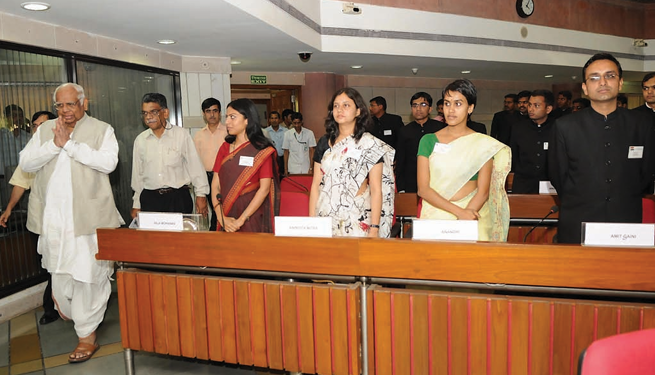
The Ecole Nationale d’Administration in France is one existing model for the proposed National Institute of Public Administration. There are others.
That the bureaucrats should be made accountable for their acts of commission and omission is unexceptionable. That they should be shown the door if they are unable to perform is an equally sound principle. The Moily Commission should be complimented for having suggested two intensive performance reviews and that those found unfit after 20 years should be denied further government service. The Commission should also be congratulated for suggesting a suitable provision in the imminent Civil Services legislation to limit the initial period of employment to 20 years.
However, any well-founded system can be made effective by honest enforcement. The extant system of performance appraisal could have delivered results provided everyone concerned – bureaucrats, politicians, social thinkers, mediapersons – had cooperated, unmindful of vested interests. Unfortunately, each one has tried to snatch self-interest from the system.
No system – not even the proposed one, which I consider praiseworthy – will succeed if various stakeholders unscrupulously try to get around it. However foolproof the system may be, we Indians have a genius for finding ways to bypass it for our own narrow advantages. Corrupting systems seems to be our forte.
The solution lies, perhaps, in doing something about our national character. It may sound like philosophical rhetoric, but there’s no denying the fact that societal values have been increasingly eroding over the decades. And no concerted effort has been made by our leaders to redeem national values.
Nevertheless, if the proposed measures for inculcating bureaucratic accountability are to have a salutary impact on administration, the bureaucracy needs to be made fairly independent of political control. Obviously, civil servants cannot be expected to function in corporate style without consideration of social and political realities, but a certain degree of freedom should be provided to bureaucrats. Accountability with hands tied at the back will be counterproductive. Accountability goes with freedom to make decisions and act on them.
Bimal Jalan says it is high time we introduce a separation within the Executive so that civil servants are directly responsible for their actions.
Additionally, we need more specialization in public administration. The relative weight of specialists and generalists in government is currently lopsided. The structure of various services should be oriented towards specialization through recruitment, training and career planning. These two aspects demand urgent attention from the policymakers.
Civil servants cannot be expected to function in corporate style without consideration of social and political realities, but a certain degree of freedom should be provided to bureaucrats. Accountability with hands tied at the back will be counterproductive

Prabhat Kumar is an Indian Administrative Service officer of the 1963 batch, he served as the Cabinet Secretary of Government of India between 1998 and 2000. Upon creation of the State of Jharkhand in November 2000, he served as the first Governor.