






















Over the last month the media has carpet-bombed the nation with a combination of news, views, editorials, opinions, snap polls, and instapunditry about the Indo-US nuclear deal (123 Agreement) and its political fallout with such ferocity that we ordinary mortals feel shell-shocked. Our instinct right now is to head for bomb shelters to protect ourselves from the confusion raining down on our heads from television screens, Internet blogs, and newsprint. What’s really going on? Who are the Good Guys, who are the Bad Guys? Is Uncle Sam trying to smother us in a neo-Imperialist bear hug? What does the Left really want? Has our Prime Minister sold us out? Is the media taking sides? Is there a political collapse ahead? Will there be a mid-term poll? Are the BJP and Marxists pursuing a new Minimum Common Programme? Who is sleeping with which enemy? What is the geopolitical context of this entire controversy…? The gfiles editorial team retreated into its private bomb shelter – our editorial office – to cogitate on some of these issues.
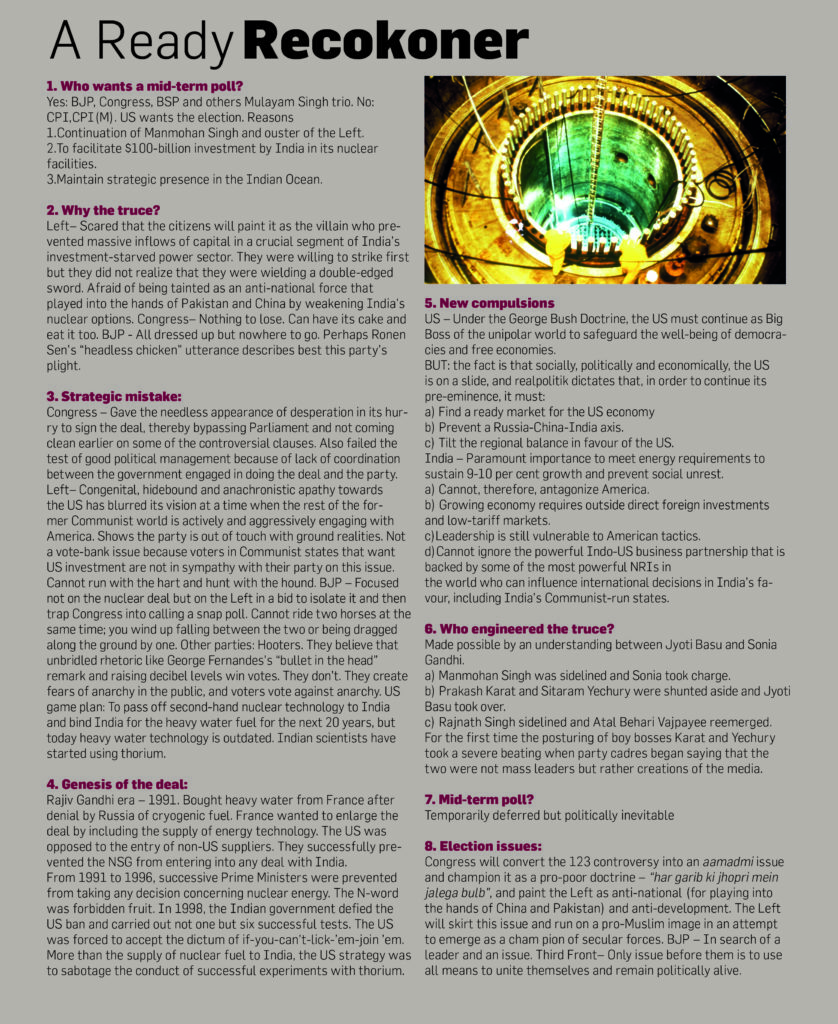
We carried no research documents or news clips. Debate and analysis – based on hard talk, common sense, experience, and a sense of history – ensued. Five hours later, we began to see with a little more clarity. We publish below the results of our cogitation. Because we are weary of information overload, we did not want to burden our readers with copious copy and reams of tortuous intellectual bafflegab. They are simplified – but not simple – answers to basic questions being raised by the housewife, the man on the street, as well as bureaucrats who run the government. Their merit can be tested easily against ground reality. You may be accurate in describing this as a professionally-prepared ready reckoner – an unbiased and quickly digestible brief, call it a cram paper if you will! – prepared by a savvy district collector. In this package, we also include two articles with strong points of view – one by a former senior civil servant and the other by a former IFS ambassador – that we believe address the two core issues that concern India as a nation: energy security and executive accountability.
Have India’s long-term energy security needs been sacrificed at the altar of business and economy?
At the height of political turmoil threatening the survival of the UPA government, Prime Minister Manmohan Singh sent a strong message to parties opposed to the Indo-US civil nuclear cooperation. At an ONGC function on August 20, he said that nuclear power plays a crucial role in pursuing a sound “energy security” strategy. The implication was that the 123 Agreement would provide energy security for India and that those who oppose it do not have the national interest at heart. This revelation was conspicuously absent in the PM’s 3,516-word statement in Parliament a few days earlier stoutly defending the deal, where there was hardly any mention of energy security. Now, unable to explain away the compromise of India’s “strategic security,” he has turned to “energy security,” obviously as a subterfuge.
Since energy security through the nuclear route seems to be the raison d’être of the 123 Agreement, this needs to be scrutinized closely. Energy security, or security of supply, is indeed a key component of energy policy. Since all economic activities require the use of energy resources, the continuing availability of energy at a price that protects economic growth is a genuine Indian concern. If nuclear power is to provide energy security, it has to fulfill certain essential requirements – it should be free from danger, injury, anxiety, or fear, should have a critical mass, and should come with a guarantee that the obligation of uninterrupted fuel supply will be met.
Nuclear power is not free from danger or injury and it does not provide freedom from anxiety or fear.This is whatThe MIT and Harvard University Report of 2003 says: “The prospects for nuclear energy as an option are limited by four unresolved problems: high relative costs; perceived adverse safety, environmental, and health effects; potential security risks stemming from proliferation; and unresolved challenges in long-term management of nuclear wastes.” The Oxford Research Group, in its July 2007 Report, endorses this and states: “For these risks to be worth taking, nuclear power must be able to achieve energy security and a reduction in global CO₂ emissions more effectively, efficiently, economically and quickly than any other energy source. There is little evidence to support the claim that it can, whereas the evidence for doubting nuclear power’s efficacy is clear.”
Nuclear power is costly, unsafe, risk-prone, and ineffective in combating global warming. The US will not meet the basic obligation of uninterrupted fuel supply. The “deal” would cater to only about 10 per cent of India’s energy needs at the best of times and, as such, does not have a critical mass. Some of India’s top nuclear scientists have endorsed this view. Let alone making India a “nuclear weapon state,” as trumpeted by the “spin masters,” the deal harms the country’s “strategic security.” The 123 Agreement only codifies technical rules of nuclear commerce. It is subject to the Hyde Act, which includes provisions imposing restrictions on the transfer of technology and barring access to dual-use technologies, thus denying India a full nuclear fuel cycle. The US President has to report to Congress every year on how India is complying with the provisions of the Hyde Act. The Act enjoins on the administration the prevention of fuel supplies and equipment from other countries to India if the US terminates the bilateral agreement.
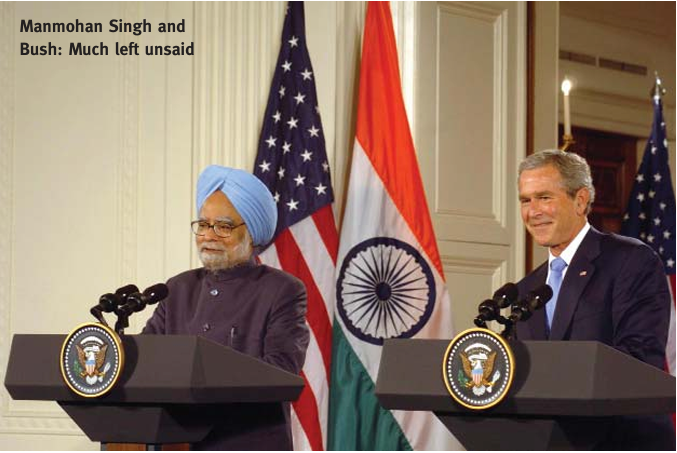
Nuclear power is costly, unsafe, risk-prone and ineffective in combating global warming. The US will not meet the basic obligation of uninterrupted fuel supply
The Indian agenda of energy security and strategic security is not served by the 123 Agreement.Then what and whose agenda does it serve? Obviously the American Agenda of garnering $100-billion business in India’s power sector! Starting from the early 1990s, USAID has been dominating the dialogue on India’s power sector reforms. It was this agency that was responsible for dumping the energy efficiency/renewable energy approach and instead adopting a supply-sided restructuring model suggested by certain US consulting companies. Under this model, State Electricity Boards were to be dismantled and turned into “independent organizations” with “unbundled functions.” These entities were to be privatized to facilitate US power utilities taking them over. Despite full backing and funding by the World Bank and Asian Development Bank, this move did not succeed. To make this happen by triggering the market, the Electricity Act, 2003 introduced the “open access” mechanism. Under this, theoretically, any generator can sell to any consumer and any consumer can buy from any generator. This also has not taken off.
Both the “restructuring” and “open access” models were meant to pursue a private benefit agenda of “quest for profit.” The former favored privatization and Independent Power Projects, while the latter facilitated IPPs cherry-picking high tariff-paying customers, leaving the others in the lurch. Yet, the $100-billion business did not materialize. So the “reformers” have now taken the nuclear route through the 123 Agreement and are enacting a big charade to sell it to the gullible public. Manmohan Singh addressed the US Congress in July 2005, pleading for the nuclear deal and stating that US investment could spur India’s economic growth and bring in $100 billion in the next decade for nuclear power plants.
This was done despite the fact that India has several options in the energy field that can provide the needed security without compromising its sovereignty. These include gasification combined cycle processes for clean and efficient coal-fuelled generation, which has huge potential; pithead clean-coal power plants; coastal plants with imported coal; large, massive untapped renewable sources of energy including hydro power; reducing energy intensity and substantially augmenting efficiency in the use of energy resources and generated power; accelerated domestic oil and gas exploration; alternative energy technologies like hydrogen fuel; and the Indo-Iran gas pipeline. As it transpires, the real agenda seems to be energy security for the US and not India.
The growing energy demands of the Indian and Chinese economies had raised concerns among US policy-makers regarding global energy availability. The Indian shift toward nuclear energy is in the best interests of America to secure its energy needs of coal, crude oil, and natural gas; hence the deal. The $100-billion business for US companies in India is only icing on the cake. Yet the Prime Minister insists that the deal is “honourable” and in India’s national interest.

The stand that government can ignore legislative scrutiny is a misguided assertion of ‘executive privilege’
By Niranjan Desai
Reams of paper have been devoted to the merits and demerits of the 123 Agreement, but no one, barring Justice B.P. Jeevan Reddy, has raised a fundamental constitutional issue – the right of Parliament to examine and ratify international agreements or treaties that have a fundamental bearing on all major aspects of the future of the country and its citizens. Justice Reddy, a former judge of the Supreme Court and former Chairman of the Law Commission, has eloquently argued the issue in an op-ed piece titled “The Nuclear Agreement and Parliament” in The Hindu. He lays to rest the myth perpetuated by successive governments, including the present one, that the executive has a “prerogative power” immune from parliamentary scrutiny in matters regarding entering into treaties and agreements with foreign countries, and in implementing treaties, agreements, and conventions with foreign countries. This is similar to the seminal issue underlying the Watergate scandal in the 1970s – President Nixon’s invocation of the self-christened doctrine of “executive privilege,” which struck at the principle of separation of powers. The US President was, in effect, trying to shield the executive from scrutiny by the legislature.
The Asian Age of August 14, 2007, quoted External Affairs Minister Pranab Mukherjee saying that international treaties never come up for ratification before Parliament and that there can be “no occasion to have a substantive motion (on the 123 Agreement)” nor can there Be a “sense of the House” resolution. This posturing flies in the face of the express provisions in the Constitution. As Justice Reddy argues, Clause (3) of Article 75 states that “the Council of Ministers shall be collectively responsible to the House of People” and therefore it follows that every sphere of activity of the executive is accountable to Parliament. Thus, Parliament has unrestricted power derived from the Constitution not only to examine but, if it chooses to do so, approve or reject any international agreement or treaty.
The context and manner in which the 123 Agreement has been negotiated makes it imperative for Parliament to insist on a substantive discussion on and approve or reject, as the case may be, all international agreements before they become operationalized.
In the case of the 123 Agreement, the first thing that strikes one is that the whole process of negotiation has been asymmetrical. On the US side, both the executive and the legislative branch had been involved in laying out the framework for the agreement and that accounts why a whole lot of extraneous issues like relations with Iran have been incorporated into the Hyde Act which is the US national law which will govern the 123 Agreement despite our government’s assertions to the contrary. Besides, the agreement now reached between the two governments will again come up before the US Congress for final approval before it is operationalized.
The Indian side displayed Machiavelian secrecy and sought to mould opinion, rather unsuccessfully, through media briefings and leaks to friendly journalists and hangers-on
Now look at the Indian side. The negotiations had involved only a handful of people with no input whatsoever from the legislature. The general attitude has been disdainful of the opinion within India as exemplified by the Prime Minister when he told the Left parties that either they accept the agreement or lump it. It was even implied that those who questioned the government’s wisdom were lacking in patriotism. There has not been any major substantive discussion on the issue in Parliament; the Prime Minister has made two suo moto statements with a number of promises which his critics say he has failed to fulfil. As a result of this, the process was relatively more transparent in the US and the public and informed circles in India received most of their information from US discussions and debate rather than the Indian side. Instead, the Indian side displayed Machiavelian secrecy and sought to mould opinion, rather unsuccessfully, through selective media briefings and leaks to friendly journalists and other hangers-on.
It therefore defies logic that the executive has been reluctant to have any substantive discussion on an agreement which will impact and influence in a substantive manner the economic, political, military, strategic, foreign and energy policies of the country over the next 40 years. Besides This agreement has seriously fractured the broad consensus the country had enjoyed over foreign policy for the last 60 years. Hence the pathetic show with walkouts and shouting in both Houses of Parliament on August 13, 2007 when the Prime Minister rose to defend the agreement.
The previous practice of merely informing Parliament, as in the case of the Indo-Soviet Friendship Treaty (which is being quoted as a precedent), belonged to a different era when a single party dominated Parliament. Currently, where minority coalitions rule with support from outside, Parliament must exercise its due Constitutional right and hold the executive accountable for all its actions.
The Executive mindset needs to be reminded that the days of dictatorship of the executive are over. Threats of resignation or a show of peevish stubbornness cannot wish away the fundamental Constitutional reality which is the principle of accountability of the executive to Parliament.

IAS (retd) with a distinguished career of 40 years - worked in Army, Govt, Private, Politics & NGOs.