























A blueprint to bring succour to the poorest of the poor
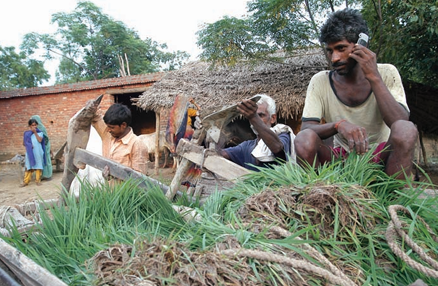
Every five years, the electoral battle is fought and won but the battle to build a dignified and contented India rages on without pause. The biggest challenges every government faces are essentially linked to rural India – to elimination of poverty, creating adequate rural infrastructure for adequate growth, creating employment, building a reliable public healthcare system, providing affordable and standard education, providing access to land for the rural poor, disseminating technology, creating a hassle-free system of providing agricultural inputs in time, funding capital investment in the agriculture sector, creating a dependable source of water harvesting using watershed technologies, and reconciling the conflicts in rural areas.
Far from flourishing a wish list before the new government before it has even got down to business, the following is intended to remind it that its tasks are already cut out for it. It is not sufficient to carry on with the agenda of the previous government, new dimensions must be added.
National Rural Employment Guarantee Scheme (NREGS)
The National Rural Employment Guarantee Scheme (NREGS), for all its success, is under a statutory frame which imparts rigidity to it. It needs to be given a flexible structure which will permit local variations to blossom without compromising on its essentials. Being a manual labour-based programme addressed to certain activities, it has obvious limitations. What will happen when all the ponds have been dug and the waterworks excavated? A knowledge component has to be added.
NREGS has to move towards integration with other programme structures. It must develop into a bridge for different programmes. The “100 days’ work” principle must be used as a value addition programme by investing in the human environment and generating new human potential. Further, opportunity must be provided for the rural worker to use the 100 days of work to learn new skills or to upgrade skills, thereby improving his/her market potential and value.
The evolution of human capital into social capital must be stimulated and sustained through the instrumentality of new democratic rural institutions such as Self Help Groups (SHGs). It must be recognized that the SHG functions in the realm of participatory democracy which is necessary for its sustenance.
A system of increased self-reliance of the worker must be developed due to increased marketability and returns. Returns on labour must be increased even while reducing the burden on the exchequer as more “rural workers” move out of “needing wage employment” into “needing new markets for his/her skill”. The programme must restore dignity to “labour” and “livelihoods”.
Sampoorna Gram Swarna Jayanti Yojna (SGSY)
The essential content of this programme lies in its social mobilization; it helps to create the capacity among the poor to organize themselves. The target-oriented approach must be reformatted to allow people to undertake self-mobilization. The financial ceilings of the programme have to be relaxed and lending must be need-based.
Our present form of banking and other institutional finance is heavily urban-oriented and designed to serve urban customers. Even implantation of banking institutions into rural areas has not brought in the required change. Successful SHGs and their federating institutions can be allowed to grow into formal banking institutions while retaining their flexibility. The government may frame legislation regulating the bare essentials.
The concept of self-managed Village Banks using peer pressure and self-regulatory mechanism may be put in place. Greater integration of the SHGs into the NREGS and the social security programme structures is needed. The delivery of NREGS is better where implemented through the SHGs.The Special SGSY is a wonderful programme that builds capacity among the rural youth and integrates them into the urban job market. It needs to grow with special focus on the absolute poor, Dalits, minorities, the landless and those left out of the State-sponsored development process and their greater integration into the private sector and both national and international labour markets.
There must be an adequate flow of technology into the rural sectors; an institutional mechanism in the form of Technology Bank (TeBank) has been conceived for auditing, selection, dissemination and adoption of the appropriate technologies, providing the marketing and institutional finance support and developing a platform of the technology providers, users, marketing firms and banking and other financial institutions. The SHG must be viewed as the pin that holds the two flanges of a hinge together, one flange being the NREGS and the other the SGSY. There has to be greater reliance upon the instrumentality of SHGS for delivery under the NREGS for planning and execution. Possibilities must be developed for the SHG to raise their own resources and finance the productive endeavour of the new “skilled” worker. A way must be paved for a transition from wage employment to self-employment.
Institutional Support to Rural Endeavours
The success of rural endeavours depends upon the robustness of institutional support. Panchayats have been designated “units of self-government” in the Constitution and it has been left to the states to empower them suitably. The empowerment and growth of Panchayati Raj Institutions, however, is differentiated despite the fact that they deliver more than 85 per cent of NREGS. It has to be realized that the PRIs have to be empowered as units and not in parts and the support has to be of a much greater degree.
The Government of India must take a holistic view in this matter and rise above inter-ministerial rivalries/squabbles and strengthen the Panchayats for being the main instruments of delivery. It must be recognized that the SHG is not adversarial in its instrumentality to the PRIs, but can support and supplement the PRI as an institution of the community. The Kudumbashri model is a highly apt model but its replicability would depend upon the institutional base in the state.
The empowerment of the Panchayats is plagued by rivalry with the state government articulated through the institution of the Collector. The West Bengal model unifies the two within a single structure. The states must be persuaded to adopt this model. A part of their budget must be devolved to the Panchayats as untied funds.
Training is the weakest link in Panchayats. The national capability building format has to unfold as a national programme. Panchayats must be provided e-connectivity and evolved as a business model to make them self-sufficient. Also, the institution of social audit must be developed as an internal mechanism within the Panchayats on a wider scale. There must be a special incentive for the resources mobilized by the Panchayats.Network and linkages amongst the Panchayats must be created.
Rural Infrastructure
The level of the specification of rural roads must be raised to urban standards. There must be more investment in rural housing, taking Andhra Pradesh as a model, and in solar lighting and small power stations. Village youth must be trained in maintenance of solar lights and the micro and agro-waste based power stations. Public distribution must be handed over to the SHGs and a “Food Bank” created in villages for food security through procurement in the local markets. The coarse grains must be used for the PDS and the Village Food Bank. A “Fertilizer Bank” must be created in every village to make fertilizer locally available and the fertilizer pricing policy must be revised.
Training
Training is the most neglected aspect of our management of the rural development programmes and constitutes its weakest link. It is a committed position that not less than 1 per cent of the budget is to be spent on training. At present the Ministry spends hardly Rs 60-70 crore on training. This expenditure must go up to 1 per cent.
It is not a question of expenditure alone. The training institutions must build up absorptive capacity in respect of the additional outlay on training. An apex institution must be selected as the lead institution and it must be allowed to develop a network internalizing the State Institutes of Rural Development, the Extension Training Centres, the Agricultural Universities, engineering colleges, private institutions and the civil society based organizations etc.
The need for training has gone up with the phenomenal rise in the quantum of Central and State Sector Programmes. Training is required more at the district, Intermediate Panchayat and Panchayat levels. There are some 90 Extension Training Centres at the district level as a part of the national network of training institutions for capacity building. District Training Centres must be set up for co-ordinating the training at the district and sub-district levels.
The pedagogy in the existing training institutions is heavily lecture oriented. It must switch to case studies, games, field visits with clearly stated course objectives and learning outcomes, and inbuilt evaluation mode. The best doers are also the best trainers. Successful SHGs, Panchayats, co-operatives and CBOs should be encouraged to develop into training institutions. Strong incentive-disincentive structure must be in-built in the training programmes so that the trainees take it seriously.
The very poor, the Dalits, minorities, the landless and other marginalized sections need a group-wise and region-wise differentiated training programme structure. Technology and placement linked skill formation must take priority over other modes of training. India must extend its training institutions and its training skills with the countries in Africa, Latin America, the Caribbean and, of course, South Asia, Southeast Asia and West Asia as an extension of its diplomacy. The infrastructure and the other facilities of its training facilities in its institutions must be world class.
Planning
Delivered development is a dangerous thing. Despite decades of effort, grassroots planning is not in evidence in many places. Instead of setting up innumerable committees and devising complicated models, the government should select from amongst existing ones.
The groups which have devised and implemented these models should also be given responsibility for their dissemination. Micro-planning and district planning should form a major component of all training programmes.
Conflict Resolution
Liberal democracy is on trial for its failure to speed up the pace of development and make the process inclusive. The Left-inspired radical movements pose the greatest challenge to democracy so far and exercise a disruptive effect upon rural development programmes. The only solution tried so far is that of the gun. There is an imperative need to try other solutions of which there are several models.
Differentiated programme designs must be encouraged to emerge from the affected areas and the actors involved. There is need to adopt inclusive strategies for such groups and allow space for them in the democratized programme structure. Local self-government institutions must be allowed to assimilate such groups and allow space to them.
In general, our entire programme structure should be not in delivery mode but allow growth from the people. The government should have the capacity to recognize and incorporate such programmes.There should be no insistence on uniformity in the programme structure. No scheme can apply with the same intensity to all areas and groups. There should be space for flowering of local genius.
The government should always be prepared to learn from the people. Even the most backward have something to give. Above all, the poor must be treated with dignity.
(The author is Director General, National Institute of Rural Development, Hyderabad. The views expressed are personal and not those of the government.)
NREGS has to move towards integration with other programme structures. It must develop into a bridge for different programmes. The “100 days’ work” principle must be used as a value addition programme by investing in the human environment
Banking and other institutional finance is heavily urban-oriented and designed to serve urban customers. Even implantation of banking institutions into rural areas has not brought in the required change. Successful SHGs and their federating institutions can be allowed to grow into formal banking institutions while retaining their flexibility
The empowerment of the Panchayats is plagued by rivalry with the state government articulated through the institution of the Collector. The West Bengal model unifies the two within a single structure. The states must be persuaded to adopt this model
Training is the most neglected aspect of our management of the rural development programmes and constitutes its weakest link. It is a committed position that not less than 1 per cent of the budget is to be spent on training. At present the Ministry spends hardly Rs 60-70 crore on training
