





























The nation’s defence planning and strategy need top to bottom overhauling
India’s emergence as an economic power of global significance and our essential reliance on the sea for energy, trade and projecting influence, is rapidly changing perceptions and arousing the dormant maritime consciousness of the Indian intelligentsia. While India possesses all the attributes and potential of a major power, an inherent cultural diffidence has so far held her back from assuming the mantle of regional maritime responsibility. The challenge thus clearly lies in our minds; and the naval leadership has consistently been trying to re-mould national perceptions. This endeavour is now manifesting itself as the Indian Ocean Naval Symposium (IONS), in which chiefs of 30 regional and other navies are expected to participate. Scheduled in mid-February 2008, IONS will provide a window of opportunity for the Navy’s guests to witness the Def Expo taking place concurrently.
Conventional deterrence and war are indeed the bread and butter of navies, but these remain essentially linked to threats, which tend to wax and wane cyclically with diplomatic activity. Such has been our naiveté and myopia in matters of national security that periodically there emerges a view amongst decision makers that with “peace breaking out” all round, the possibility of conflict is diminishing and that defence spending needs to be cut. On many occasions, just as such a view was about to prevail in South and North Blocks, a crisis has arisen to bring us back to sanity.
Of all the Armed Forces, navies take the longest to build and consolidate; and a growing force like our Navy cannot afford to remain hostage to fluctuating security perceptions. The challenge for our Navy lay in reducing emphasis on threat perceptions as the sole arbiter in the force planning process, and bringing opinion (within and outside the Navy) around to focus on India’s long-term permanent interests in this context.
In 2004 the Navy issued its Maritime Doctrine which defined India’s core maritime interests as well as the roles and missions of maritime forces. With India’s long-term maritime interests as the focal point, an exercise was then undertaken by the Navy to prepare a plan to prioritize the capabilities (as distinct from number of platforms) required to safeguard these interests in the context of predicted fund availability. This was followed in 2006 by a document titled “Freedom of the Seas: India’s Maritime Strategy”. The Navy has thus equipped itself with the intellectual underpinning for planning its future hardware acquisitions, as well as a concept of operations.
Facing up to obsolescence
We were fortunate that the seeds of a self-reliant blue water Navy were sown by our farsighted predecessors when they embarked on the brave venture of undertaking warship construction in India four decades ago. Since then, our shipyards have delivered more than 85 ships and submarines, many of Indian design, to the Navy.
While the hull and even the propulsion machinery of a warship is meant to last for two-three decades, what naval planners dread most is the onset of obsolescence of weapon systems as soon as the ship is launched. This is a very real challenge because a ship may take anything from six-eight years to construct (in Indian conditions), and since the imported weapons/sensors when nominated for fitment were already in service, they would be at least 10-15 years old by the time the ship becomes operational. Thus when the ship completes just half her life, the on-board systems are already over 25 years old and rapidly losing efficacy against contemporary threats.
The latest warship delivered to the Navy in 2005,INS Beas, was stated to be80-85 per cent indigenous in content and this is heartening. But we must face the stark reality that the remaining 15-20 per cent consists of weapons, sensors and combat management systems, which define the fighting potential of the ship. These systems not only constitute the most expensive component of a warship, but are also most susceptible to obsolescence and have so far remained beyond the capability of DRDO as well as the Defence PSUs to design or produce.
In a desperate effort to beat obsolescence, the Staff Qualitative Requirements (SQRs) are often pitched at levels derided as “unrealistic”, and then not frozen till as late as possible. This has been termed as the classic struggle between “good enough” and “best”.
Dependent as we have been, to a very large extent, on various constituents of the former Soviet Union, our shipbuilding endeavours have remained hostage to their opaque, unresponsive and sluggish system of negotiations, contract and supply. This reliance introduces an element of uncertainty into the construction schedules and is the single most common cause for cascading time and cost overruns that we have faced in our recent warship building programmes. While this has often led the Ministry of Finance to heap scorn on NHQ and MoD for “poor programme management”, they completely overlook the courageous leap of faith that the Navy has taken by shunning the easier import option and going down the thorny road of indigenous warship design and construction. The Navy could easily have taken the easier route followed by its sister services and remained captive to foreign vendors.
This problem has been engaging the Navy for a considerable period. A hard decision had to be taken that the SQRs should be made more realistic, so as to accept current systems, which are “good enough” to counter extant threats. As a corollary, as soon as a unit (ship, submarine or aircraft) enters service, it would be assigned a date for a mid-life update (MLU) a decade or more down the road. This would permit adequate time for the “best” contemporary systems to be developed and made available for the MLU.
The ultimate and only acceptable solution is, of course, to become self-reliant and that constitutes the next challenge.
Procurement hurdles
One of the less obvious but crucial factors impinging on the force planning process (and consequent combat readiness) of our forces is the efficacy of the existing procurement procedures. The absence of a national security doctrine, as well as long-term funding commitment, are debilitating factors for coherent defence planning. But an intractable and ponderous procurement procedure can have a significant impact not just on current, but also future force accretion plans. Witness the void in fighter capability which the IAF currently faces.
The Defence Procurement Procedure (DPP) has undergone a series of evolutionary changes since its inception in 2002, and the definitive document was released in mid-2006.While the DPP has organized and streamlined the processes involved and made them as transparent as possible, only time will tell if following these procedures adds to the acquisition time-cycle instead of reducing it. One of the possible pitfalls in this context could be the 30 per cent offset clause, which has been made mandatory for all contracts above Rs 300 crore. Identification of offsets by the bidders and comparison of competing offsets by the MoD could both be complex and time-consuming exercises.
A factor which creates serious impediments in the procurement process is the current procedure, which subjects each case to the scrutiny of four layers of bureaucracy: the Service HQs, the Department of Defence, the Department of Defence Finance and the Ministry of Finance. After this some cases need CCS approval. With many queries to be answered, and every file movement taking weeks, if not months, one financial year is simply not enough for most cases to be cleared. Financial authorities have unfettered freedom to examine and re-examine issues, but no corresponding accountability for delays in procurement, which have a cost in terms of national security, lives of troops in the field or monetary loss to the exchequer.
The Navy could easily have taken the easier route followed by its sister services and remained captive to foreign vendors. It has chosen the thorny road of indigenous warship design
This system defies all logic and it should surprise no one that the MoD has to frequently surrender funds voted by Parliament for defence of the country. It has often been suggested that file movements need to be replaced by a culture of “collegiate functioning”. Functionaries should process cases by discussion on the phone, walking into each other’s offices and calling for regular meetings and discussions. The important observations and decisions can finally be endorsed on file for record.
Impediments to self-reliance
If there is one lesson that the Indian armed forces should have learnt during the past few decades, it is about the hazards and pitfalls of depending on foreign sources for defence hardware (which invariably comes with embedded software now).The days of “friendship prices” are behind us and no matter what the source, we are paying top dollars for everything we buy in the ruthless international arms bazaar. The recent antics of the Russians in the context of contracts which have been laboriously negotiated, signed and sealed is a clear illustration of how we can be held hostage by an arms supplier. We must therefore remain acutely conscious of the fact that every time we contract a weapon system or platform of foreign origin, we compromise a little bit of our security because: we become dependent on a foreign power for yet one more combat system/platform for its complete life cycle; the equipment manufacturer will progressively keep hiking the price of spare parts and overhauls without any rationale; availability of product support (including spares) will keep declining, till it affects our combat readiness; unless adroitly negotiated in advance, the software source codes will be kept out of our reach to hamper inhouse repairs.
Apart from all these we have now repeatedly been witness to the spectacle of overseas defence purchases being used as weapons of vendetta by powerful vested interests as well as politicians. It seems to be now child’s play for anyone inimical to India’s vital interests – an arms lobby, a foreign intelligence agency or even our own media – to put a spanner in the works by making allegations (real or concocted) about malfeasance in an arms contract, and bring the modernization of India’s armed forces to a grinding halt .As a consequence, the acquisition process is being repeatedly stalled because the bureaucracy has been frightened into total inaction; perhaps with good reason.
Two remedial actions may possibly stem the rot setting in.
First, the acquisition process needs to be made as transparent as possible within the bounds of security parameters, so that foreign firms do not feel the need to enlist self-appointed lobbyists. Second, a legitimate methodology for political parties to raise funds needs to be instituted so that arms contracts are no longer seen as lucrative sources of election funding. This will ensure that influence peddlers do not hoodwink foreign vendors to muddy the waters and endanger national security, while feathering their own nests.
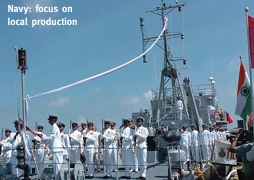
The ultimate solution is, again, to encourage our indigenous R&D as well as industry and to become self-reliant as soon as they can. The Navy’s recently established Directorate of Indigenisation has made a good start by focusing on the local production of systems and sub-systems of the Scorpene and the aircraft carrier projects and the response from the industry has been encouraging. But the path of self-reliance is neither easy nor free of pitfalls.
Working in compartments
Such a culture of collegiate function can come about only if the wall which has been created over the years to circumscribe the Service HQs and keep them outside the government is demolished. We need to clearly recognize the deep impact that the changing nature of warfare is inevitably having on the force planning process. At the lower end of the spectrum, we need to cater for asymmetric warfare, while simultaneously preparing for conventional conflict. The higher end of the spectrum requires us to plan for credible nuclear deterrence, many elements of which will sooner or later come within the ambit of routine force planning. It will become increasingly difficult to meet the demands of such planning under the system we currently have in place.
The best and oldest democracies in the world have retained firm “civilian control” over their armed forces, by subsuming them within the central edifice, and integrating their functioning with that of the government. Today we must be unique amongst the major powers in having deliberately sequestered our armed forces and placed them under bureaucratic (instead of political) control. The key to efficient functioning of the nation’s security establishment lies in integrating the Service HQs totally with the MoD and involving them in the national security decision-making process. To implement this long overdue but essential change would require vision, firm resolve, and above all, political will – none of them commonplace in our environment.
DRDO, when not engrossed in ‘demonstration’ projects, has often struggled for years at great expense to reinvent the wheel