







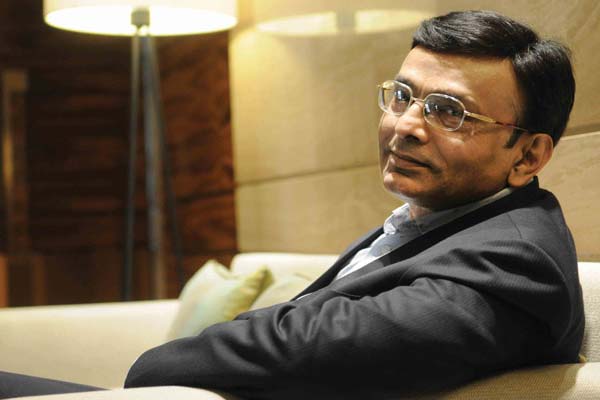







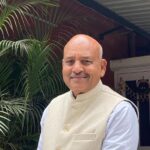



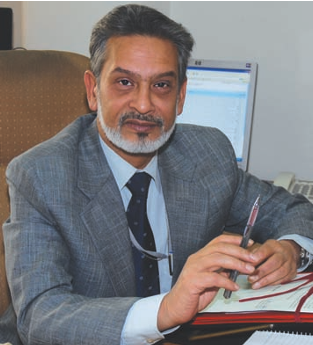
Dr Pronab Sen,Chief Statistician and Secretary,Ministry of Statistics and Programme Implementation,generates key data on all our economic indicators such as Gross Domestic Product, index of industrial production, price indices and national sample surveys. Before becoming Chief Statistician, Sen spent 12 years in the Planning Commission where he played a key role in shaping government policy in areas which included civil aviation,agriculture and pharmaceuticals.He was reportedly the frontrunner to be chief economic adviser in the Finance Ministry before Montek Singh Ahluwalia was brought into Yojana Bhawan. Sen acquired MA and MBA degrees from George Washington University and a doctorate in economics from Johns Hopkins University.He also possesses expertise in development issues.
gfiles: How close do you get to mapping information regarding the employment opportunities available to people in both the organized and unorganized sectors?
Pronab Sen: This is a very difficult job. The employment exchange does not work in India.Rather,it works only for the government and public sector,it does not work for the private sector.Therefore it cannot be considered a sensitive indicator of what is going on because it covers only a part of the overall job scenario. People whose names have been listed in the employment exchange may get jobs but then will not inform they have got jobs.As we develop further,employment is going to become a critical issue and we will need to track this on a much more frequent basis. Our National Sample Survey Organization (NSSO) data is released every five years.Our surveys are planned for a year and then repeated year after year though employment in rural areas is subject to a great deal of seasonal variation with the monsoon months being a period of low employment.
Other nations track employment on a quarterly basis. One of the reasons for this is that the bulk of their employment is in the organized sector.We cannot compare India’s data collection with other Asian nations.Take a major power like China Their data collection is pathetic. They do not collect data on the rural price rise at all. We, on the other hand, have a weekly consumer price index and also a monthly wholesale price index.
gfiles: Your ministry publishes data on employment, vocational training, nutrition, education and energy consumption patterns. What are your latest findings in these fields?
PS: Our employment-related data is okay at the national level but we do not collect data for states. States like Andhra Pradesh and Tamil Nadu have good records in tracking employment-related data but other states are very poor.They don’t have the capacity to track data and rely on what we put together.We do not track data on commercial energy consumption as that is done by the Ministry of Power which gets its information from the state energy boards. Coal consumption is put together by the Ministry of Coal though we do collect information on households using alternate sources such as energy generated from the use of dung cakes, gobar gas and wood. But in terms of growth, we remain the primary data agency. We track growth levels on a quarterly and an annual basis especially in terms of poverty alleviation.
gfiles: What is the bench line used to gauge poverty removal?
PS:The UN Statistical Commission lays down indicators that every country must use as their benchmark.The UN system of national accounts looks at the overall GDP, broad sectoral breakups such as investment, savings, household expenditure, public consumption and other details.What the public gets to see is a fraction of what we collect.
gfiles: Despite all this emphasis on data, why have the anti-poverty programmes failed to make a dent in removing poverty on the ground.What is your assessment?
PS:Their failure is largely an implemen tal issue. Most of these programmes are not designed to take people above the poverty level.They are only designed to ensure levels of deprivation are kept under control.Take the example of the National Rural Employment Guarantee Act (NREGA). It helps assure an indi vidual gets 100 days of work at Rs 60 per day which works out to a maximum of Rs 6000 per family over a 12-month period. It only provides a safety net.
‘If you want to
teach carpentry,
you would need to
hire an experienced
carpenter – someone
around 45 years of
age. But government
rules forbid hiring
anyone of that age’
gfiles: Why does the government not raise more funds from funding agencies to assist in poverty alleviation?
PS: If we start using loans for essential consumption,then how are we going to repay those loans?
gfiles: Should the tax net be increased?
PS: Our tax system is not so bad. At present,17 per cent of the GDP is being taxed. This is the non-black money component of the economy.
gfiles: How much has poverty actually declined?
PS: Between the early 1970s and 2001, poverty came down from 52 to 28 perCent. We have 300 million people living below the poverty line earning as little as Rs 12 per day in rural India. But 70 per cent of rural India is earning Rs 20 a day, and this population chunk is living above the poverty line.
gfiles: That does not sound like too much money.
PS: We are looking at the rural economy. In rural India, food prices are low, rent is low, and the cost of items like water and electricity are negligible. It is in urban areas that rent and food have come to comprise the main expenditure for families. The real issue is how do people move forward on such incomes, given the fact that land per person is going down. When we go to the remotest villages in our country, we find a perceptive change among even those living below the poverty line.
‘The mid-day meal programme is costing
us Rs 3,500 crore. (But) in Himachal Pradesh,
kids pack the food and feed it to the cattle’
gfiles: What kind of change?
PS: We can understand this by simply looking at their food consumption patterns. In the aggregate, protein consumption has gone up while calorie consumption has gone down. Earlier, 82 Per cent of a family’s expenditure was on food; now that figure has gone down to 60 per cent. Families have widened the extent of goods and services they use. Within food items also, consumption of cereals has gone down, while consumption of non-cereals like milk, food, eggs, meat has gone up. People have succeeded in diversifying their incomes. Diversification of income sources holds the key to the future. We need to equip the poor to move off the land to other activities.
gfiles: Will the Sarva Shiksha Abhiyan help reduce poverty?
PS: The Sarva Shiksha Abhiyan has ensured a dramatic increase in kids going to school. It used to be 55 per cent of kids, now the number has gone up to 80 per cent. But these kids will hit the job market 15 years from now. What About those kids who are hitting the job market today? They remain our main source of concern. Do they possess the skills to take advantage of the job market? Obviously not. Rather belatedly, the government is focusing on vocational education. The Ministry of Labour is putting a lot of emphasis on vocational education. This is easier said than done. Finding teachers to teach vocational skills is difficult. For one, it requires people willing to adopt a hands-on approach. This is difficult to find in a government set-up. It would require the changing of mindset. If you want to teach carpentry, you would need to hire an experienced carpenter – someone around 45 years of age. But government rules forbid hiring anyone of that age.
gfiles: You are emphasizing the need to become flexible.
PS: The agriculture sector is not going to throw up jobs. A large number of the rural poor are marginal farmers or else are landless agricultural labour. With average farm sizes shrinking, several Farm families no longer employ landless labour. They prefer to do their own work. This has created a serious crisis for landless labour. The NREGA scheme will help but not solve the problem. The question is, what kind of skills can be imparted to this landless group? The other question is, can they afford to take up some training? This requires time and even if they do take up a course, how will they support themselves during this training period? There is a grant component to these schemes but we must understand that a 25-year-old has responsibilities beyond himself. It is the non-farm employment segment which is going up substantively.
gfiles: You have said there has been a substantive fall in both calorie and protein intake in rural areas, especially in the northern states.
PS: The consumption pattern is moving Away from cereals to non-cereals. Under the cereal-based food security system, the government procures food from farmers and releases it to fair price shops with subsidy. Food subsidies are costing the government Rs 24,000 crore. I believe that, instead of purchasing wheat at Rs 10 and giving it in the BPL quota at Rs 6 and thereby helping the farmer save Rs 4 (and spend Rs 4 on what he likes and that could be alcohol and cigarettes), it would be better for the government to give the farmer a cheque for Rs 4 and let his family decide on how to spend the money.
The family would be better-off getting a better mid-day meal in school. The mid-day meal programme is costing us Rs 3,500 crore. The question is, is it providing kids the nutrition they require? We should not look at the Tamil Nadu example because the state government is helping subsidize the programme substantially. In Himachal Pradesh, kids pack the food and feed it to the cattle. So its impact varies from state to state and from community to community.
Mothers and small children are undernourished. The majority of mothers are anaemic while 40 per cent of kids are undernourished. Their numbers are much larger than those that show up in statistics. This could be a result of ignorance or because the intra-family food distribution is not good. This requires further investigation. I am not for scrapping of fair price shops. The fair price shop makes grain available which is not the case with the private trader because the cost of transporting food to remote areas is very high.
gfiles: How big a network do you have to conduct these studies?
PS: It’s not very big. We are using 3,000 people. It is because of this small strength that we find it difficult to do anything at the state level. We are finding it difficult to get people. We have 600 vacancies at present. Our requirement is for people with a mathematical background. Every week, five or six people leave for better jobs in consumer companies and in banks where the work is less strenuous. Our people have to spend four days in a week out in the villages.