




























Seven lessons, derived from hands-on experience in world governments
FORMER Malaysian Prime Minister Mahathir Mohammad had said, “The quality of an effective government administration cannot be lower than that of its clients—specifically the private sec-tor.” The world has moved away from the so-called Washington Consensus towards the so-called Barcelona Consensus.This has come as a result of an honest review of the development experience since World War II by the World Bank, International Monetary Fund and other major international players. Basically, they have concluded that their (and our) knowledge of eco-nomic growth is incomplete and offered a very different piece of advice from their lessons of experience. According to them, governments should abandon formulaic policymak-ing in which “any reform goes” and concentrate on supporting growth. To do so, they must identify the binding constraints to growth, which, in turn, necessitates recognizing country-spe-cific characteristics and undertaking a more rigorous economic and institu-tional analysis than a formulaic approach would call for.
After the endorsement of this viewpoint by the world’s leading development econo-mists in Barcelona, this view has come to be known as the Barcelona Consensus.
The Barcelona consensus puts the performance of a country’s government at the heart of development. I will list seven key lessons of international experience in designing a performance-oriented government that is accountable for delivering results:
Lesson # 1
Accountability for results only trickles down and does not “trickle up”.Thus, the design of the system should focus on holding the top accountable for performance and the rest will take care of itself.The Government Performance and Results Act passed by the US Congress in 1993 illustrates this point well.This Act required the President of the United States to sign a Performance Agreement with each of his Cabinet Secretaries. By holding the top accountable for results, the US President was able to let the accounta-bility for results trickle down to all lay-ers of the US bureaucracy.
Lesson # 2
The design for a performing govern-ment should focus on accountability for “results” and not accountability for “processes”. Since many governments believe that it is difficult to measure results in the government, they find it convenient to specify procedures that will lead to the desired results. Unfortunately, procedures in govern-ment have a tendency to spawn more procedures and eventually the govern-ment gets overwhelmed with its own rules and regulation. The infamous “licence raj” was a classic example of this phenomenon.
Lesson # 3
Accountability for results requires an effective performance evaluation sys-tem in the government. All experts agree that what gets measured, gets done.There is no point in setting goals and objectives if you cannot determine whether you are achieving them or moving away from them.
As I write this, I see many govern-ment officials nodding in agreement and claiming they do have evaluation systems in their governments. I ask them to evaluate the quality of their evaluation systems using the following four criteria: (a) Do you have an evalu-ation system that covers all aspects of your department’s performance? Often, many evaluation systems cover processes or other easily measurable aspects of government functioning. (b) Does your evaluation system separate and make provision for performance areas that are within the control of govern-ment managers and those that are dependent on exoge-nous factors? (c) Do you pri-oritize your performance criteria? (d) Do you have a system to evaluate variation (divergence) of performance from tar-gets? For example, if a government department creates 25 new primary health centres against a target of 30, how are we to judge its performance? Is it very good, just good, average, poor or unacceptable?
If an evaluation system in the gov-ernment lacks any of these four neces-sary conditions, then it is not really an evaluation system. It should be such that three different people using the evaluation system should come to a similar bottom-line result.
Lesson # 4
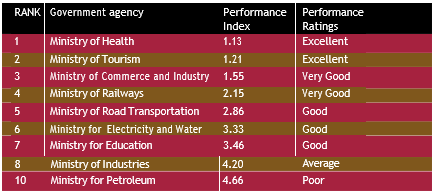
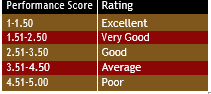
It is not only important to conduct a good evaluation of the government’s performance, the results must be com-municated effectively. The emerging international best practice in this area is clear.Leading performance management systems in government convey results in the form displayed in the adjacent table. The performance of each min-istry/department is ranked on a scale of 1 to 5, where 1 is equal to excellent and 5 represents “poor” performance.
Any performance management system that does not communicate results in this manner cannot have a fully sat-isfactory desired impact.The technolo-gy for creating this index is now stan-dard knowledge in this area. Indeed, the MoU system in India uses exactly the same methodology for rating perform-ance of public enterprise chief execu-tives. There is no reason the Government of India cannot (and should not) use this methodology for ranking performance of its Secretaries. The importance of using an index for objectively and scientifically meas-uring the performance of government departments was recently recognized by the United Nations when it award-ed Kenya its prestigious United Nations Public Service Award at the 7th Global Forum on Reinventing Government, held in Vienna.
Lesson # 5
Any reform of the government should start by reforming the system and not the people.A good system will eventu-ally attract good people and even the current government employees will respond differently.
There is a common misconception that poorly qualified people working in the government are the main hurdle to improving government performance. This flawed belief has led to many cases of brilliant people from the private sec-tor being brought into a government system only to find them eventually failing to turn around government per-formance. In fact, it is much more com-mon to find government officials turn-ing out to be highly successful when hired by the private sector. Many pri-vate sector owners are willing to pay a several-fold increase in pay to senior government officials.
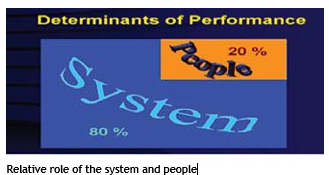
To the student of management, this is not surprising. It is said that 80 per cent of the performance of any organization depends on management systems and only 20 per cent on people, as shown in the figure at left. Of this 20 per cent, 80 per cent is accounted for by the quali-ty of leadership. Leadership, and rank and file account for 16 per cent and 4 per cent, respectively.
Lesson # 6
The use of Performance Agreements between government and Secretaries of government is an effective institu-tional instrument to improve perform-ance of government departments. Performance Agreements are known by various names around the world.
However, they all represent the same management philosophy—manage-ment by objectives.They are an explic-it agreement between a principal (gov-ernment) and an agent (Secretary responsible for a government depart-ment) which outlines their mutual responsibilities.
Lesson # 7
The effect of implementing an effective performance management in the gov-ernment can take some time to “trick-le down”. Hence, it is desirable to implement a few other schemes to yield immediate benefits. I call this the direct approach (as opposed to trickle-down approach) to improving govern-ment performance. Tools and tech-niques to fight public sector inefficiency under this category may remind development economists about the debates of yesteryear on the appro-priate development strategy to fight poverty.There were those who argued for the “trickle down” approach while others argued for a direct attack on poverty. Similarly, system-wide initia-tives like Performance Agreements bring long-term benefits in terms of increased efficiency. However, it takes some time for the efficiency to trickle down whereas Client Charters and Quality Mark, ISO 9000, E-govern-ment, E-procurement and other similar initiatives represent a direct attack on public sector inefficiency. These are complementary approaches and not substitutes for each other