



















The prestige and authority of institutions is being eroded by the actions of those in power
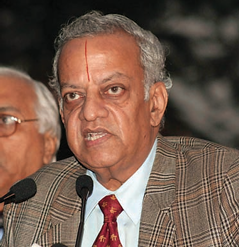
One more institution created by the Constitution has been dealt a severe blow to undermine its authority. The blow was delivered not by any of the politicians who as a class have now perfected their skill of undermining institutions that were created and nurtured with great care for the first three decades of independence. The blow came from a person who was holding the office to nurture it and strengthen it with his leadership. It came when the Chief Election Commissioner N Gopalaswami wrote to the President, of his own volition and without a reference by the President, that Election Commissioner Navin Chawla should be relieved of his post because he frequented the toilet too often when the Commission members were in session over important matters. The Chief Election Commissioner apparently does not know of the agony a person undergoes due to an enlarged prostrate gland.
He also does not seem to have studied the efforts by not only Prime Minister Jawaharlal Nehru to build new institutions of the Indian Republic in various fields but also the contribution by the Opposition to his efforts with its restrained and constructive approach. For instance, the entire Opposition made up of small parties fighting the first general election in 1952 against the only large party, the Congress led by Nehru, was enraged due to suspicions of irregularities and underhand dealings during the election. After a three-hour debate at their joint meeting soon after the election, they decided not to go public over the issue as it might have shaken public confidence in the institution of the Election Commission.
The suo motu move by the Chief Election Commissioner triggered a fierce political controversy. His action became suspect because of its timing and circumstances. The Bharatiya Janata Party had suddenly decided to withdraw its petitions in the Supreme Court and submit its memorandum for action against Chawla to the CEC. There was no comprehensible logic for this unless the BJP was not confident of getting a verdict from the apex court that would meet its political ends.
The CEC sent his recommendation to the President only a hundred days before the Lok Sabha elections and less than a hundred days before his own retirement. Surely he knew that his opinion without reference could not be binding on the President.
Gopalaswami has no plausible explanation for the timing. His explanation was that Chawla did not respond to his three reminders to answer the charges against him. If he had evidence to prove that Chawla was acting in favour of one player, the better option would have been to communicate to the President his own inability to function with one member acting thus. The President would then have had to choose between an impartial Chief Election Commissioner or a commission with one tarnished member. This would have upheld the image and reputation of both the Election Commission and its chief officer.
The Election Commission had so far maintained a clean image. Recommendations for electoral reform, based on its experiences during elections, were not heeded by successive governments till TN Seshan occupied its top post in January 1991 and transformed not only the style of functioning but also empowered himself with the latent powers that the EC had not invoked earlier. His successors had to live by the standards he had imprinted. Each successor had to be more punitive towards political parties by introducing reforms that were inherent in law but never resorted to. Candidates were earlier not obliged to file affidavits stating assets nor were they accountable for the number of public rallies in their constituencies. And never had the Election Commission appointed observers swarming all over and noting even the number of cups of tea served at candidates’ election offices. The EC became feared as it could cause disqualification for six years. The institution had found the faith of people in recent years. In one stroke, Gopalaswami made everyone view it with suspicion.
The political parties have added their bit by their partisan responses to suit their political ends instead of looking at the issue objectively as damage to the institution. The BJP said that the CEC recommendation justified its stand. The Congress responded by condemning the CEC and defending Chawla, whose past activities have come under the scanner more than once. Both sides could have put their heads together and found a solution so that such damaging incidents are not repeated. They could have worked out a formula for appointments to the Election Commission as they have done in cases of other high government appointments.
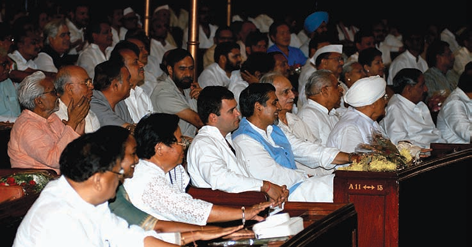
Sadly, the episode is characteristic of our times. The plight of Parliament as an institution has been even more tragic. It is no more a forum for informed debate to seek solution to the nation’s problems. As many as nine members have been disqualified for misuse of their privilege to ask questions. One had to be debarred from membership for involvement in human trafficking.
But the collective damage to its reputation was caused by flaunting of currency notes inside the Lok Sabha hours before the vote of confidence last July. Though it was established as mere drama by the Parliamentary Committee set up later to look into the allegation of bribery, the damage was done. The public trading of charges of corruption by politicians was enough ground for formation of a general perception of lack of morality and ethics among politicians.
The onslaught on the prestige and supremacy of Parliament had begun two decades earlier when some members had sought Supreme Court intervention to enforce a debate on the telecom scandal in the Narasimha Rao regime. It was patently an issue of sovereignty of Parliament where there was no scope for interference by the judiciary.
In the case of the judiciary, too, there was no less damage to it when Prime Minister Indira Gandhi superceded three senior judges in appointment of a Chief Justice in 1971. Equally damaging was the use of the Constitutional power to overcome the political crisis when the Allahabad High Court unseated Prime Minister Indira Gandhi in 1975. The reluctance of the judiciary to allow itself to be governed by the Right To Information Act and give out details of declared assets to the public is no less damaging to its image.
Nehru created educational institutes for higher technical education that earned world repute because their emphasis was on merit. Their reputation was undermined when the current Human Resources Minister forced them to adopt a procedure for admissions based on ethnic discrimination. In one stroke, the institutes and their repute was undermined in the name of social justice but essentially for petty electoral politics.
The new generations occupying posts of power give no second thought to the impact they cause by their actions based on personal consideration. Even those aspiring to the nation’s top post prefer short-cuts. They forget that there are no short-cuts to building the nation and its institutions of excellence.
The EC became feared as it could cause disqualification for six years. The institution had found the faith of people in recent years. In one stroke, Gopalaswami made everyone view it with suspicion
The episode is characteristic of our times. The plight of Parliament as an institution has been even more tragic. It is no more a forum for informed debate to seek solution to the nation’s problems