









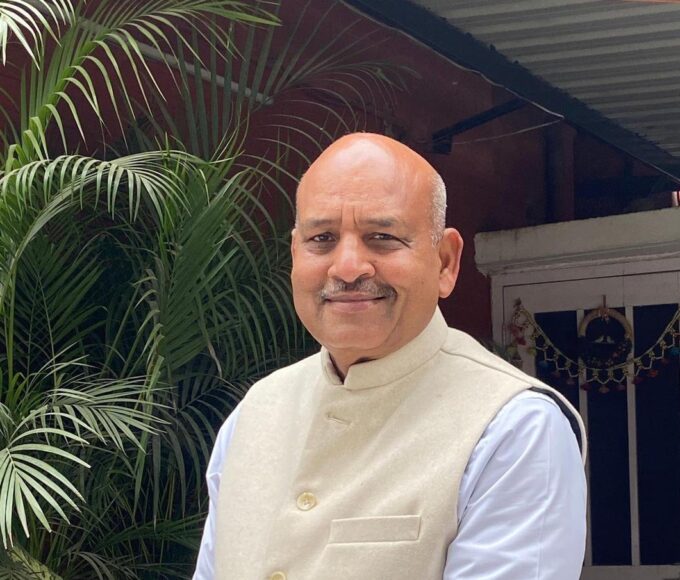










Sankaran Mahadevan
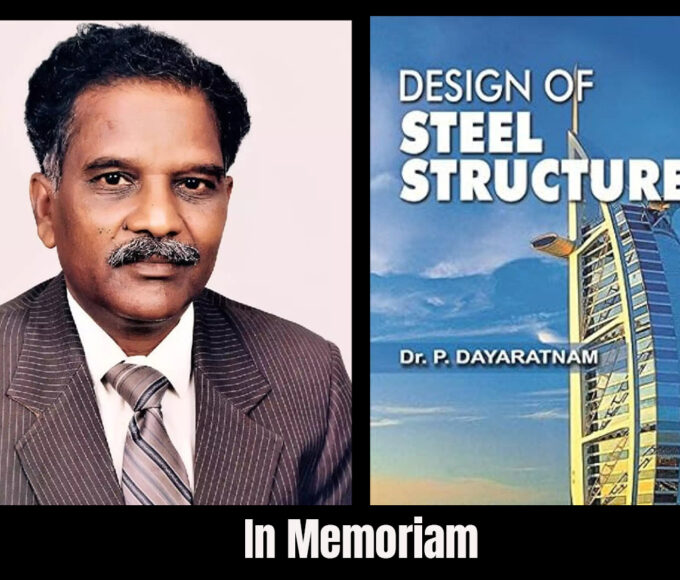
It is an honour to recount my interactions with Professor Dayaratnam, a remarkable teacher and a distinguished pioneer in structural engineering education and practice.
First, a brief overview of Prof. Dayaratnam’s professional biographical details and outstanding contributions. His education included a Bachelor’s degree in Civil Engineering from Madras University, and Master’s and Ph.D. from the University of Colorado at Boulder.
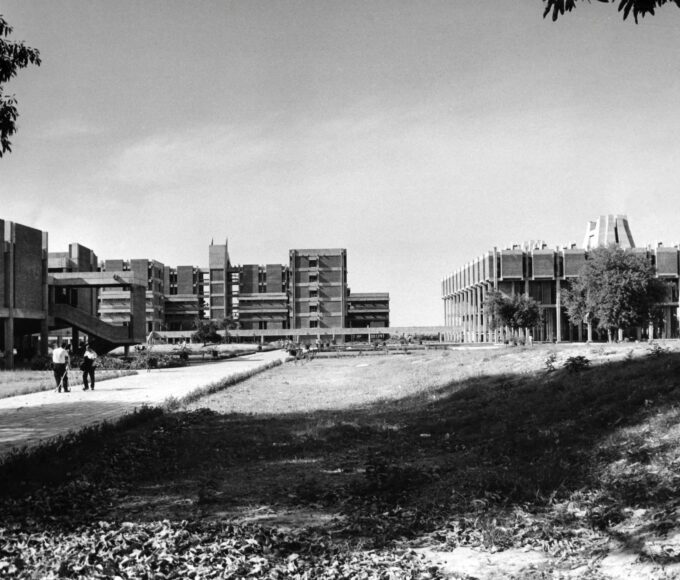
He taught at IIT Kanpur for twenty-seven years (1965-1992) and then served as Vice Chancellor at Jawaharlal Nehru Technological University (JNTU), Hyderabad, for three years (1995-1998). At IIT Kanpur, he also served as Head of the Department of Civil Engineering (1976-1979) and Dean of Research and Development (1982-1984). He has recounted his professional journey in a remarkable autobiography “Building Blocks of my Life”.
Prof. Dayaratnam impacted the education and practice of civil structural engineering in India in multiple ways. He wrote multiple textbooks on structural engineering design, several of which became foundational at many universities in India, as well as abroad. His books cover the analysis and design of steel, reinforced concrete, prestressed concrete, and brick structures.
In addition to these classic texts, he also wrote innovative books titled “Structural Engineering through Objective Questions” and “Structural Engineering (Conventional and Objective Type” that provided quick overviews and multiple-choice, practice questions in preparing for various entrance and employment tests.
His impact on civil engineering practice was two-fold. One was by serving as a consultant on civil infrastructure projects related to buildings, bridges, industrial plants, and towers. The second was as a member of committees at the Bureau of Indian Standards that developed various codes of practice in civil structural engineering.
Prof. Dayaratnam’s contributions to the engineering profession have been recognized by many prestigious awards, including the Sir Arthur Cotton Memorial Prize, the E. P. Nicolaides Prize, and the Outstanding Concrete Technology Award. He also received an honorary doctorate from JNTU, Hyderabad.
My own interactions with Prof. Dayaratnam started in 1979, during my third year of B.Tech. at IIT Kanpur, when I started taking classes in Civil Engineering. The first subject I studied under him was structural analysis. One afternoon, we met while walking to his class. I had done very well in the first mid-term test in his class, and he met me with a smile and complimented my performance. This class was followed by others on reinforced concrete and prestressed concrete in subsequent semesters.
I found myself drawn to him, not only for his depth of knowledge and well-organised teaching, but also for his warm and welcoming personality, patience in explaining difficult concepts, and genuine interest in the student’s career progress. His mild-mannered, easy conversational style put the students at ease and created the right learning environment. Sometimes I would go to his laboratory and talk to him and his graduate students about their research and experiments. I was particularly inspired by his balance of theoretical understanding and practical implementation. In one of our conversations, he told me that consulting for the industry had helped him to find and maintain that balance.
Eventually I approached him for a summer job in his laboratory, to acquire more in-depth knowledge in structural engineering. He agreed, and I worked for him during the summer of 1980. He engaged me as an assistant in writing a book on brick structures.
My task was to develop solutions for the numerical examples in the book. It was a remarkable learning experience; I ended up learning the subject of brick structures design, which was not taught as a regular class at that time.
Through our weekly discussions, I also learnt many practical aspects of structural design, and about civil infrastructure in general. Even more than the technical knowledge, I learned from his patient, mild-mannered, and cheerful personality how to be an inspiring leader and encourage students and employees to deliver their best performance.
During 1981-82, I had the opportunity to serve as Convenor of the Student Senate at IIT Kanpur, and in that capacity, attend the meetings of the Faculty Senate. At those meetings, I saw firsthand the admiration and respect Prof. Dayaratnam received from his faculty colleagues whenever he rose to speak. I never once saw him show annoyance or utter a harsh word even in the middle of contentious arguments. He would make his points in a gentle but firm and well-organised manner, always accompanied by a disarming smile.
Not surprisingly, I requested Prof. Dayaratnam to be the faculty guide for my final year project. He agreed, and I formed a two-member team with my classmate, Sundar Krishnamurthy (now Professor of Mechanical and Industrial Engineering, University of Massachusetts, Amherst, MA, USA). We designed a sports and entertainment complex for a community, and won the best final year project award. We met with Prof. Dayaratnam on a weekly basis, and he guided us through space planning, architectural design, and structural design of various facilities such as auditorium, sports complex, etc. This was a great experience where we learnt “big picture thinking” before getting into the details.
I remember several instances in my later career where my learning from Prof. Dayaratnam had a strong impact. After completing B.Tech. in 1982 at IIT Kanpur, I worked at Engineers India Limited, New Delhi, for two years (1982-1984). I was engaged in the design of concrete and steel structures in petroleum refineries. As part of my work, I also spent a few months at a construction site where I got to compare my own designs to practical constraints in construction. I found my past interactions with Prof. Dayaratnam very helpful in quickly translating academic learning to practical implementation.
Interestingly, during my Ph.D. preliminary examination at Georgia Tech in 1986 that covered all the structural engineering subjects, the questions I answered the best were on concrete structures, all learnt from Prof. Dayaratnam’s classes.
Later, as a faculty member at Vanderbilt University, I taught classes on concrete structures design and structural engineering laboratory for several years, and I would often remember his treatment of the various topics and draw inspiration from his example.
Prof. Dayaratnam has similarly impacted the lives of several generations of engineering students. Many of his students are sharing fond remembrances of his influence on their careers in online posts since his passing on November 11, 2025.
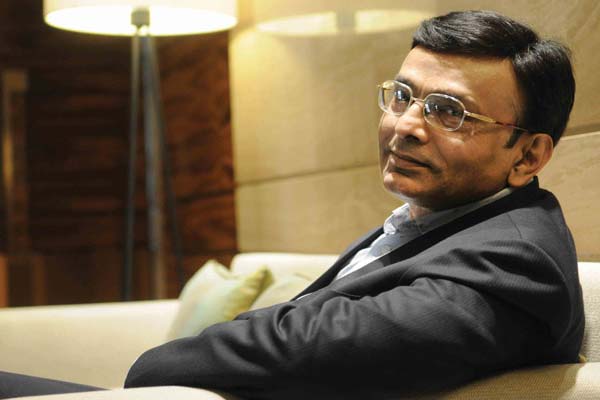
Sankaran Mahadevan
Professor of Civil and Environmental Engineering, Vanderbilt University, Nashville, Tennessee, USA. He obtained his B.Tech. in Civil Engineering at IIT Kanpur in 1982, M.S. in Civil Engineering at Rensselaer Polytechnic Institute, Troy, NY, USA in 1986, and Ph.D. in Civil Engineering at Georgia Institute of Technology, Atlanta, GA, USA in 1988.