





















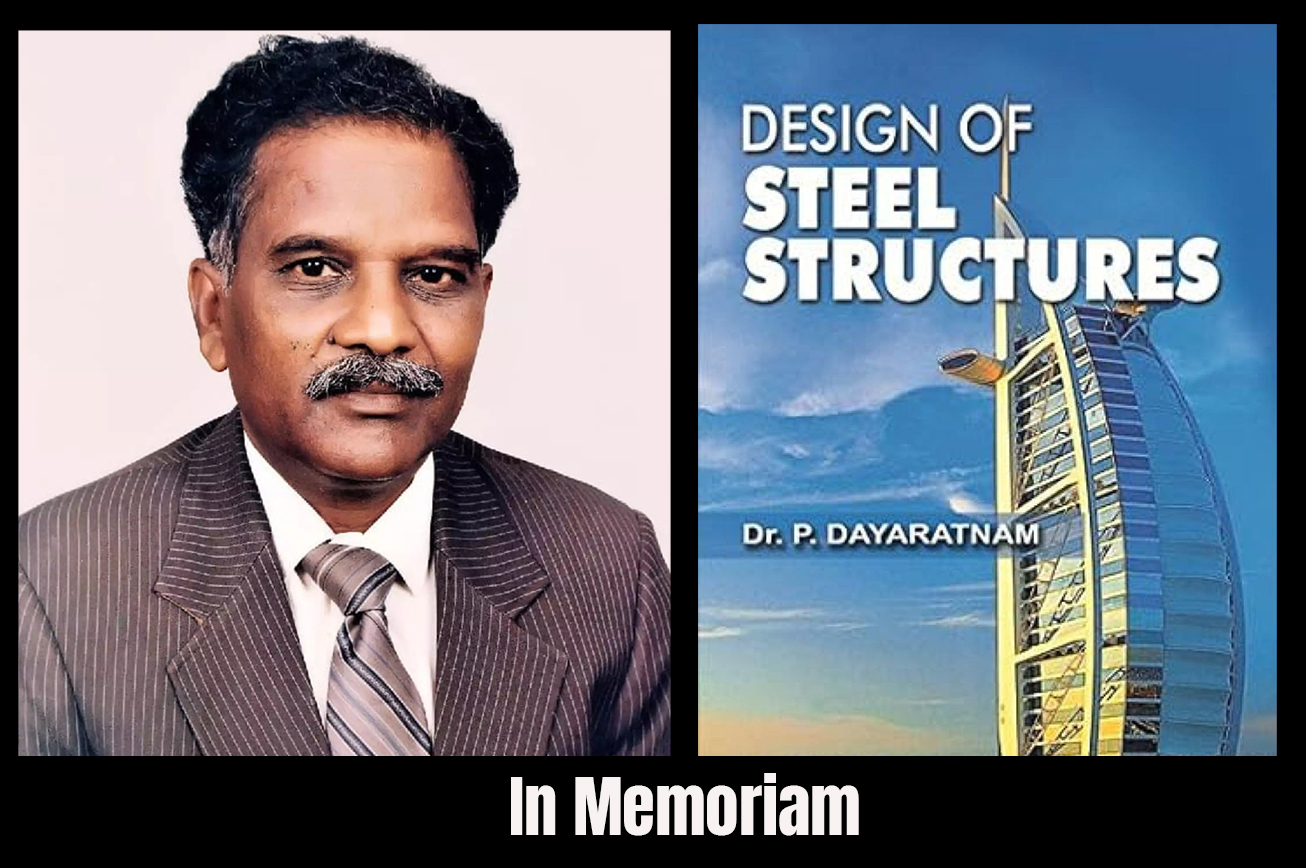
If you receive regular water supply in your urban home, you have to thank Dr Pasala Dayaratnam. The massive elevated concrete water reservoirs in each city neighbourhood would have been built by engineers, who copied their designs from his textbooks.
Every time you make a cellular phone call, you have to thank Dayaratnam. The ubiquitous tall telecommunications towers would have been erected by engineers who copied their various designs from his textbooks.
The outpouring of tributes to him on LinkedIn and X Twitter, even by engineers who had never met him, underscored his influence over generations of engineers in several countries.
The 12 textbooks authored by him were widely used not only in India, but in numerous foreign nations as well. He headed the all-India board for undergraduate engineering education for several years. He was also instrumental in formulating the Asian and Indian engineering standards for concrete and steel structures and buildings. He served on international committees which formulated model building codes.
He was also one of the first persons in the world to develop computer software packages for civil and structural engineering. He would arrive at IIT Kanpur’s computer centre just after dawn each morning to run his software programmes on scarce mainframe time.
Born in November 1932, Pasala Dayaratnam obtained his Bachelor’s degree in Civil Engineering from the University of Madras. After working in the Public Works Department as well as a stint as a lecturer, he then went to the University of Colorado from where he obtained his masters in 1960 and his doctorate in 1962. He was honoured with its Distinguished Alumnus Award.
He joined the faculty of Indian Institute of Technology Kanpur in 1965 and was its dean for long years. He served as Vice Chancellor of Jawaharlal Nehru Technological University, Hyderabad, from 1995 to 1998.
Among the numerous professional awards and honours he won were the Sir Arthur Cotton Gold Medal and EP Nikolaidas Award from the Institution of Engineers. Professor Pasala Dayaratnam was a legendary teacher at IIT Kanpur while I was a student there. However, I did not have the privilege of being taught by him. But I attended the joyous Christmas parties which he and his wife hosted—they were devout Christians of the Andhra Evangelical Lutheran Church.
He was a consultant to numerous organisations in the US. But so strong was his commitment to his students that he would fly out to USA to investigate a building collapse, fly back three days later to IIT Kanpur to deliver his scheduled lectures, then fly out again to USA for two days to serve on an international standards committee, and return to IIT Kanpur for four days to guide his students.
His students used to be fascinated by his in-depth analysis of the Sears Tower in Chicago and the Sydney Opera House. He was also a consultant for the nuclear power plants at Narora, Kaiga, and Kalpakkam.
His contribution to society and structural engineering will be remembered for long.

Ravi Visvesvaraya Sharada Prasad is a computer scientist and author. He writes on technology and historical events in post-independent India. He is Associate Editor at gfiles.