



















Over the last decade, on every death anniversary of former Deputy Prime Minister and Home Minister Sardar Vallabhbhai Patel, who passed away on December 15, 1950, the falsehood is spread that the then Prime Minister Jawaharlal Nehru did not attend his funeral, and further that he tried to prevent President Rajendra Prasad too from attending the Iron Man’s funeral.
In fact, Nehru, Prasad, general Chakravarti Rajagopalachari, minister without portfolio, and former governor, and the speaker G.V Mavalankar attended his funeral in Mumbai. As did B.G Kher, Premier of Bombay State, Morarji Desai, Home Minister of Bombay State, Purushottam Das Tandon, President of the Congress party, Govind Ballabh Pant, Premier of Uttar Pradesh, numerous other foreign diplomats, and politicians.
A week of national mourning was declared. Patel was given a state funeral with full military honours, with his body being drawn on a gun carriage by an Indian Navy contingent. The three service chiefs were in attendance, led by the Commander-in-Chief of the Indian army, General K.M Cariappa. Prominent newspapers published photographs of these, along with detailed reports.
In August 2014, the YouTube channel of British Pathé, official partners of Reuters and Spiegel TV for historical audio-visual archives, released a video, which shows Nehru, Prasad, Rajaji, Pant, Desai, Tandon, and B.G Kher following in open army vehicles. The British newsreel also showed Nehru, Rajendra Prasad, and Tandon seated near the pyre, as well as General Cariappa and Indian Navy officers saluting Patel’s mortal remains.
Sardar Patel had been ailing for several months. His doctors advised him to shift to Mumbai, believing that the sea air would revive his health, as well as get him away from Delhi’s cold. Nehru saw Patel off at the Willingdon Airport on December 12, 1950. Patel was accompanied by his private secretary V. Shankar, an Indian Civil Services officer of the 1932 batch. (Shankar was my father’s senior colleague when he served as Principal Secretary to Prime Minister Morarji Desai in 1977-1979. He wrote numerous volumes about Patel.)
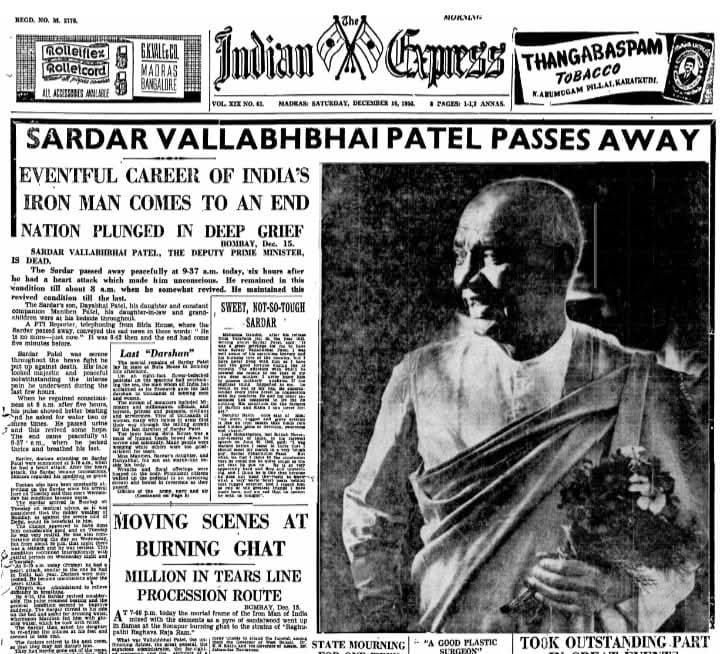
At 3 am on December 15, 1950, Patel went into a coma. His longstanding doctors M.D.D. Gilder and Nathubhai D. Patel gave him no chance of survival. Shankar informed Kher, Desai, and S.K Patil, a strongman of the Congress party in Bombay, all three of whom immediately rushed to the Sardar’s bedside at Birla House. Mavalankar got the news and he immediately rushed from Delhi to Mumbai. President Rajendra Prasad too was informed early in the morning that the Sardar’s demise was imminent, and he decided to depart for Mumbai.
My late father, H.Y Sharada Prasad, was one of the editors of the Selected Works of Jawaharlal Nehru, and he edited the transcripts of Nehru’s extempore speeches for publication in the official records. Nehru informed the Parliament at 10:45 am on December 15, 1950, announcing the demise of Sardar Patel at 09:37 am at Birla House in Mumbai. The deputy speaker M Ananthasayanam Ayyangar was in the chair, in the absence of the speaker. Both Nehru and Ayyangar spoke extempore, without notes.
The following is the transcribed version of their extemporaneous remarks as published in the official records of parliament:
The Prime Minister (Shri Jawaharlal Nehru):
I have to convey to you, Sir, and to the House mournful news. A little over an hour ago, at 9-37 this morning, the Deputy Prime Minister, Sardar Vallabhbhai Patel, passed away in Bombay City. Three days ago many of us saw him off at the Willingdon airfield and we hoped that his stay in Bombay would enable him to get back his health which had been so grievously shattered by hard work and continuous worry.
For a day or two he seemed to improve, but at last early this morning he had a relapse and the story of his great life ended. It is a great story, as all of us know, as the whole country knows, and history will record it in many pages and call him the Builder and Consolidator of the New India and will say many things about him.
But perhaps to many of us here he will be remembered as a great captain of our forces in the struggle for freedom and as one who gave us sound advice in times of troubles as well as in moments of victory, as a friend and colleague on whom one could invariably rely, as a tower of strength which revived wavering hearts when we were in trouble.
We shall remember him as a friend and a colleague and comrade above all, and I who have sat here on this bench side by side with him for these several years will feel rather forlorn and a certain emptiness will steal upon me when I look to his empty bench. I can say little more on this occasion.
My colleague Mr. Rajagopalachari and I are going almost immediately to pay our last tribute and homage to him in Bombay. I understand that the President had also decided to go to Bombay immediately, and the Speaker, Sir, went early this morning.
I have no doubt that many of my colleagues and honourable Members of this House would have liked to go to Bombay on this occasion to pay this last tribute, but I feel that he, magnificent worker that he was, would not have liked us to leave our work and just go in large numbers to Bombay at this moment.
So, I have asked my colleagues to stay here, except for Mr. Rajagopalachari, who was perhaps amongst all of us here the oldest of Sardar Patel’s colleagues and comrades. And it is right that he should go, and it is right that that other old colleague of his, the President, has also gone. For the rest it is up to us to carry on the work here and elsewhere, for the work of the country never stops, never should stop.
And so, in spite of this grievous sorrow that has come over us we have to steel ourselves to carry on the work in which the great man, great friend and colleague, who has passed away, played such a magnificent part.
The Deputy Speaker’s response:
The Lion of Gujarat and Sardar of India has passed away. In his demise India has lost one of its national heroes, one of the greatest sons of India. He was the right hand of Mahatmaji. The title of Sardar that he got was not one that was conferred by any king but it was a symbol of the hearty recognition by the entire population of India. His undaunted courage and unflinching sacrifice is known to all. He died as a soldier in the battlefield. To the last day he was rendering service unflinchingly, even at the cost of his health.
He performed a miracle in this country both in winning the freedom for this country and also, after winning freedom, in the cause of unification and consolidation of this country. He really performed a miracle. A revolution—a bloodless revolution—which is unknown in the history of the world has been brought about by him. The five hundred and sixty-five odd States and the medieval rule have all been eventually dissolved.
India owes a deep debt of gratitude to him. His name will be cherished by all of us and will be handed down to posterity. His life will be a beacon-light for all of us and also for the future generations. I am sure that though he has left his mortal coil his spirit will be with us and guide us for ever and ever. May his soul rest in peace. In his memory I would adjourn this House today and there will not be a sitting of the House tomorrow. We will stand in silence for two minutes as a mark of respect. We will meet on Monday.
Parliamentary records added: ‘The House then adjourned till a Quarter to Eleven of the Clock on Monday, the 18th December, 1950.” One week of state mourning was declared.
Just before Dahyabhai Patel lit his father’s funeral pyre, he requested Rajaji, Rajendra Prasad, and Nehru to speak.
Choking with emotion, Chakravarti Rajagopalachari stated:
Thirty-two years ago, when Gandhiji was at Madras, one morning he asked me whether I had seen Vallabhbhai, who he said, was brave and very trustworthy. You should meet him, he had said. I did see him and since then I have been seeing him without a break.
What inspiration, courage, confidence incarnate, a force Vallabhbhai was. Let us not think that the Sardar is dead. The real Vallabhbhai will survive even after the Vallabhbhai we know has breathed his last. We have assembled here now to give vent to our grief and take courage and confidence from his ashes.
We will not see the like of him again. But do not think he lived in vain. He led an honest life from which we all can take something, provided we have the character and moral courage. Let us be brave. Let us not shed tears. We should not give way to fear and depression.
I am an old man and the melancholic privilege of addressing you all on this occasion has been given to me. Further, I am the oldest friend Vallabhbhai has left behind. I have seen many pass away. Now Sardar has also left us, and he has left his brother Jawaharlal to carry on alone. May God bless his soul.
President Rajendra Prasad, who was one of the pall bearers, was emotionally overwhelmed, and breathless from the exertion of carrying the Sardar’s body. There is no transcript available now of his remarks.
However, the Hindustan Times and Indian Express newspapers reported the president as saying:
The earthly body of Sardar Patel has gone. But in the form of services he has rendered to this country, he would live for all time.
He was an irreplaceable servant of the nation whose dedicated work ensured India’s stability. That there is today an India to think and talk about is very largely due to Sardar Patel’s statesmanship and firm administration.
A sobbing Jawaharlal Nehru broke down numerous times during his eulogy (recorded and transcribed by his secretary N.K Seshan, who was our next-door neighbour and very close family friend):
Sardar Patel, a great Indian and unmatched warrior in the cause of freedom, a lover of India, a great servant of the people, and a statesman of genius and mighty achievement. In the passing of Vallabhbhai, I have lost a comrade and colleague of many years. Our nation has seen many a catastrophe. But nothing more distressing and gloomy as the death of our Sardar, who stood behind all of us like a rock of strength, patience and courage.
More than thirty-four years ago, he fell under the spell of the Father of the Nation, Mahatma Gandhi, and from that day onwards his magnificent talents and abounding energy were devoted to the struggle for India’s freedom. By his matchless courage, inflexible sense of discipline, and genius for organisation, he became one of the principal lieutenants of the Father of the Nation and a great leader in India’s struggle.
His championship of the poor and underprivileged made him the leader of the peasant campaign at Bardoli. The success of that movement demonstrated his capacity for leadership and his great organising power. Under that leadership the peasants of Bardoli maintained the strictest discipline in the face often of grave provocation. Bardoli became a symbol and an inspiration to the rest of India.
In failing health, he continued, without rest or respite, his service of India. When freedom came at last to India, it was inevitable that he should take an outstanding part in the service of free India. It was fortunate for India that Sardar Patel should have had this opportunity to put the coping-stone to his life’s labour.
He had, as it now appears, only a little more than three years to give in that service, and these years were periods of great turmoil and conflict in India and the world and, for him personally, of increasing ill-health and physical weakness. Yet his achievements during this period will be recorded in India’s history with pride and admiration.
He concentrated his attention on the great task of unifying the country and maintaining its stability at a time when disruptive forces were at work. In particular, his genius was demonstrated in the way he handled the difficult and complicated problem of the old Indian States.
He fixed his goal, a united and strong India, and set about to achieve it with skill and determination. Step by step he advanced towards this goal, ever keeping the final objective before himself and others, and at the same time by negotiation and friendly compromise winning the willing consent of the people he was dealing with.
Thus, without any ill-feeling on the part of the rulers or the people of those States, he made a united India out of a welter of States, whose separate existence would have been a powerful force for disintegration in these troubled times. He devoted himself also to the maintenance of peace and stability of India which were continuously challenged by internal strife and by the conflict that has been the heritage of the post-war world all over.
As Deputy Prime Minister and in charge of two of the most important portfolios of Home and States, a heavy responsibility was cast upon him. That burden and responsibility he bore with patient courage, wisdom and equanimity. To the people of India and to the Governments at the Centre and in the States, the loss of Sardar Patel is grievous and irreplaceable.
Yet he laid solid foundations and that work has to be carried on by those that follow him. It is for the people of this country to follow his shining example, his devotion to duty, his steadfastness, his sense of discipline, and thus to realise in ever growing degree that free and strong and prosperous India for which he laboured.
That will be the true and imperishable monument to his memory and that of the Father of the Nation who led him to his path of destiny.
This extempore speech by Nehru at the pyre formed the core of the cabinet resolution condoling the demise of the deputy prime minister.
Nehru’s statements in Parliament that ministers, MPs, and government officials should attend to their work rather than travel to Mumbai have given rise to allegations over the past three decades that he was insulting the Iron Man of India. These allegations originate from a few paragraphs in one single source—a 1967 publication of the Bharatiya Vidya Bhavan titled, Indian Constitutional Documents: Pilgrimage to Freedom, by Kanhaiyalal Maneklal Munshi, who was Food and Agriculture minister at the time of Patel’s demise.
Munshi recorded in his 1967 document that in spite of Nehru’s statements in Parliament, he himself, Narhar Vishnu Gadgil, minister for Power, and Satya Narayan Sinha, Minister of State for Parliamentary Affairs, attended Patel’s funeral since they were already near Mumbai.
It is significant that Munshi published this long after he had co-founded the Vishva Hindu Parishad in August 1964 together with MS Golwalkar and S.S Apte of the RSS. Munshi had led the campaign to renovate the Somnath Mandir, and he had left the Congress party several years earlier in protest against Nehru’s refusal to permit state funds to be used for its renovations. Munshi’s objectivity is therefore open to question.
It is also being claimed nowadays that Nehru had ordered that if officials of the Home Ministry wanted to attend Patel’s funeral, then they should pay for their tickets out of their own pockets, but Vappala Pangunni Menon, Secretary of the Ministry of States, stymied this, and instead chartered a plane to transport all officials of the home ministry, at his personal expense.
There are no records whatsoever to substantiate this allegation. There are photographs and newspaper accounts of V.P Menon attending the funeral, but none of other officials of the Home Ministry. It is unlikely that Nehru would have had the time to issue such an order, since he and Rajaji left for Mumbai immediately after addressing Parliament, and the Sardar’s state funeral was scheduled for 5 pm.
There is no record whatsoever of any cabinet resolution advising President Rajendra Prasad not to attend the funeral, as is being alleged for the last decade. No such cabinet meeting was ever held, as can be cross-checked with government records.
In fact, the President had made preparations to depart for Mumbai even before Patel was declared dead by his doctors, well before Nehru’s announcement in the House. There could not have been any cabinet meeting at all because Nehru and Rajaji (third in the cabinet hierarchy after Patel) departed for Mumbai minutes after Nehru’s announcement in Parliament. The first cabinet meeting after Patel’s departure for Mumbai on the December 12 was held on 26 December 1950.
At this meeting, Nehru read out the extempore statements he had made at the cremation (typed by N.K Seshan). The voluminous cabinet resolution included excerpts from tributes paid by world leaders, governors, rulers of the princely states, and prominent politicians. These cabinet resolutions can be seen in the official government papers and were reported in newspapers. The Parliament re-convened on Monday, December 18, 1950, to pay tribute to Patel.
In their comprehensive biographies of Patel, neither V Shankar nor Rajmohan Gandhi have mentioned anything about Nehru snubbing the legacy of the Iron Man. Nor has Patel’s daughter Maniben Patel, who was a Member of Parliament for three decades, made any such accusations in her published diaries.
It is significant that these allegations began only in the 1990s, based mainly on the few paragraphs in KM Munshi’s documents, which he wrote years after he had co-founded the VHP. These accusations were repeated by M.K.K Nayar, Balraj Krishna, and R.C Mody. Munshi’s publication, which had long been out of print, was reprinted in 2010.
Dahyabhai Patel, as an MP of the Swatantra Party, often attacked Nehru’s economic and other policies harshly. But he never attacked Nehru personally. When Nehru passed away, he made a moving speech in the Rajya Sabha. Bipin Patel, son of Dahyabhai, was our family friend. He never mentioned anything to us about Nehru disrespecting his grandfather.
Nehru and Patel had numerous differences on policies, often of a serious nature, but they respected each other highly and worked together closely in the interest of the nation.

Ravi Visvesvaraya Sharada Prasad is a computer scientist and author. He writes on technology and historical events in post-independent India. He is Associate Editor at gfiles.