












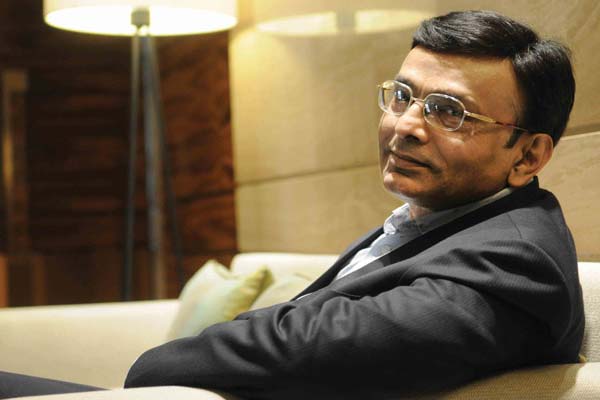
















His background as Assistant Secretary in the Ministry of Defence has come in handy for Central Vigilance Commissioner Pratyush Sinha, India’s topmost anti-corruption cyjicer, in scrutiny ef defence deals. A 1969-batch L4S officer ef the Bihar cadre, he was Secretary in the Ministry of Personnel, Public Grievances and Pension when he retired. His_iob as CVC requires him to interact closely with government per- sonnel in scrutinizing the allegations against them. Sinha has a post-graduate degree in economics from the London School ef Economics.
gfiles: When NVittal was CVC, he told the media there were lakhs ef corruption cases pending against eftcers. How far was that correct? Pratyush Sinha: I don’t know about this comment.The maximum number of corruption cases that we deal with relate to tenders, procurements and purchases. When I took over in 2006, we issued an order for the leveraging of procurements whereby all tenders have to be placed on the website. The
National Information Centre developed an e-tender format and all the details of these transactions are now available for scrutiny on the web.We have also set up small bodies to mon-itor these transactions. But I must add that we deal with com-plaints relating to Central government officials. We have no jurisdiction over state governments.
gfiles: Who makes complaints against this tendering process?
PS: Contractors are the biggest source of information for us. NGOs also complain about malpractices in government departments.
gfiles: In how many cases were you able to make a positive intervention?
PS: We have been able to help in several cases. For example, we insisted that the NTC hold an open auction.But we do not interfere with the process of tendering so cases come to us on a post and not a pre basis.
gfiles: How many cases do you deal with on an annual basis? –
PS: In 2006, we received 10,598 cases. Of this, 4,555 of the charges were found to be not of a serious nature. Another 5007 charges were not of a verifiable nature. From this lot, 736 cases have been forwarded for further investiga-tion. From the time we were set up, we have dealt with over a lakh cases. Apart from Central government officers, our jurisdiction extends over thousands of A-level officers in public sector units and also the public sector banks. We also provide vigilance clearance for all senior appointments. I personally look at 400 files a month.The numbers are only increasing.
‘Many of our complainants are not careful about hiding their identity and will send their complaints to half-a-dozen government offices in which their names and other details are revealed’
gfiles:You also play a recommendatory role for defence deals?
PS: In the past, the CVC has given its recommendations to the Ministry of Defence.They do consult us during the process of procurement. But ever since we prepared a new set of guidelines for defence procurement, there have been no complaints. A major move that we have undertaken is to suggest that all public sector units and government ministries undertake the signing of an integrity pact whenever a major pur-chase has to be undertaken.The concept of an integrity pact was started in Germany. It involves the setting up of an independent body which will monitor all important deals. ONGC has already set up a three-member watchdog com-mittee.A similar one has been set up by the Ministry of Defence. We are also insisting that the petroleum companies such as HPCL and the power companies such as NTPC set up similar watch dog committees. By doing so, we hope to ensure transparency in all purchases.This must be done through persuasion and not through force.The whole aim of this exercise is to set up a system of improve-ment rather than making improvement a one-time effort.
gfiles: It was on your recommendation that the $600-m Eurocopter deal was cancelled. PS: The Ministry of Defence had some reservations about the deal. We agreed with them. I will not say there was something mala fide in what happened.
Procedures were short-cut and certain parameters were not being fulfilled. gfiles:The CVC has had reservations about many defence deals.This is just one of them? PS: There are some allegations about middlemen and the need to have them banned. We believe that it is vital that defence deals do not get delayed unnecessarily. But because of the nature of these deals and the amounts involved, they attract a great deal of attention. It is for this reason that we have been stressing that we develop an institutional response to streamline these deals.We need to have a system in place which encourages competition. We have persuaded the Ministry of Defence to lay down clear-cut pro-curement procedures.
gfiles: What are they?
PS: They will have to ensure that all
THE Supreme Court has no reason to be apologetic about what two of its esteemed judges recently described as “judicial activism”. The history of the functioning of India’s highest judicial body has mostly been one of restraint, fairness, and a strictly constructional view of the Constitution. In fact, if a popular poll were taken, it would most likely show that our citizens would actually applaud a pro-active and interventionist Supreme Court.
The Indian public has repeatedly opined that the three institutions it trusts the most are the Supreme Court, the Press, and the Army. Unfortunately, our civil services and politi-cians are way down on the totem pole. It is not hard to see why. Over the years, politicians of all hues have desecrated the once majestic standing of the civil service by making it the handmaiden for their own venality and unconstitutional conduct.
Part of the reason this has occurred is that the system of checks and balances and sep-aration of powers which are the cornerstones of a Republican democracy does not oper-ate here. Our whole political system is skewed towards Executive dictatorship: the Legislature, which is supposed to be a counter-balance to the power of the Executive, is not only a slavish parliamentary extension of the Executive, but also Ministers, who are legislators, head all Executive departments. The Executive performs judicial functions at the district level, participates in judicial appointments, and actually chooses the President.
In this scenario of Executive dictatorship, how then do you bring to account a legislator who flouts the laws of the land, a civil servant who helps break the law at the behest of a politician who controls his career, a business house that finances a ruling political group, a Chief Minister who uses the civil service to deprive citizens of their Constitutional rights?
Brave and conscientious civil servants whose duty it is to ensure the continuity of gov-ernance, and not of any particular government, often refuse to obey illegal orders or par-ticipate in unconstitutional conduct. But they face political vendettas. It is for this reason that ordinary citizens have resorted to PILs and sought the intervention of the courts. Without an element of activism by the courts, government accountability would be non-existent. It is largely because of interventions by the Supreme Court and High Courts that ruthless developers disfiguring the environment, vehicles polluting the atmosphere, criminals being protected by politicians, rogue policemen violating human rights, Chief Ministers running their states like private milch cows, VIPs violating civilian rights, have been brought to justice.
In the absence of serious Constitutional reform, our Supreme Court, far from being interventionist, has been a force that has helped to empower the common man to check the Executive from running amok.
vendors enter into an integrity pact with the Ministry of Defence. This will in turn be overseen by an external group of eminent persons.
gfiles: Who are the members of this group?
PS: They include retired bureaucrats, including former Secretaries TR Prasad and PC Rawal. There are two areas where problems arise in defence purchases. The qualitative requirements of weapons need to be very scientifical-ly defined in order to avoid a single ven-dor situation. These details need to be very comprehensively phrased so that competition is not restricted. Some of the complaints we receive allege that, during the user trials,the equipment was unfairly rejected.
My other recommendation has been that we associate experts from outside to test systems. At present, this remains an entirely in-house operation. My suggestion has been to involve retired military personnel or specialists in that field. If electronic equipment has to be tested, expert electronic engineers can be brought in to make the necessary assessments. The qualitative require-ments of the hardware will remain con-fined to the defence forces. Such infor-mation will not be placed in the public domain. I have written a letter to the MoD outlining these suggestions.
‘The previous Punjab government set up a state vigilance commission and this government abolished it. If the Centre wants to pursue this at the state level, then it needs to enact a Central law’

gfiles: What have you done to ensure that whistleblowers remain safe?
PS: The entire system has been put in place. If we receive a complaint, the name of the complainant is immediate-ly removed. A Joint Secretary in the Ministry of Home has been deputed to provide protection in case the whistle-blower is apprehensive about his person-al security. The problem with many of our complainants is that they are not careful about hiding their own identity and will send their complaints to half-a-dozen government offices in which their names and other details are revealed.We are constantly highlighting the need for whistleblowers to try and maintain the utmost secrecy about their own identity.
gfiles: From the number of complaints you receive, how many actually lead to punish-ment?
PS: I would say 25 per cent of the cases result in punishment.We have come to believe that wherever we witness serious misconduct, we need to look into the role of the supervisory officers.
What were they doing when this gross misconduct was taking place? Responsibility needs to be fixed on them as well. We have expanded our ambit and are now looking at the system as a whole. We are studying the role of technology and computers to see how they can help us wipe out corruption.
gfiles:You are overseeing areas such as excise and custom,utilities,infrastructure,police,and income tax. Do all these areas suffer from endemic corruption?
PS: We have been insisting that all records in the customs and excise offices get computerized.The process is on and should be completed soon. It’s a lengthy process that requires very sophisticated software. Also, the records go back sev-eral years.We have come to the conclu-sion that personal interaction between the government employee and the pub-lic should be kept to a minimum. So whether it is municipal corporations, or other government departments, we are trying to minimize areas which are cor-ruption-prone. For example, conver-sion of leasehold into freehold, the giv-ing of completion certificates when houses have been built, must all become computerized. All this requires the development of sophisticated software and it is all in the process of being devised.
gfiles: What is being done to remove corruption in state governments?
PS: Our jurisdiction is confined to the Central government and the Union Territories. The Department of Personnel is per-suading state governments to set up independent vigilance commis-sions at the state level. The state governments are reluctant to do so. The previous Punjab government set up a state vigilance commission and the present government abol-ished it. If the Centre wants to pur-sue this at the state level, then it needs to enact a Central law. Fighting corruption is a complex process. It’s a long legal process requiring intervention at various levels. But our effort has been to remain an accessible organization which can be contacted by people from all quarters.