





























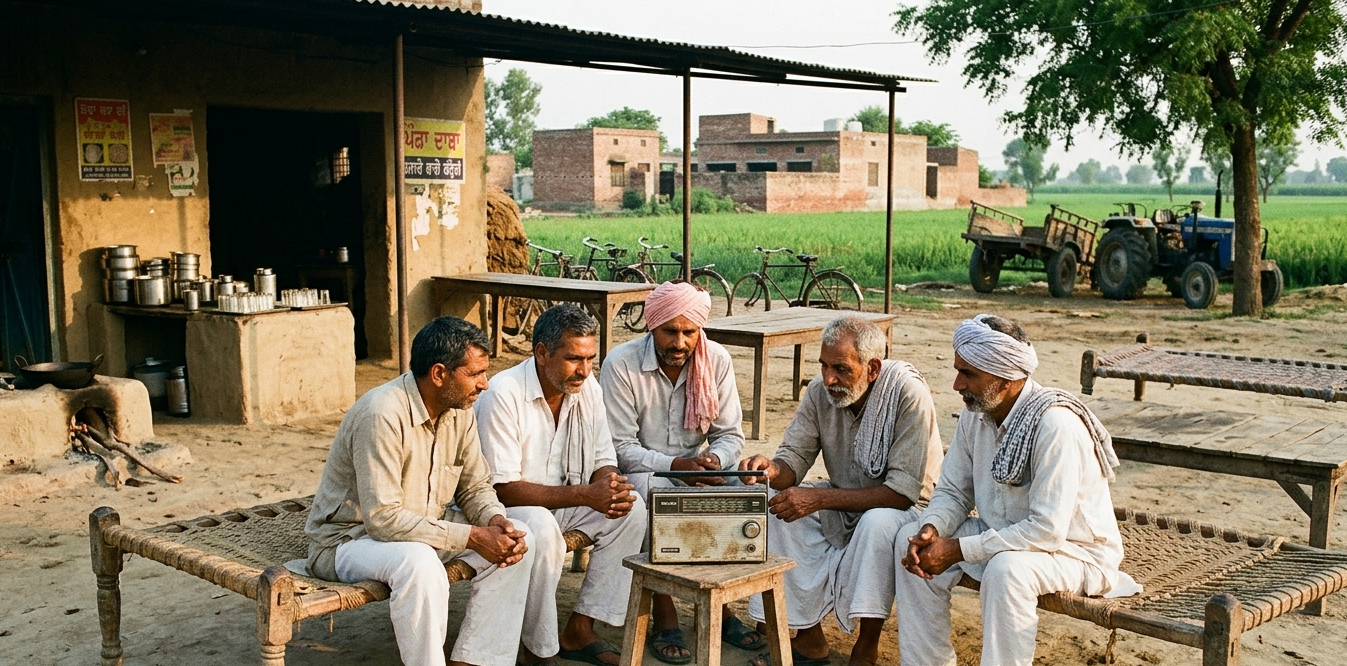
Radio broadcasting has proved to be a very effective means of mass communication that has enabled the building of capacities of non-literate and marginalized communities in rural India. Over the years through programming to inform, educate and entertain it has also strived to forge in our civil society, a public sphere that is plural, egalitarian and equitable.
The first regular radio service was inaugurated in India by the Indian Broadcasting Company in July 1927. Ever since then AIR (All India Radio) has expanded to become a network of 215 broadcasting centers covering 91 percent of the rural population by area in 24 languages and 146 dialects.(blow up) With 13.2 crore radio sets in about 11.7 crore households, the average actual listeners of AIR, including those residing in rural hinterlands, on any day are roughly estimated to be 53 crores.
As a part of the Seventh Schedule of the Union List, radio broadcasting is governed by the Indian Telegraph Act of 1885, The Wireless Telegraphy Act of 1933 and an assortment of other legislations. Consequent to the historic Supreme Court Judgment of 1995 declaring “airwaves to be public property”, the Prasar Bharati (Broadcasting Corporation) of India was set up in November, 1997 as an autonomous body to deal with policy, programming and operational issues pertaining to AIR. Besides, since 2004 the carriage part of radio broadcasting has been brought within the ambit of telecommunication services under the TRAI (Telecom Regulatory Authority of India) Act, 2000.
In the above backdrop, the first wave of liberalization in 1999 enabled private companies registered in India to seek licenses to set up independent FM radio stations in forty cities and broadcast only entertainment programming and no news. Later in 2003, well known universities, schools and colleges were also granted licenses to run campus radio stations for educational purposes. Again, allowed to broadcast programming only within campuses, the latter were interestingly called “community radio” initiatives.
But civil society groups and various review committees appointed to examine the reach and impact of radio broadcasting continued to pinpoint the top down and vertical reach of AIR and these later initiatives. This was especially highlighted in the context of rural hinterlands where the fight against backwardness, poverty and illiteracy necessitated the dire need for community access and ownership in radio programming. Therefore the question raised was- how could radio broadcasting help to create a participatory (blow up-editor) model of development in the vast rural hinterland where information flowed not only downwards from the government to the people but also upwards from people to the government? Resultantly, the issue of autonomy and the degree of the state’s monopoly over broadcasting has also been conceptualized and brainstormed time and again. Other than aiming at enabling AIR to function as a true public service broadcaster and not as propaganda machine, the various reports have raised perennial questions about people’s access to communication technologies and facilitation of self-representation through popular and community based media.
Thus, the 2006 policy guidelines for setting up community radio stations envision that marginalized communities in rural areas manage, own and operate radio stations with the help of civil society and voluntary organizations. The aim is to generate a horizontally dialogic and community based media literate environment for articulating locally relevant needs- be they cultural, social or economic.
Hence, non- profit civil society and voluntary organizations willing to serve a well defined local community are eligible to apply for a radio license. The guidelines are very specific about the fact that such organizations should have an ownership and management structure that is reflective of the community that the community radio station seeks to serve. Besides, fifty percent of the content would be generated with the participation of the local community for which the station has been set up. Thus, with a transmitter having an effective radiated power of 100 Watts, the community radio station is expected to cover a range of 6-10 kilometers. Besides, non- profit organizations that apply will be eligible to seek funding from multilateral aid agencies. It goes without saying that as per the guidelines the programmes for broadcast have to be relevant to the developmental and socio-economic needs of the community in the region that the radio station seeks to serve.
The above policy guidelines are a landmark in enabling, for the first time, the poorest of poor in rural hinterlands to have access to relevant information though participatory radio communication. But to translate them into viable and operational local community access stations a few pertinent issues have to be addressed (see box).
ESSENTIAL STEPS
- First and foremost, the grassroots grounding of such stations needs to be structurally dovetailed with the constitutionally backed third tier of rural local self-governance, i.e. the gram panchayats. In the backdrop of the second generation reforms currently underway to devolve three F’s (funds, functions and functionaries) to gram panchayats, civil society and voluntary organizations can enter into public private partnerships with them to run rural radio stations.
- The Union Government should make available to the state governments the expertise and advise of community radio consultants. The latter would facilitate sharing and brainstorming of the administrative, financial, technical and operational criticalities involved in setting up rural radio stations. This is especially relevant in the context of state governments perhaps unable to appreciate the purpose and viability of running a rural radio station within a radius of 6-10 kms.
- District Magistrates are the cutting edge of the administrative machinery in the districts. They need to be sensitized about the relevance, need and utility of the 2006 community radio guidelines to establish radio stations for effective empowerment of marginalized rural communities. Their role as field coordinators is very crucial in identifying and addressing systemic bottlenecks that could assist non-profit and voluntary organizations to set up rural radio stations in partnership with gram panchayats as body corporate.
- A few very reputed non-profit non-governmental organizations such as the Mysore Resettlement and Development Agency in Karnataka, Alternative for India Development in Jharkhand, Kutch Mahila Vikas Sangathan in Gujarat and Deccan Development Society in Andhra Pradesh set up community radio production centers in remote rural hinterlands before 2006. In the absence of station licenses forthcoming, they rented airtime on the local AIR station to serve the poorest communities after narrow casting programming in local dialects. The Ministry of Information and Broadcasting needs to put together the experience gained by these NGO’s in entry point activities related to media literacy campaigns and extensively disseminate the same through their website and by other means.
- High start-up costs prohibit access to the medium as envisaged in the 2006 guidelines. The estimated budgets for setting up a rural radio stations under the current dispensation range from Rs. 20 to 50 lakhs in the first year with the equipment to be purchased only from the authorized dealers. Besides, the five minutes of advertising allowed per hour of programming cannot cover the operational costs. Therefore, one viable option could be to create structural synergies to use dedicated funds within umpteen centrally sponsored rural development schemes for IEC (Information, Education Communication) with multilateral funding that is availed to set up and run the radio station.
- Today marginalized rural communities are indeed engulfed with news and entertainment flowing for terrestrial, cable and satellite television in addition to the regional AIR channels broadcasting in all major vernacular languages. But the need of the hour is to put in place a ‘third tier’ of community radio broadcasting that is a product of their socio-cultural moorings and with which they truly identify. Thus, non-profit organizations in tandem with gram panchayats have to work towards creating a tangible database of oral community narratives, dialects and ethnicities that could form inputs for radio programming relevant to 6-10 kms of the local area.
- If we envisage a rural community radio station to be a public- private partnership between a multilaterally funded non-profit voluntary organization and a constitutionally backed gram panchayat it is pertinent to pay attention to the practical nature of the management structure for the rural radio station. Hence, the need to outline the mandate and composition of a Community Radio Council (CRC), as a multi-sectoral body, that provides a set of locally written policies, rules and directions to successfully operationalize the rural radio station.
- Last but not the least, in a convergent multi media environment the fusion of community radio broadcasting with other information technologies, specially the Internet, could further and in no time, shift the paradigm with several fresh options for transmission and reception of rural community radio. Therefore it is pertinent to study further the regulatory reforms initiated in the community broadcasting regimes of countries such as South Africa and Australia. The rightly raised demand for a Communication Commission of India to facilitate the development of and access to a national communication infrastructure is perhaps the critical need of the hour. Setting up of such an organization alone would enable the future level playing field between competing AIR, private FM and community rural radio stations.