
















You can’t be a first world nation if you have filth outside your heritage sites
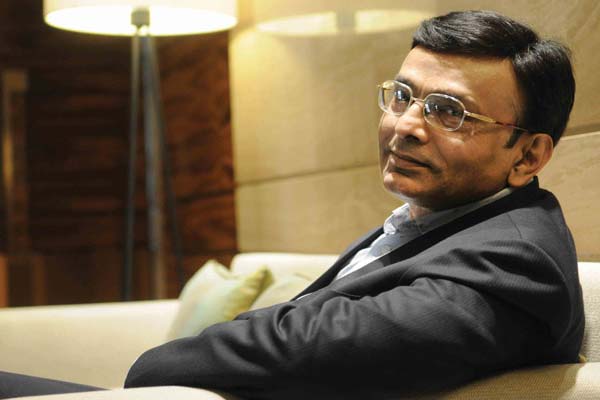
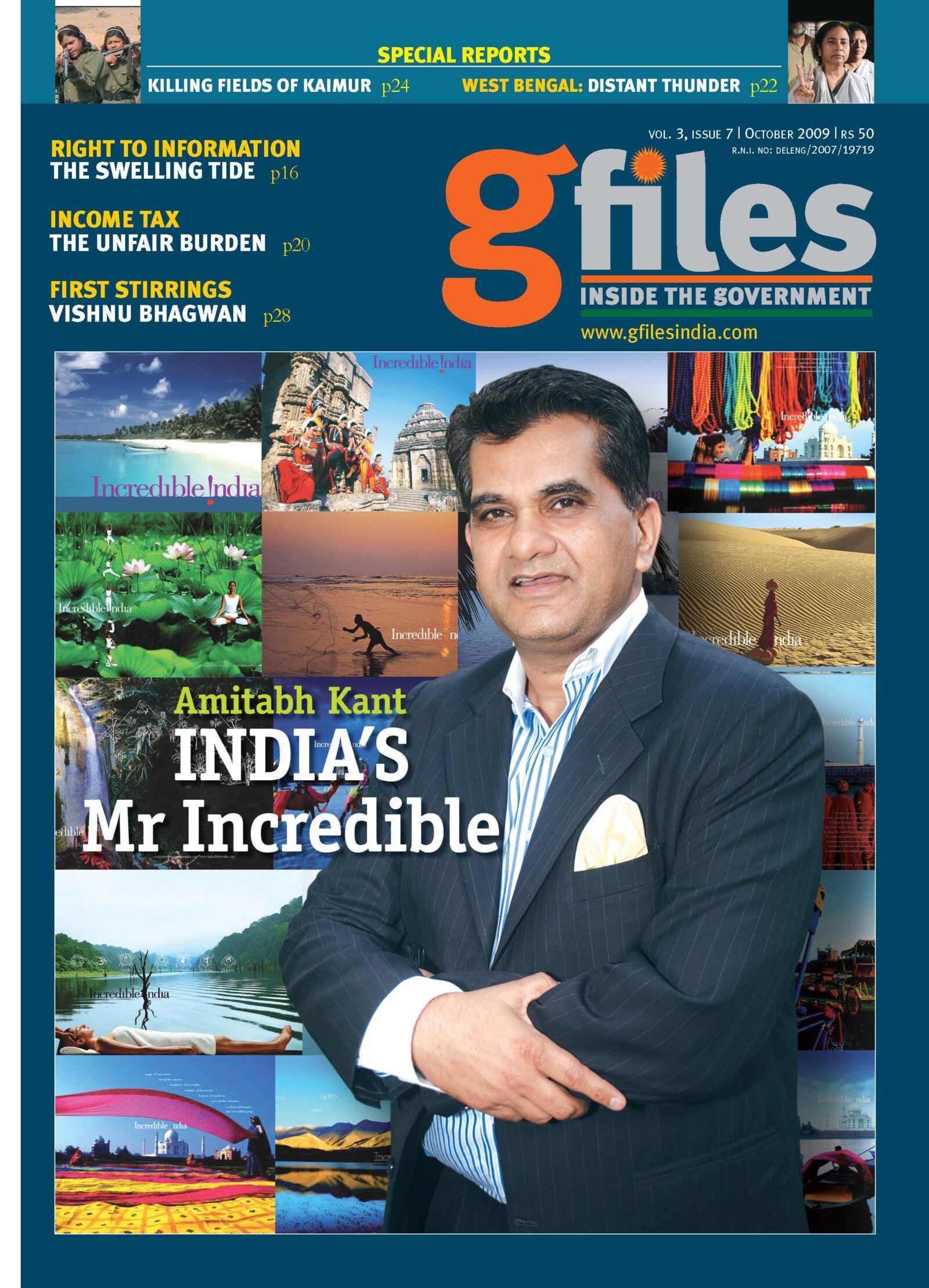
The kingdom of Kosala – now Ballia district in eastern Uttar Pradesh – has never ceased to spawn favourite sons. The lineage includes rishis Jamadagni and Bhrigu, social activists and political leaders such as Jayaprakash Narayan, Chittu Panday, Mangal Panday, Acharya Hazari Prasad Dwivedi, Acharya Parushram Chaturvedi, and former Prime Minister Chandra Shekhar. It is to this former ancient kingdom that Amitabh Kant also belongs.
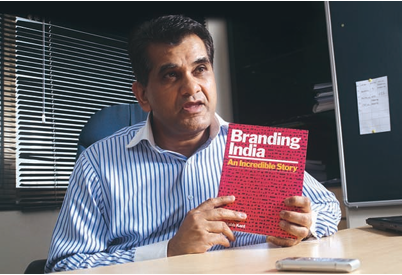
This IAS officer (1980 batch) from the Kerala cadre has been making waves with the release of his book, Branding India – An Incredible Journey. It is a vivid and compelling account of the complex and massive exercise that the author, former Joint Secretary in the Ministry of Tourism, and his colleagues, cutting across various government departments, undertook to put India – a magnificently diverse country, with 28 States, seven Union Territories, 18 official languages and 1.12 billion people – under one brand on the world tourism map. It is the behind-the-scenes story of the “Incredible India” campaign.
During his tenure in the Ministry of Tourism, Kant focused on infrastructure development, diversification of tourism products, and raising their quality and services. The initiatives included:
- Implementing the JBIC (Japanese Bank for International Cooperation)-financed Integrated Ajanta-Ellora – Phase I and Phase II project.
- Formulation, sanction and implementation of the JBIC-assisted development plan for Buddhist destinations of Uttar Pradesh.
- Formulation of a development plan for Buddhist centres and cultural learning centres in Bodh Gaya, Rajgir and Nalanda.
- Preparation and finalization of the Asian Development Bank (ADB)-assisted Tourism Master Plan for improving infrastructure in major tourism states.
- Formulation and implementation of the scheme for integrated circuits and destinations in key heritage sites like Mahabalipuram, Agra, Varanasi, Hampi, Humayun’s Tomb and Ajanta-Ellora.
- Implementation of the “Atithi Devo Bhave” – the “Guest is God” campaign to train taxi-drivers, guides, immigration officials and make them stakeholders in the tourism development process.
- Diversification into medical tourism, rural tourism, and cruise tourism.
Kant is passionate about his work – whether as Secretary, Tourism, Kerala or Joint Secretary, Ministry of Tourism in the Government of India, or in his current assignment as Chief Executive Officer (Additional Secretary level) of the Delhi-Mumbai Industrial Corridor, a dream project of Prime Minister Manmohan Singh. As for the book, Kant gives credit for his writing skills to his mother Dr Sita Srivastava, an eminent educationist.
gfiles: What is incredible about India?
Amitabh Kant: The Incredible India campaign was started in the aftermath of September 11, 2001. There was a war in Afghanistan, an attack on Parliament; international airlines were in a shambles. There were travel advisories against India and hotels had 20-25 per cent occupancy. Inbound tour operators became outbound tour operators. The challenge was to bring back consumer demand.
At the peak of the crisis we launched the Incredible India campaign. We used the crisis as an opportunity to brand and position India in the global market. Research went into this – what market are we going to attack, what markets are we going to consolidate, what market are we going to seek for the future. We worked with the most creative minds in this field, Ogilvy Mather, Bharat Bala. We penetrated global markets. Our arrivals then were 2.1 million. In 2008, it was 5.6 million. Domestic tourism was 220 million, now it’s 518 million. Our foreign exchange earnings went up from $2.3 billon to $11.6 billion. We were able to position and brand India in the global markets through this campaign. Simultaneously, we did some domestic campaigns; we marketed north in south and east in west. This campaign basically enabled Indians to discover India.
gfiles: This is strategy. But what is incredible about India?
AK: CNN recently did a survey. Across Asia-Pacific, Europe and America, India emerged the richest in terms of culture and heritage. There is research by Peter Hydrophore, who researched for the World Tourism Organization in the 1980s. He looked at 10,000 world respondents. His survey stated that 87 per cent want to see sun, sand and sea. In 2007, he used the same sample and asked what people want to do. They said they wanted to go to a country which is rich in heritage and culture, for experiential tourism. He defined those 10,000 respondents as alert, independent travellers. So from the 1980s to 2007, world tourists moved away from Triple S 5-star categories to experiential tourism. India is rich in culture and heritage, she has competitive advantage, and that is what makes India incredible and unique. The demographics of the world are changing.
Europe and America have aging populations, with 8000 people retiring per day. These people want to travel for heritage and culture only. So India has a huge market which is not tapped and that is the uniqueness of India. You have to differentiate your product and you differentiate it not by aping the West. You have to go back to your roots. Kerala became God’s own country because it went back to its roots. It went back to its traditional architecture, Kathakalli and Mohiniattam, appam and stew, and martial art. That is Kerala’s uniqueness. That is why National Geographic Traveller said it was among the 10 exotic paradises of the world. India’s uniqueness is in its heritage and cultural art forms which have to be made experiential in character. India will never become incredible by opening casinos and having night life. India’s strength lies in what is unique about her that is what a Westerner wants to discover.
gfiles: To attract tourists, you need infrastructure. Do you see it available?
‘You have to improve destination management, you have to have better airports, better lighting at monuments, better signage and, above all, the best toilets’
AK: As a marketing campaign, “Incredible India” is fine. If India wants to sustain its growth, it has to make its experience credible. The key issue on the ground is the quality of experience for the tourist. The quality of experience comes from the quality of infrastructure. You can’t be a first world nation if you have garbage and filth outside your heritage sites. You have to improve destination management, you have to have better airports, better lighting at monuments, better signage and, above all, the best toilets. We are in the process. A number of things are happening. Airports and highways are happening. In several places – Ajanta-Ellora, Mahabalipuram, Hampi, and Bodh Gaya, a lot of improvement has taken place in infrastructure.
‘Tourists come not just to the Taj Mahal, they come to Agra. We have failed to manage civic governance of Agra city. As you enter Agra city you see wires, hoardings, garbage, filth and lapkas at the railway station’
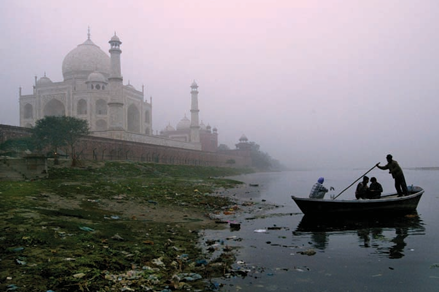
gfiles: In 62 years, we are unable to manage one of the world’s major monuments, the Taj Mahal. Its backyard is stinking and filthy. You can’t touch the Yamuna water.
AK: The Taj Mahal is extremely well managed as far as the sites of the Archaeological Survey of India (ASI) are concerned. But tourists come not just to the monument, they come to Agra. We have failed to manage civic governance of Agra city. As you enter Agra city you see wires, hoardings, garbage, filth and lapkas at the railway station. With that experience, you go to the Taj Mahal which is an overwhelming site.
gfiles: Civic responsibility lies with the state government. It means there is no coordination between the Centre and the State.
‘The ownership of tourism has to be taken over by every department of the government, starting from the Home Ministry and including all Ministries, all State governments, and especially municipalities. When this happens in this country, tourism will take off’
AK: Tourism by nature is multisectoral. It cuts across various sectors. Tourism happens, whether it is Malaysia, Thailand, Singapore, because there are excellent roads, airports, brilliant signages and hotel infrastructure. There was good connectivity by air. Tourism is a civilization issue. The ownership of it has to be taken over by every department of the government, starting from the Home Ministry and including all Ministries, all State governments, and especially municipalities. They all have to become owners of tourism. When this happens in this country, tourism will take off. People must understand tourism is a multiplier of employment and growth.
gfiles: You are very emotional on this subject. When one goes to Varanasi, Agra, Hardwar, Allahabad, the situation is pathetic. One is ashamed.
AK: I agree. I showed the problems of Varanasi in one of my presentations. After showing garbage and filth, I also said there is nothing to feel despondent about in this country. We are a young nation. It is not that work has not happened. We have done a lot in Hampi, Mahabalipuram – it should have a demonstrative impact on other places. The Ministry of Tourism cannot take over local governance in a federal structure. The latest study by the world tourism body stated that the highest growth of employment will come from tourism.
‘Baron Haussmann, mayor of Paris during Napoleon’s time, from 1853 to 1870, made Paris the symbol of national pride, the greatest city in the world. That became the inspiration for other French cities. Look at how Italy has developed. Italy is full of heritage and culture. Italy is the best example of tourism’
Baron Haussmann, mayor of Paris during Napoleon’s time, from 1853 to 1870, made Paris the symbol of national pride, the greatest city in the world. That became the inspiration for other French cities. Look at how Italy has developed. Italy is full of heritage and culture. Italy is the best example of tourism. The political realization that tourism drives employment is now coming in, in Madhya Pradesh, Rajasthan and so on.
gfiles: You mentioned small countries. India a large, federally managed country.
AK: Kerala today generates its employment through tourism. Other states should also realize tourism creates employment. When I went to Bodh Gaya, the road was full of potholes. The entire road has been done up. At Ajanta-Ellora, there were 462 encroachments. We relocated them 3 km away. We forested the whole area; you can now go by eco-friendly buses. These have become demonstration sites, other places can replicate. Every State should create a model of two heritage sites, which must give you a holistic experience from the point of arrival to point of departure. Tourism is a state subject. It is happening in every state now.
gfiles: How does the Centre fund the States for tourism?
AK: The Centre funds States for tourism infrastructure. The implementation is largely done by State government machinery. The Centre has destination development and circuit schemes. It is approved and funded by the Centre, and implemented by the State government. We need better implementation and maintenance by the States.
gfiles: UP has neglected tourism, messed it up. There is political chaos, no political will….
‘I saw 16 Secretaries of Tourism in UP. No Secretary stayed more than three to four months. There is no political and administrative commitment for growth of tourism in UP. It has the potential to be India’s number one destination. There is no focus on improving infrastructure on the ground, which is why Varanasi has turned into one of the filthiest cities’
AK: I was Joint Secretary in the Ministry of Tourism for five-and-a-half years. I saw 16 Secretaries of Tourism in the state. No Secretary stayed more than three to four months. There is no political and administrative commitment for growth of tourism in UP. It has the potential to be India’s number one destination. There is no focus on improving the infrastructure on the ground, which is why Varanasi has turned into one of the filthiest cities of the country.
gfiles: What is the motto of our tourism? Earning money? Or you want to show the great nation of India? What class of tourist do you want?
AK: We were not looking for mass tourism. It puts pressure on infrastructure, which is already constrained. We need to bring in discerning travellers, the upmarket tourist. They come to Rajasthan, Goa and Kerala. We need to bring other states into this fold of growth. Incredible India is a mother brand; we need to create sub-brands. So, if an incident happens in Mumbai, the brand of Madhya Pradesh, Kerala, Northeast should not suffer. India is bigger than 23 countries of Europe.
gfiles: You say only four states have come up as tourist destinations. Why have Gujarat, Maharashtra, Orissa and Andhra Pradesh not come up too?
AK: Several states have focused on industrialization. They have focused on their core competence. Some, like Karnataka and Andhra Pradesh, focused on information technology. Now they realize that the next era will be one of culture and tourism and they are proceeding on that road.
gfiles: You are talking about expansion of this industry, but where is the trained human resources?
AK: One of India’s least talked of success stories is the creating of world-standard human resources for this industry. The Indian Institute of Hospitality and Management (IIHM) produces the world’s best trained manpower for tourism and hospitality.
gfiles: But what about unorganized HR like taxidrivers, rickshawwallahs, guides, bus drivers….?
AK: When we were doing the Incredible India campaign, we realized one of the major obstacles involved taxidrivers, guides, and immigration staff. We then launched the parallel campaign, Atithi devo bhave. We started with seven cities and finally included 15 cities. We trained taxidrivers, guides, and immigration and customs staff so that they became ambassadors of India. We did certification programmes The campaign became more important than Incredible India.
gfiles: What is to be done to spread the tourism concept to States?
AK: The key drivers of tourism are connectivity, civic governance, communication strategy (which needs to be constantly innovated), emphasis in terms of improving the destination experience on the ground. If this happens, a sense of national pride will come among the states.
gfiles: What tourism sector does India lack most?
AK: There is huge potential for India to emerge in a sector called Meetings, Incentive, Conventions and Exhibitions (MICE) tourism. If a Convention Centre is developed in four or five cities, India will host all the meetings of the world.
gfiles: Any State taking interest in this?
AK: Many States are talking about it but none has been able to do it. We have not been able to develop any international Centre except one in Hyderabad.
gfiles: Which countries are most interested, especially after the Incredible India campaign?
AK: The traditional markets are in Europe – France, Germany and Italy – and now America. These are long-haul markets. We don’t have short-haul tourists. We don’t get tourists from Pakistan. In Europe short-haul tourists are there but we don’t get them. India has to make itself a destination for Southeast Asia. We should focus on Thailand, Malaysia, Singapore and Indonesia. China, by 2020, will be the biggest outbound market in the world. It has a hundred million outbound tourists. In coming years, we have to focus on the markets in China, Russia, Japan and Brazil.
gfiles: What about Latin America and Africa?
AK: Latin America is geographically very far. Direct air connectivity from this market is not very good. Air connectivity from Europe and America has improved a lot.
gfiles: How do you see the tourism industry in 2020?
AK: India should not look at numbers. The World Tourism Organization predicted that India, by 2020, will have about eight million tourists. I hope we will pass this figure in 2010. The challenge for 2020 is that tourism should be the key driver for India’s economy for both economic growth and employment. The highest multiplier effect on employment should come from tourism. It should be a creator of hard and soft jobs in India. If that realization comes in the minds of politicians, then travel and tourism will take off.
gfiles: It is a soft sector. Will the government govern it methodically?
AK: Did you visualize the IT revolution? Did you visualize Kerala? It takes time for things to happen. The realization is coming.
gfiles: What about your current task as CEO, Delhi-Mumbai Industrial Corridor Development Corporation?
AK: The DMIC seeks to create a strong economic base with globally competitive environment and state-of-the-art infrastructure to activate local commerce, enhance foreign investments and attain sustainable development. The DMIC is proposed to be developed on either side of the Western Dedicated Freight Corridor of Ministry of Railways within a band of 150-200 km. It will be a model Industrial Corridor of international standards with emphasis on expanding the manufacturing and services base and will be a global manufacturing and trading hub. The project aims at doubling employment potential, tripling industrial output and quadrupling exports from the region in the first five years.
The story was first published in Oct 2009 issue of gfiles