



























What are the items of business the incoming government should take up asap?
In Alice in Wonderland, Alice asks the Cheshire cat, “Which path should I take from here?” and the cat replies, “That depends mainly on where you want to go.”
A new government is going to be in office in less than two months. Whether it wishes to continue with the ongoing trend of governance or wants to break new ground will determine its agenda for the next five years
The question is important in the national context today. A new government is going to be in office in less than two months. Whether it wishes to continue with the ongoing trend of governance or wants to break new ground will determine its agenda for the next five years.
The new government will obviously not be new in its configuration. The same players of the political game, whether of this party or that, will wield power at the Centre. I do not foresee a sea change in the dynamics of power that include unprincipled contracts between those who share power. I do not see any reduction in corruption, unfairness or injustice. I do not see the emergence of a revolutionary spirit in favour of the poor and deprived. In short, I have no hope for better governance than we have suffered during the last decade or more. The paradox is that when we urgently need a performing and effective government, we may not get one. An unstable ruling coalition is most likely.
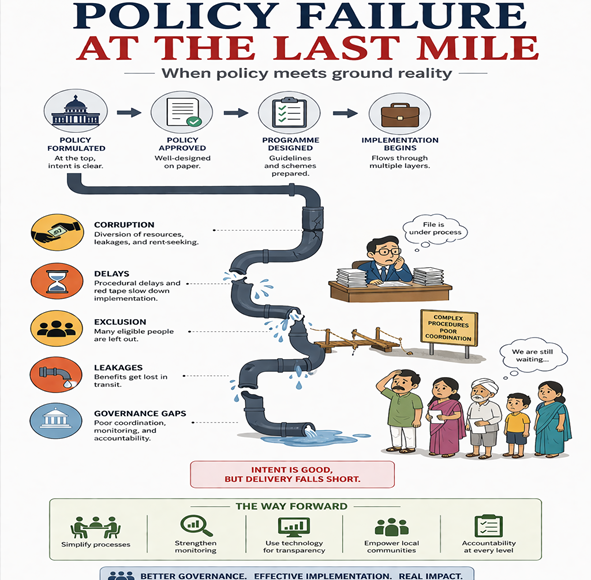
People cannot eat policies. The policies have to be translated into programmes and schemes, and further broken down into individual projects
Yet, were I to think of a progressive agenda for the new government, here is what comes to mind. The larger development and welfare canvas has been painted hundreds of times by thinkers, economists, social scientists and governance experts. We can always revisit what has been prescribed by eminent analysts and theorists. The devil, they say, lies in the details. The election manifestoes of the major political parties evidence their objective of wooing the electorate. Loyalty to the manifesto is not necessary. Broad guidelines do occupy a pivotal place in public policy formulation. But people cannot eat policies. The policies have to be translated into programmes and schemes, and further broken down into individual projects. The projects then become understandable to ordinary people like you and me.
Now, the key question is what happens to the projects with laudable objectives.
Recently, my friend TS Krishna Murthy spoke at the Confederation of Indian Industries (CII) national conference. He said, “In my opinion, the time for taking about reforms is over. Whatever reforms have taken place have been only incremental and therefore have been tantalizingly and agonizingly slow in implementation and impact. Our mantra from now on should be ‘No more incremental reform; we need to transform totally’ if we have to survive the global competition and meet the expectations of the people. The sooner we transform our practices, procedures and policies in all sectors of governance the better for the survival of our democracy or else we may have to face the people’s wrath in the form of violent agitations or total revolution.”
He further observed that our immediate focus ought to be in respect of civil service, police, judicial and electoral reforms.
Now, tell anybody even remotely interested in public governance and he will immediately agree. But tell the new masters in North and South Blocks; they will dismiss it by saying they have known this for decades, there is nothing new in it. So, they have to be told in the language they understand.
At a national conference on transparency and accountability as far back as April 2005, I had made the following suggestions:
• Rewrite all rules and regulations in every Central Ministry and every state government department within one year to simplify them and change their basis from suspicion to trust. Simultaneously, make the penalties for their violation very severe. For example, penalty for evasion of taxes should be mandatory imprisonment.
• Enact and notify Central Right To Information legislation without any further delay. Every state government should also do so in one year.
• The legislation relating to protection of whistleblowers should be immediately enacted. It should not be confined to protection of whistleblowers as has been recommended by the Law Commission, but should also provide rewards to them.
• The law regarding forfeiture of properties relatable to corrupt practices should also be put in the statute book without delay. The draft is available with the government.
• Every Ministry should complete the exercise of exiting from such functions which are not mandatorily required to be done by the government. For instance, there is no need for the government to issue driving licences if the penalty for traffic offences is sufficiently high.
• The use of computers in government offices should be a rule rather than exception. Manual processing of public services corrupts them.
• All Swiss bank accounts held by Indian nationals should be nationalized. This simple act would neutralize hundreds of thousands of crores of rupees, which could then be used to create economic and social infrastructure for the poor.
• Similarly, it would be prudent to consider the seemingly outlandish suggestion of demonetizing the currency and replacing it with a new currency to unearth the black money held by mafia, drug runners, corrupt businessmen and also corrupt officials and politicians.
I had added that these suggestions were fraught with the risk of opposition from the lawmakers themselves. In the four years since, only one of these suggestions has been implemented. I sometimes wonder how the RTI Act was passed by MPs!
The Nobel laureate Samuelson was asked whether he did not get bored setting the same questions in the examinations year after year. He replied, “No, because in economics, we keep changing the answers every year.”
Similarly, good governance is also a moving target.
I would prioritize 15 immediate tasks classified under three heads for the new government (see box).
Bill Clinton memorably won his first election in 1992 with a single-sentence slogan: “It’s the economy, stupid!” It behoves the new government to send out this same message to all Ministries, departments and state governments.

Prabhat Kumar is an Indian Administrative Service officer of the 1963 batch, he served as the Cabinet Secretary of Government of India between 1998 and 2000. Upon creation of the State of Jharkhand in November 2000, he served as the first Governor.