






























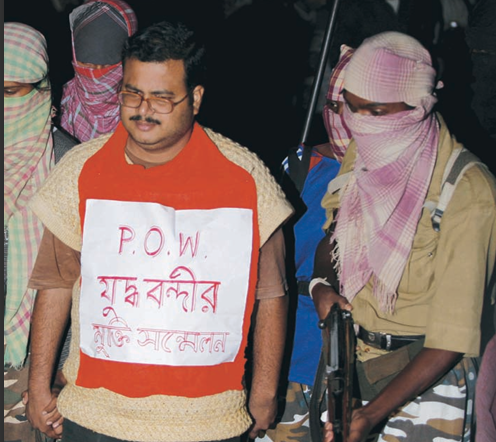
INTERNALsecurity is an important dimension of national security, the maintenance of which is a fundamental duty of any government. A government’s claim to legitimacy and public loyalty arise from the satisfaction it can give to its citizens over issues of security. Judged by this criterion, the public record has not been too good in India.
In 2004, Naxalism was officially identified by the Centre as the most dangerous internal threat facing the country. In 2009, exactly the same description was officially given again to this phenomenon. The conclusion seems inescapable that while the nature of the problem was understood, no practical solution could be devised to tackle it in the inter regnum.
Naxalism grew from a minuscule movement launched by Charu Muzumdar in Naxalbari village of Darjeeling district, West Bengal. The movement was carved out by him in 1967 after a split with the ultra-Left sections of the CPI (Marxists). The movement, basically anti-landlord, acquired the nomenclature of CPI (Marxist Leninist) in 1969. A similar group, calling itself Marxist Communist Centre (MCC), was operating in the south. The CPI (M) and the MCC merged in 2004 and became the CPI (Maoist), appropriating the Maoist doctrine of revolutionary agrarian war to seek power through armed violence and surrounding urban centres. Their activities soon accounted for 90 per cent of the revolutionary armed action in India. This brand of revolutionary activities came to be described broadly as Naxalism in recognition of Naxalbari, from where the bugle of armed revolutionary agrarian revolt was first sounded.
The CPI (Maoist) stuck for long to the Maoist doctrine of waging a people’s war from the countryside and set about increasing its influence and presence in a planned way. According to the government, as of today, 20 states of India, covering 223 districts, feel the brunt of its progress in a major or minor way. Its growth is methodical. It is setting up a state committee as it expands into a state. Two special area committees exist, one for UP, Uttarakhand and North Bihar, and the other for West Bengal, Jharkhand and the rest of Bihar. The three most deeply affected regions Dandakaranya, North Telengana and the Andhra Pradesh-Orissa border – have each a special zonal committee to oversee the movement’s activities and growth in these areas. What all these committees together represent can be called the first well-knit organizational structure and super-structure for waging a war of revolution in India. If one looks at the land area where the Naxalites hold sway, it has to be conceded that Naxalism has come a long way in these four decades plus from its birth in Naxalbari.
The CPI (Maoist) has also widened its tactics. It is no longer an agrarian-driven movement. For some time it has been trying to make common cause with other centres of rural and urban dissatisfaction, tribal or non-tribal. All sections of marginalized populations are being targeted to enlarge its base. “Land for the tiller” is not the only war cry. Attempts are on to bring all those aboard its band wagon who regard themselves as victims of globalization, privatization, unemployment, lay-offs, displacements caused by project development and the like, or those who have been ignored or left behind in socio-economic progression. Industrialized areas appear to offer them special opportunities. The industrial cities of Surat, Ahmedabad, Pune and Mumbai in western India and Kolkata, Ranchi, Dhanbad and Bhilai in the east are on the Naxal radar for enhanced penetration.
The roping in of disaffected groups as allies was a classic united front tactic of the international communist movement in the last century. The Naxal leadership has appropriated it. This has also brought a bonus. The urban centres of disaffection against the state are often led by educated leaders, usually from affluent or semi-affluent backgrounds, who get deflected to an agitational agenda for ideological, moral, personal or societal reasons.
WHERE united fronts have been successfully established, the leadership of the Naxals also lands in their lap. The beneficiary is ultimately Naxalism. Such associations mostly remain and function at the covert level. Some intellectuals, human rights workers, and political or media activists seem to belong to this category. In other words, no class is left out. Semi-proletariat, petty bourgeoisie and even national bourgeoisie are tapped for support and collaboration. The success in making such inroads gfiles inside the government seems to suggest that some grounds for a revolution, howsoever embryonic, do exist in the country.
The Naxal united front tactics have resulted in exploitation of sentiments and of people involved or affected by issues like the Singur agitation, the Nandigram uprising against SEZs, the murder of Dalits at Khairlanji, and farmer suicides in Vidarbha and elsewhere.
Naxalism and its threat to the state have been growing steadily in the past 40 years. The ideology appeals to the deprived and downtrodden. They have a coherent organization whose members are ready for sacrifice. They have visionary plans of seizing political power through armed violence. Their strength should not be counted by the number of those with arms or by incidents staged; their strength lies in the numbers who have been given military training. They display a robust will and determination of purpose. www.indianbuzz.com determination of purpose.
Juxtaposed against this is the Centre’s recent awakening to the complexity of the problem and its bid to devise a counter-strategy. The Home Ministry, until P Chidambaram took over, was inclined to play down the Naxal threat, treating it merely as a law and order problem which the bureaucrats and police would be able to tackle at their own level. The earlier less-than-enthusiastic approach of the Centre could have been caused by the Constitutional division of labour and powers between the Centre and the states. In the case of a law and order problem, the states have a Constitutional right to deal with it. The Centre could claim only a role for co-ordination which opposition-ruled States could effectively ignore. The Salwa Judum experiment of arming self defence volunteers in Chhattisgarh to counter Naxalites, though somewhat successful, has been unacceptable in other states and was so earlier even to the Centre. The Chidambaram strategy combines armed action by Central paramilitary forces with a heavy dose of development. The states have been invited to send their own police forces to join the hunt for Naxalites.
Under this pilot scheme, codenamed Operation Greenhunt, about 50,000 men will be deployed in five of the most affected states in the near future. Most will have been put through some special training before action begins. In the tribal areas covered by the CPI (Maoist) special zones, there are large areas where the state has never been able to penetrate. Land where state authority fails to reach remains ungoverned. Naxals rule there, calling them liberated areas. The government’s new strategy aims to physically drive out the Naxals from such areas and introduce governance by building roads and establishing schools, health clinics, markets, panchayats