










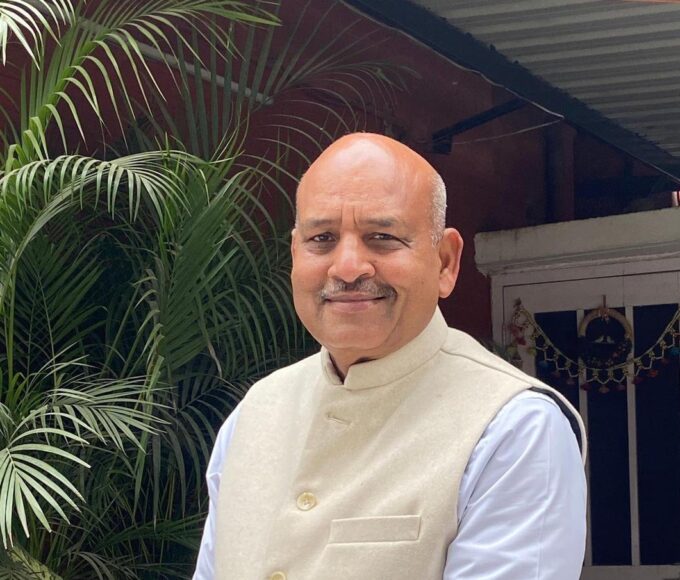







I was born in a lower-middle-class family. My father was a Deputy Registrar of Sagar University. My uncle was in the civil service and my grandfather had also been in it. In Classes IX and X, I had a teacher, Laxmi Dhar Acharya, who taught many subjects. When he was transferred, he said to me, “You belong to a family of administrators, so you must get into the IAS but you must retire as a poet (meaning die as a poet).” I carried those words through life.
I started as a science student and topped the university in physics, mathematics and chemistry. When I began nurturing the ambition to get into the IAS, I opted for Arts. The Vice-Chancellor was DP Mishra, who later became Chief Minister of Madhya Pradesh. He said, “Why do you want to go to Arts? Are you mad?” I explained my reasons. He said he would grant me the transfer but asked me to promise I would top in BA.
My father then said, “Since I am in charge of the examination section of the university, people will think that you keep topping because of me.”
I had two choices of university. One was Allahabad, where my father had studied. The other was Delhi. I had realised that the literary capital of Hindi was shifting to Delhi. So I got admitted to St. Stephen’s College and did MA in English Literature.
In 1962, I was an Assistant Lecturer in Dayal Singh College. I had started enjoying teaching and I was interested in being a writer. I thought the IAS would be a bit of a bore. So I skipped the first chance and lied to my father that I had appeared but would probably not qualify. Unfortunately, my marks list was sent to my home address in Sagar and it showed I had been absent.
On my father’s insistence, I appeared for the exam in 1964. Meanwhile, the great Hindi poet, Gajanan Madhav Muktibodh was in a coma and I would visit him almost every day in hospital. So I hardly prepared for the exam. He died on September 11 and the exam started from October 3. To my great surprise, I qualified.
I phoned my father and told him I had qualified but didn’t want to join the IAS. Again, he persuaded me and I joined.
We were in Mussoorie for a year. Then, my first posting was as Assistant Collector, Raipur where I had a Collector, DG Bhave, 1957 batch, MP cadre. I was the 13th original resident of Madhya Pradesh to have qualified for the IAS. Our district training used to be for 18 months. After 10 months, he said, “Now you are SDO of Mahasamund.” I pointed out that I had had only 10 months’ training. He replied, “I’m responsible for your training. You are trained enough to be an SDO.”
Now came my first encounter with politicians. DP Mishra was CM but his government fell and Govind Narayan Singh Thakur became CM. VC Shukla, who was a Minister, was coming on a tour of his constituency so my Tehsildar said, “Sir, what about crowds?” I asked what he meant. “Sir, we always arrange crowds for these leaders.” Nothing doing, I said. On that visit, there were about 17 or 18 public meetings scheduled. Eight or 9 had to be cancelled because nobody came. At one, there were only three people. They turned out to be the teacher, fatwari and kotdwara. So it showed the popularity of these leaders.
I organized the first Chhattisgarh Young Writers’ Conference in Mahasamund and 100 writers were invited.
After about 10 months, I was posted as Under Secretary and then I became Collector of Sidhi. Now Sidhi was part of Baghelkhand, where the politics involves a running feud between Brahmins and Thakurs. Both are very powerful and demand undying loyalty from their kith and kin.
At that time Arjun Singh was not an MLA from my district, he was elected from Shadol. My first experience with him was strange. He called on me, and my wife and I sat with him. After he left, my wife scolded me, “We were together for 45 minutes, you spoke for 41 minutes, he spoke for two minutes and there was silence for two minutes.” So I said, “If he doesn’t speak, what should I do?” But that is his nature, he’ll phone you and then not speak.
Next I was transferred to Sarguja. It had a civil servant, a senior IAS officer of the 1954 batch – MS Singh Dev. He was the former ruler of Sarguja. So he had a political existence and also an old court which was being converted into a collectorate. There was a huge durbar hall, decorated with marble and tiles with a large chair where the ruler used to sit. When some previous Collector had tried to use this as a court room, there were objections. When I learned of it, I felt I must assert the independence and authority of the Collector, representative of the government. So I started using it as the Collector’s seat though it was very uncomfortable.
This led to some tension. On visits, he would stay in the palace. In the room where he met people, all the officers would sit on the floor and he on a chair. Out of courtesy, since he was my senior, I went to see him once. There was no seat for me so I asked for it and a chair was brought. He was actually a nice man but all these feudal issues made him seem otherwise.
Then his wife was given the Congress ticket to contest as an MLA.A cricket match was held at the Sarvajana Club between the Collector’s XI and Citizens’ XI or something. Afterwards, a lunch was to be hosted at the palace. I said, the election procedures have started so it’s not possible for the returning officers to go to anybody’s residence and the lunch has to be at the club itself.
People ask why I keep smiling. British author John Wayne, who later became professor of poetry at Oxford, had a book of poems called Weep before God – taken from a Jewish proverb, “laugh before man, weep before God’’. I’m a non-believer, so I took up the first part.
When the great Hindi poet Muktibodh was ill in AIIMS, Nemi Chand Jain’s family looked after him. I met one of the daughters at that time and ultimately we got married.
I joined as Deputy Secretary, Bhopal on August 10, 1972. On August 15, 1972, Arjun Singh was sworn in as Education Minister. My principle was to stay away if anybody I knew acquired power or wealth or glamour. If they needed me, they would seek me out.
One day, I was coming out of MN Buch’s residence after dinner. I did not know that Arjun Singh lived next door. He called out to me, “Arre, aap kahan hai? I’ve been searching for you all these days.” He asked me to visit him the next day. There, he told me that there was a plan regarding culture and that I should prepare a blueprint. In Sidhi, I used to tell him that if the government has responsibility for education, agriculture, irrigation, road and transport, why not for culture also?
After a few months I was shifted as Deputy Secretary, Education. That was when a massive cultural initiative started. There was an institution called Madhya Pradesh Kala Parishad, of which the Secretary, Education used to be virtually ex-officio secretary.
I was made Secretary and held the job for 17 years without a break. One issue that occurred to me was that Madhya Pradesh was made out of leftovers. It has borders with seven states. In some ways it was very cosmopolitan because each part had contributed. It did not have an integrated cultural identity. Because I belong to Madhya Pradesh, I wondered if we could create an integrated image of the state.
In 1973, on the occasion of 25 years of India’s independence, we mounted a huge Utsav ’73 at which we honoured 13 outstanding Madhya Pradeshians, including Prasad Shankar Pandit, Ustad Amir Khan, Kumar Gandharv, Amjad Ali Khan, Habib Tanvir, Satyadev Dubey and so on. For the first time, Madhya Pradesh realised that the best of its culture in terms of music, folk arts, theatre or visual arts was the best in the country. This Utsav became an annual event.
Arjun Singh was then a non-interfering politician. He left the matter to me to the extent that I was labelled the cultural czar of Madhya Pradesh. I would not allow any single ideological outfit to dominate because we must create pluralism. Also, if you expose people to modern poetry, dhrupad music, experimental theatre, abstract arts and so on, they respond.
In 1974, the government under Indira Gandhi decided that states should have multi-arts centres named Bharat Bhawan. Some assistance would be given by the Centre. No other state responded except Madhya Pradesh. I was made Member Secretary of the Committee. Then the financial proposal had to be worked out. We had identified a plot and chosen Charles Correa as the architect. But then Chief Minister SC Shukla objected to Bharat Bhawan being next to his residence. So we had to look for another site. Charles was keen to have a water body which would add to liveliness. Then the SC Shukla government fell and we could return to the original site.
As Education Minister, Arjun Singh tried to create an independent department of culture at my behest. The proposal was rejected by SC Shukla. In June 1980, Arjun Singh became CM. Within two months he created a department of culture.
As Education Minister, Arjun Singh tried to create an independent department of culture at my behest. The proposal was rejected by SC Shukla. In June 1980, Arjun Singh became Chief Minister for the first time. Within two months he created a department of culture. Then I became the Secretary and remained so for 10 years, even after he left.
The second decision taken then was to complete Bharat Bhawan. My energy, youth, and neglect of family all happened during that period. It was an incredibly satisfying experience to set up Bharat Bhawan. We used to get a lakh visitors a year because there is no entry fee on Fridays. The population of Bhopal was only 10 lakh, so 10 per cent of the city’s population visited it. Bhopal is not a significant tourist destination. Even now, when Bharat Bhawan is in severe decline, the number of visitors daily is more than the number who visit the Gallery of Modern Art and National Museum taken together.
Correa used to say it was a non-building. You can’t see the whole building from anywhere. In nine years that was the best happening in this country, the most innovative, lyrical, epical, disturbing and outrageous. It was a great experience. I cherish those days and the friendships with the artistic community. No civil servant had my luck and so many friends. I opted for a better wealth.
For the inauguration, we had decided that we would invite 200 people from all over the country and the world. We wanted Mrs Gandhi to spend some time with them. When her programme schedule arrived three days ahead, it said there was a meeting of Congress workers at Ravindra Bhawan so she would go from there to Bharat Bhawan, inaugurate it over 45 minutes, and go back. I went to Arjun Singh and said, “Sir, all these people like Mulk Raj Anand, Akbar Padamsee, J Swaminathan, MF Husain, SH Raza, Peter Brook etc are coming but the PM is not getting time to meet them.” I asked if I could try something. He agreed. I rang up to Pupul Jayakar, whom I had never met. But she said, “I’ve heard a lot about you.” Then I said, “Madam, we’ve run into a problem. I want the PM to spend some time with these outstanding cultural figures.” I told her everything. She said, “I’ll talk to Indu.”
Three days before the inauguration, Padamsee, Husain, Ram Kumar, Manjit Bawa, Krishen Khanna were helping Swaminathan put together the museum. I was a civil servant, working the whole day at the secretariat. In the evening, I would buy a couple of bottles of Old Monk, kebabs and samosas and go there at about 7 pm. By that time they would’ve fought like dogs so I would restore good humour with the rum.
That evening, at 10 pm, a messenger came rushing from the CM’s residence. The CM wanted to see me. Arjun Singh told me, “Aap ka chakkar chal gaya.” The PM’s schedule had been changed. She would now meet all the artists at an at-home at the Raj Bhawan. “So the guest list will be decided by Mrs Jayakar and you. Even I don’t have a say. This is what the faxed message says,” said Arjun Singh.
The PM said that it looked like Bhopal was going to be the cultural capital of India and congratulated those who had contributed. I estimate that that must have instantly created 200 enemies of mine. “Achha, uski tareef. Hum toh sochthe the, ‘nachaya, gabeiya ke beech’.”
In her speech the PM said that it looked like Bhopal was going to be the cultural capital of India and congratulated those who had contributed. I estimate that that must have instantly created 200 enemies of mine. “Achha, uski tareef. Hum toh sochthe the, ‘nachaya, gabeiya ke beech’.” The PM became so fond of Bharat Bhawan that when we decided to convert it into a trust, she gave me Rs 1 crore immediately.
When Arjun Singh left, Motilal Vora took his place. He was a weak man, not very intelligent and very vulnerable to any kind of pressure. He removed me as Secretary, Culture. The Congress lost the next election and Sunderlal Patwa became CM. This man singlehandedly inflicted enormous damage on culture. The problem with the BJP is the congenital fascination for mediocrity. They can’t pick any outstanding man in any field of knowledge, creativity, arts and culture and so on.
In 1990 I was shifted as a member of the Board of Directors, Revenue, for one-and-a-half years. I had earlier declined to be DG of Doordarshan, Festival of India and Archaeological Survey of India, Joint Secretary, I&B, Executive Director, NIFT and the like.
In mid-1992, I became Joint Secretary, Department of Culture which is part of the Ministry of HRD and remained there till 1997 when I was appointed VC, Mahatma Gandhi International Hindi University which was a five-year term. Although I retired in 2001, I continued as VC.
When IK Gujral was PM, the post of Secretary, Culture was vacant. I got a call from NN Vohra that I should meet the Cabinet Secretary. Mr Subramanium said, “We can’t promote you from the IAS to this post but if you resign from the IAS, we can appoint you for a three-year term in your personal capacity.” I phoned him after one hour and said I would resign. It was end-1997. I had an invitation to attend the Nobel Award Ceremony and also to inaugurate an international conference on the history of north Indian classical music in Rotterdam. I had accepted both. On the return flight, I read in a newspaper that someone had been made Secretary, Culture.
I enjoyed the service and have no regrets though it failed me towards the end. I’ve written 13 poetry anthologies, seven books of literary criticism and edited a lot of other things. The service can provide space for your passions, it doesn’t necessarily come in the way. As a writer, I valued the service giving me the experience of raw reality. I would have been a teacher sitting in Delhi. I got to realize the glory and dignity of the ordinary people. This affected me in two ways. One, I became a first draft writer. All my books and poems are first drafts. I developed a habit of writing in a hurry. Two, I realized there is so much dignity and spirituality in the ordinary in this country. I lost fascination for power because I saw the powerful being so dirty, so mean – not just politicians but also bureaucrats. I have found politicians with courage and integrity who are tolerant of dissent but their number is dwindling.
Today, young officers have all the wrong dreams – to have a rich father-in-law, to make money. When I got into the IAS, some judge from Allahabad wanted me for his daughter and offered my father Rs 5 lakh. My father said, “You think my son is a vegetable that you’ve come to buy.”
The worst thing is that the corrupt officers are not punished. Section 311 should be scrapped because this protection has been misused by the bureaucracy itself.