

















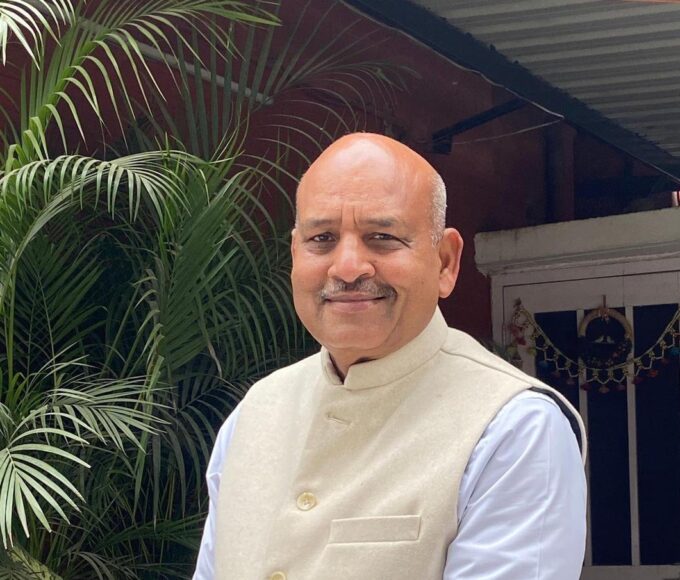













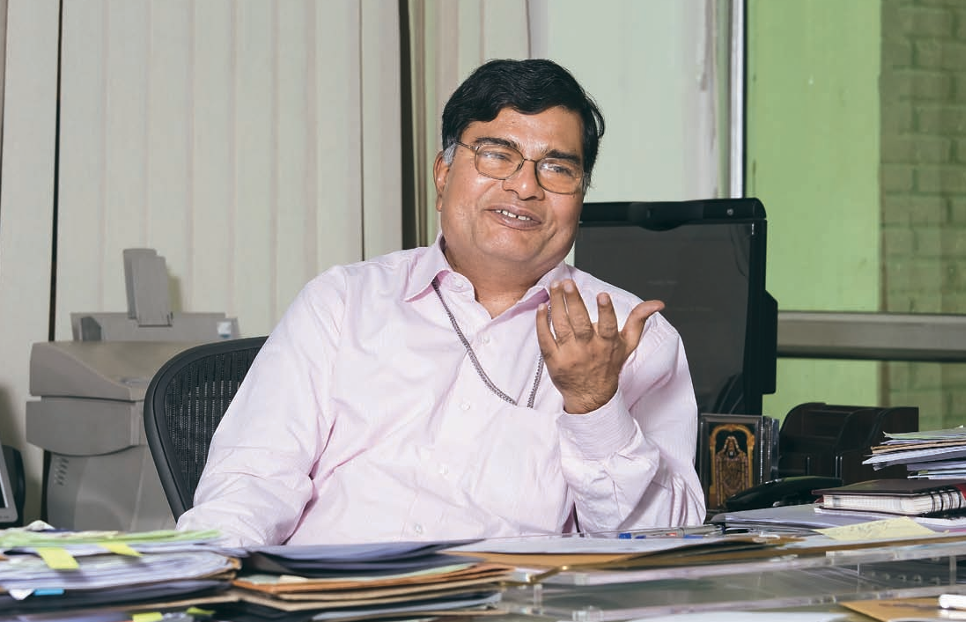
R Bandyopadhyay, Secretary, Ministry of Corporate Affairs, Government of India, was earlier Secretary, Department of Public Enterprises in the Ministry of Heavy Industry and Public Enterprises. During his tenure, the number of Navratna companies grew from 12 to 18. He also developed the concept of Maharatna for very large profit-making Central Public Sector Enterprises. He was instrumental in implementing a new pay package for the executives of all the Central PSUs. At the field level, he has worked as ADM / DM / Divisional Commissioner in West Bengal. Bandyopadhyay was also a member of the Committee on Financial Inclusion, headed by Dr C Rangarajan, former Governor, Reserve Bank of India.
Under his stewardship, the Ministry of Corporate Affairs
has introduced e-stamping with MCA-21 to facilitate e-registration of companies. Rules for the Limited Liability Partnership Act have been issued and a series of workshops has been organized throughout the country for the benefit of investors. Bandyopadhyay has an interest in bringing in modern management in the industrial sector.
gfiles: Thestandard of corporate governance in Indian companies is low. What is your ministry doing in this regard?
R Bandyopadhyay: Since last year we have taken initiative regarding corporate governance and development. FICCI, ASSOCHAM and CII have joined hands with us. In December 2009, we held the first-ever India Corporate Week and conducted 124 programmes throughout the country on corporate governance, corporate social responsibilities, IFRS, auditing and so on. CII, FICCI, ASSOCHAM, Bombay Chamber of Commerce and Industry, PHD Chamber of Commerce and Industry, ICAI, ICWAI and ICSI were with us. Two booklets prepared by the Ministry – “Voluntary Guidelines on Corporate Governance” and “Voluntary Guidelines on Corporate Social Responsibility” were released. They contain guidelines to help the corporate sector achieve the highest standard of corporate governance. We are getting an enormous response from the corporate sector now.
We also have a specialized organization, National Foundation for Corporate Governance, chaired by the Minister for Corporate Affairs. It has a Board of Trustees of which I am the Chairman.
gfiles: But little has been delivered regarding investors’ protection. What are you doing to empower investors so that they can take informed decisions?
RB: We are emphasizing investor education through the Investor Education and Protection Fund. In July, we are organizing a massive programme on investor education and protection throughout the country. Apart from various other institutions, we’ve also involved SEBI, RBI, NSE, BSE, and the Multi Commodity Exchange of India Limited. Some of the Indian Institutes of Management and the All India Management Association have shown keen interest in these development programmes. We plan to have 3,000 investor education and protection programmes throughout the country this year.
gfiles: But these numbers remain numbers and hardly any concrete delivery takes place. We boast of meeting targets in numbers and forget the effectiveness of the entire exercise.
RB: We are not limited to numbers. Simultaneously we are doing three other activities: 1) we are preparing a booklet, “Trainers’ Training” which will be released in July. This will ensure that the person who is educating the investors should know all that needs to be delivered to them. We’ll print thousands of copies and will also allow all the associations to print as many books as they like without any copyright. 2) A smaller booklet of 20-25 pages will be translated into all regional languages. It will give basic guidelines about investors’ rights, risks associated with different investment alternatives and so on. Our slogan is “Informed Investor – An Asset to Corporate India”. Our duty is to make them aware of their rights and responsibilities. However, it’s not our job to suggest they invest in this or that company. 3) We have developed a website for investor protection under the IEPF that will be translated into all the regional languages. Also, we’ll make programmes for the electronic media for investors’ education.
gfiles: The main problem in this exercise is lack of qualified resource persons.
RB: I don’t have a problem as I don’t depend on government officers only. I have 1,65,000 chartered accountants, 50,000 cost accountants and 25,000 company secretaries associated with this Ministry. They are not only the most qualified people for this purpose but have also shown keenness to be associated with this programme. Even if 10 per cent of them are active, the programme will be a success.
gfiles: What is the likely budget for this programme?
RB: Budget is not an issue for us. Though we have the usual budget of Rs 5 crore and have asked for Rs 10-15 crore extra, this is not driven by the fund – partly because the District Chambers of Commerce or State Chambers of Commerce and Industry, CII, FICCI, ASSOCHAM, and other organizations will be there to support us. It will not be a programme run by the Ministry alone.
gfiles: The New Companies Act is likely to be enacted by the year’s end. What are its notable features?
RB: The Bill is now before Parliament and it will not be appropriate to comment. The Act of 1956 had been amended 22 times, but everybody felt there should be a modern Company Act. The final form of the Bill was placed in Parliament in August 2009 and is being examined clause by clause. By the monsoon session we expect to have their recommendations. The world atmosphere has become more liberal but at the same time we had things like the global meltdown. The law should not hinder the growth of the corporate sector. We believe in the concept of enlightened regulation i.e. before we make a law, we collect information relating to that from various sources, put it on our website for comments and critical inputs from all the stakeholders and then finalize the legislation. We also wish to have inclusive corporate growth. What is there for the common man in the corporate sector? All that we have talked about investor education gets covered here.
The main focus of the new Act can therefore be summed up in two simple phrases: 1) Corporate growth with enlightened regulation, and 2) Corporate sector with inclusive growth.
gfiles: What steps are you taking to remove the lacunae that you have in the present law to prevent Satyam-like scams?
RB: I don’t know what lacunae you are talking about. The Bill focuses more on preventive steps. The functioning of directors, independent directors, auditors, and company secretaries is being fine-tuned to make them more accountable. An affair like Satyam would not have happened had people performed their duties properly. Why Satyam happened is a matter to be investigated by the investigative agencies who will file their reports in due course. The Bill seeks to tighten the internal and external check systems. We are trying to develop certain parameters that can work as an early warning system such as abnormal decline or increase of profits and so on. We have released voluntary guidelines on corporate governance that talk of rotation of auditors, the role of independent directors, the responsibilities of the executive functionaries and so on.
gfiles: If we look at various scams such as vanishing companies, fly-by-night operators, promoters misusing public money, manipulating stocks, misrepresentation in the prospectus, window dressing of accounts, and so on, it appears that the law is not a deterrent.
RB: Our experience is different. Every time the rules are made, people tell us they are very stringent and we receive a number of representations about overregulation of the corporate sector. IPC and CrPC are very stringent, but people commit crimes and even murders. What is important is to stick to the ethical values and to develop and maintain appropriate regulatory procedures.
gfiles: What, according to you, is a happy state of affairs for a company?
RB: They should work like a responsible corporate citizen with more disclosures and transparency in their functioning. Here comes the concept of what I earlier described as enlightened regulation which comprises two things – more disclosures and comply or explain. There may be a situation where you are not able to comply; you have to explain it, not to the government but to your own stakeholders.
gfiles: But your legislative framework appears to be made for listed companies which are otherwise subject to scrutiny by the public eye, investors, shareholders, analysts and so on. Most unlisted companies can easily avoid such scrutiny. Out of around 8 lakh companies registered with the Ministry, the exercise is focussed on 5,000 or so listed companies – which is not even 1 per cent of the total number of companies. The unlisted companies have also invested large capital and have taken loans and so on from banks and FIs? Do they also need to be regulated properly? What steps have you taken in this direction?
RB: This Ministry does not work for the listed companies only for whom there is a separate regulator called SEBI of which I am also a member. This Ministry looks after any organization which is registered as a company under the Company Act. We have 8.5 lakh registered companies. The Act does not differentiate on the basis of listed or unlisted but on the basis of private and public. We have around 82,000 public companies. We have MCA-21 where the directors’ reports, annual, and other reports are to be filed. But it is not for listed companies alone. All that applies to unlisted public companies as well as to private and all other types of companies. So you are right when you say that listed companies are subject to more scrutiny because there is a separate regulator in SEBI for them and they are also regulated by stock exchanges. You can check out the reports of any company on MCA-21 which is on our website.
gfiles: But half of the companies do not even file their reports….
RB: That is not really correct. Due to changes in the situation, some companies are not able to raise the paid-up capital. Their names are still there but they are not working or are defunct. On May 30, 2010, we introduced the Company Law Settlement Scheme 2010, giving defaulting companies the opportunity to make good by filing belated documents and to become a regular compliant company in the future. The Easy Exit Scheme 2010 gives them the opportunity to get their names struck off from the register by following a simplified procedure under Section 560 of the Companies Act, 1956.
gfiles: But you charge a hefty fee….
RB: The fee is not important. The procedure is a far bigger impediment. Usually, it takes decades under the liquidation scheme, going to the High Court, Official Liquidator and so on which is very difficult and people don’t know which office to approach. I’m very sure that after three or four months, if you come back to me, another 2-2.5 lakh companies’ problems will be sorted out. I believe that these two schemes will solve 60-70 per cent of the problems. For the remaining 30 per cent, which are under litigation or inquiry, we can’t offer the Easy Exit Scheme. But my theory is that, like every person in the country is counted in the census, every company, defunct or otherwise, needs to be counted. If some registered company is not on the MCA-21 list, we should know why.
gfiles: What kind of cases are investigated by the Serious Fraud Investigation Office (SFIO)? The success rate of investigation and prosecution by SFIO is very low.
RB: The SFIO is a multidisciplinary organization to investigate serious financial fraud that involves violation of multiple provisions of the law. It takes up cases that are usually recommended by the Registrar of Companies (ROC). We are seriously looking at this issue and thinking of giving SFIO the prosecution powers it doesn’t have since it is only an investigative agency. Once it has more teeth, we can hope for speedy disposal of cases.
gfiles: With the MCA-21, you collect so much information about companies. Using your database, private enterprises like CMIE, Capitaline are making money. Why are you not evolving a self-sustaining mechanism for your Ministry by using the data and making it available for a fee?
RB: (Laughs) You have said something I have been thinking about. But the government can’t do this type of business as it’s the sovereign duty. Everybody is reporting to us as they are supposed to do it under the law. CMIE and other organizations are collecting the information themselves and doing business. Here we are collecting it as a regulatory authority, for our own use. We have now started providing information free or for a small fee for public use.
gfiles: Do you have more schemes like MCA-21 that has worked wonderfully?
RB: We have a scheme for the official liquidator because the liquidation process takes a lot of time. There are many reasons, one of which can be sorted out through e-governance mode. But MCA-21 has also been improved by adding a lot of things, the most important being e-stamping. Since stamp duty is with the State government, you may be getting everything else done very quickly but paying the stamp duty takes a lot of time. So, in consultation with the States and the RBI, we have established a system where the stamp duty can be paid through the e-governance system. Another thing we have done is that sometimes people commit mistakes (which are not deliberate), say, while filling in the form under MCA-21. We have now created a provision for rectification.
gfiles: Are your officials equipped to handle the accounting, financial or other technical aspects relating to the corporate sector?
RB: The majority of our staff is drawn from a specialized service cadre, the Indian Company Law Services (ICLS). The recruitment policy of ICLS was such that almost half of them were lawyers and the other half were accountants. These ICLS officers are the backbone of this Ministry and they even go up to the level of Joint Secretary.
gfiles: Doesn’t duplication of regulatory powers and areas of conflict between the MCA, SEBI, RBI and Ministry of Finance for the same corporate entity make it difficult to enforce rules?
RB: MCA is not a regulator but a Ministry like Finance or Law, whereas SEBI is a regulator. The Finance Ministry is the administrative Ministry for the RBI, SEBI, IRDA and so on. The Telecommunication Ministry is the administrative Ministry for regulators like TRAI and TDSAT. Similarly, the MCA is the administrative Ministry for regulators like ROCs, Regional Directors and organizations like ICAI, ICWAI, ICSI, CCI, CLB (a court regulator) and so on. The MCA is a Ministry and is mainly concerned with taking policy decisions and reports through the Minister to the Cabinet and Parliament. It is a relatively new Ministry and was earlier part of bigger Ministries like Law, Justice and Company Affairs or the Ministry of Finance and Company Affairs. A Ministry’s job is quite different from that of a regulator.