




















Nearly seven years after the decision, there is only lip service to the need for integration
When the Service Headquarters renamed themselves last year, Army Headquarters became Integrated Headquarters (Army), Ministry of Defence. The other two Services were also renamed in what was a meaningless exercise in semantics as there is hardly any integration of the three Services, let alone of or with the Ministry of Defence. If mere change of nomenclature could work, India would have been a land of milk and honey. The most surprising part is that the Service Chiefs of that time accepted this bureaucratic ploy without a murmur of dissent being reported. Consequently, we continue to be one of the largest militaries of the world that remains disjointed.
The Indian military had realized the importance of being joint soon after Independence. This vision was translated
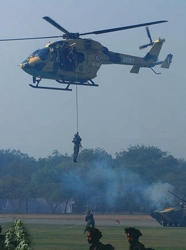
into reality by the setting up of joint institutions like the National Defence Academy (NDA), the Defence Services Staff College (DSSC) and the National Defence College (NDC).These institutions, all joint, covered a wide canvas, from pre commissioning training to the highest level of formal training an officer undergoes. Unfortunately, somewhere along the way, we lost our focus and drifted into separate entities, which over time became institutionalized.
The wars we fought since Independence added to this “lone ranger” syndrome. Our first war, in Jammu and Kashmir in 1947-48, was essentially an Army affair, with limited and sporadic combat support from the Air Force. The Navy was not involved. In 1962, when China attacked us, the Army again operated alone, as it was decided not to employ the Air Force. Once again, there was no role for the Navy. The next war, in 1965 against Pakistan, saw all the three Services fighting the enemy, but mostly independently, although the Army and Air Force did carry out coordination in specific operations.
It was only in the 1971 war that the three services were employed synergistically and won the war decisively. Besides the above mentioned conflicts, the Army has also been involved, almost continuously, in fighting different types of insurgencies and terrorism in various parts of the country. The nature of these operations does not need the Navy and the role of the Air Force is marginal, as they do not want to decentralize air assets. Essentially, therefore it is again the Army operating on its own. This had its repercussions during the Kargil conflict in 1999, when initially the Air Force refused to participate, on the plea that it would escalate the conflict. When they did come in later, it took time to build up the necessary synergy. It is apparent that our experiences post-Independence lulled us into a state of complacency and we made little effort to forge joint concepts, structures and institutions, thus obtaining less than optimal results.
A major recommendation of the Kargil Review Committee, which was eventually accepted, was to set up joint structures. While an integrated defence headquarters and two joint commands were formed, a key recommendation i.e. the establishment of the post of Chief of Defence Staff (CDS) continues to remain unimplemented and the joint structures therefore remain headless. The antiquated Chiefs of Staff Committee has been entrusted to stand in. This organization, which has neither the teeth nor the inclination to take any strong and meaningful decisions, is unable to perform the role. Unfortunately, this state of affairs suits the principal actors, viz. the political leadership which continues to be bugged by the non-existent ghost of a military takeover, however preposterous it may sound after six decades of independence; the bureaucracy, who see the CDS as threatening their lording over of the Service headquarters; and even the Service Chiefs, who are highly reluctant to part with any power which will dilute their fiefdoms.
Nearly seven years after the decision, there is only lip service to the need for jointness and the appointing of a CDS. The result is that we flounder along, believing in our fatalistic fashion that everything will turn out right in the end and through some sleight of hand the Army will, for the umpteenth time, again pull the chestnuts out of the fire, as it always has when the chips are down! The moot point is, should policies of such great importance, relating to the security and indeed the very existence of our nation, continue to be sacrificed at the altar of expediency or sloth or indifference, or all three?